

Universal healthcare is defined as a system in which all residents of a country receive comprehensive health coverage, regardless of their ability to pay. For Americans considering relocation abroad, it represents one of the most compelling reasons to make the move. The United States remains the only high-income nation without universal health coverage, and the financial and logistical burden of that gap is real. Countries like Japan, Brazil, the United Kingdom, France, and the Netherlands offer working models of universal health coverage that include preventive care, primary care, maternity services, and pharmaceuticals. Understanding how these systems work, and who actually qualifies, is the most important research any American can do before choosing a destination.
What universal healthcare means for American expats
Universal health coverage, the term used by the World Health Organization and policy researchers, means that all people receive the health services they need without suffering financial hardship. For Americans seeking healthcare abroad, the practical reality is more nuanced than the headline promise.
Access almost always depends on legal residency status. Most countries require a valid visa of a certain duration before an American becomes eligible for public health coverage. Japan’s coverage starts after three months of residency, with mandatory enrollment in the public insurance system for anyone holding a visa valid for more than three months. Short-term visitors and undocumented individuals are excluded from this coverage entirely.
Coverage scope in universal systems typically includes:
- Preventive care such as screenings, vaccinations, and wellness checkups
- Primary care including general practitioner visits and referrals
- Maternity and newborn care from prenatal appointments through delivery
- Pharmaceutical coverage for prescribed medications, often with co-payments
- Mental health services in many but not all systems
- Specialist and hospital care following referral or emergency admission
The timeline for gaining coverage matters enormously. An American who arrives in Japan on a six-month work visa becomes eligible for the national health insurance system almost immediately. Someone on a 90-day tourist visa does not. Planning your visa category and duration with healthcare eligibility in mind can mean the difference between coverage from month one and a gap of six months or more.
Tip: Before choosing a destination country, confirm the minimum visa duration required to access public healthcare. Applying for the right visa category from the start avoids costly gaps in coverage.
How top countries compare on universal healthcare
The best healthcare systems abroad for American expats operate through different structural models. Understanding those models helps you choose the right destination for your health needs, family situation, and budget.
Japan
Japan provides mandatory public insurance for all residents, including non-Japanese nationals with visas valid for more than three months. The system offers free choice of providers, low barriers to specialist access, and broad coverage. Enrollment is not optional. Americans living in Japan pay monthly premiums based on income, and the government covers a significant share of all medical costs. Private insurance supplements the public system but is not required for basic coverage.

Brazil
Brazil’s Unified Health System, known as SUS, offers tax-funded free care at the point of service for all residents and visitors, including undocumented individuals. Approximately 80% of Brazil’s population relies solely on SUS. Services include primary care, specialty care, mental health, hospital treatment, and prescriptions. About 25% of the population also carries supplemental private insurance to access faster appointments and private facilities. For Americans relocating to Brazil, SUS provides a genuine safety net from day one of residency.
United Kingdom
The National Health Service covers UK visa holders who have paid the Immigration Health Surcharge, which is a fee paid upfront as part of the visa application process. The surcharge grants access to NHS care on broadly the same terms as UK residents. However, prescriptions in England still carry a patient charge, and some dental and optical services require additional payment. Settled persons and those with indefinite leave to remain are generally exempt from the surcharge and receive free NHS care.
Comparison table: universal healthcare models for expats
| Country | System type | Eligibility for Americans | Private insurance role | Key out-of-pocket costs |
|---|---|---|---|---|
| Japan | Mandatory public insurance | Visa valid 3+ months | Supplemental, not required | Co-payments per visit |
| Brazil | Tax-funded (SUS) | All residents and visitors | Optional supplement | Minimal under SUS |
| United Kingdom | NHS (tax-funded) | Visa + Immigration Health Surcharge | Optional supplement | Prescriptions, dental, optical |
| France | Social insurance | Legal residency required | Common supplement (mutuelle) | Co-payments, reimbursed partially |
| Netherlands | Mandatory private insurance | Legal residency required | Core system is private | Monthly premiums, deductibles |
| Australia | Medicare | Permanent residency or eligible visa | Optional extras cover | Some specialist gaps |
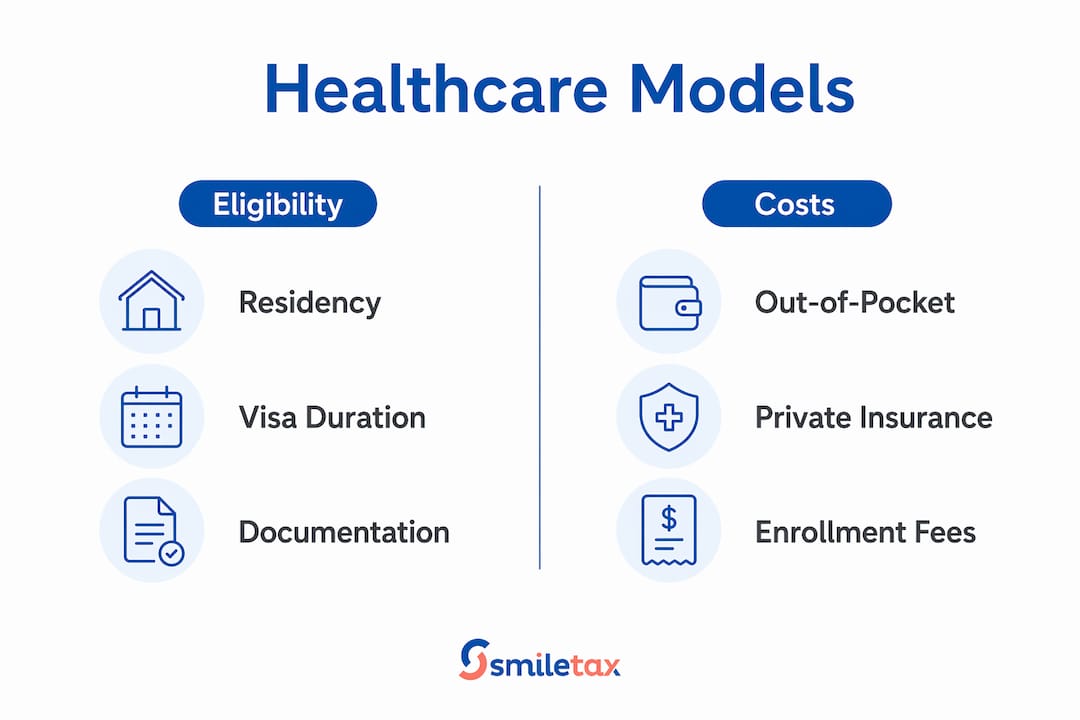
Tip: In countries like the Netherlands, the “universal” system is built on mandatory private insurance rather than a government-run fund. Research whether your destination country requires you to purchase a private plan to access universal coverage.
Challenges Americans face when accessing universal healthcare abroad
Universal healthcare does not automatically mean free, frictionless care for every American who moves abroad. Several practical challenges can affect access, cost, and quality of care.
The WHO’s 2026 global report on refugee and migrant health found that only 30 of 62 countries surveyed report equal healthcare access for all migrant subgroups. No country surveyed provides fully equal access for irregular migrants. This matters for Americans because residency documentation directly determines the tier of access you receive.
Common challenges include:
- Registration delays. Many countries require you to register with a local health authority or general practitioner before accessing non-emergency care. This process can take weeks.
- Language barriers. Medical consultations in a second language increase the risk of miscommunication. Countries like Japan and Brazil have limited English-speaking medical staff outside major cities.
- Regional variation. Healthcare quality and wait times vary significantly between urban centers and rural areas in most universal systems.
- Out-of-pocket costs. The Commonwealth Fund’s 2026 analysis confirms that patient out-of-pocket costs vary by country and health needs, even within universal systems. Co-payments, prescription charges, and specialist fees can add up.
- Chronic condition management. Americans managing ongoing conditions such as diabetes, hypertension, or autoimmune disorders need to verify that their medications are available locally and covered under the public system.
- Supplemental insurance gaps. Private health insurance often supplements universal public coverage by covering excluded services or reducing wait times, but its role and cost vary significantly by country.
Budget for residual costs even in the most generous universal systems. A country with free hospital care may still charge for prescriptions, dental work, or physiotherapy. Verifying the full scope of coverage before you arrive prevents financial surprises.
How to choose the right country with universal healthcare
Selecting the best destination from the available countries with universal healthcare requires matching your personal situation to the specific features of each system. No single country is the best fit for every American.
Work through these criteria before making a final decision:
- Visa and residency eligibility. Confirm the minimum visa duration required for healthcare access and whether your intended visa category qualifies. Japan requires three months. The UK requires both a qualifying visa and payment of the Immigration Health Surcharge upfront.
- Coverage scope for your needs. If you manage a chronic condition, verify that your medications are covered and available. If you are moving with children, check pediatric and maternity coverage in detail.
- Quality and efficiency of local services. The Commonwealth Fund’s international comparisons show that all countries except the U.S. and Mexico among those surveyed offer universal coverage, but quality and efficiency differ meaningfully between them.
- Language and integration support. Countries with larger English-speaking expat communities, such as the UK, Australia, and the Netherlands, reduce the friction of navigating a foreign health system.
- Cost of supplemental insurance. Factor in the monthly cost of a private supplement plan if the public system has notable gaps in your destination country.
- Family-specific needs. Americans moving with families should review school health programs, pediatric specialist access, and emergency care protocols. The best countries for American families abroad often combine strong public healthcare with good international school infrastructure.
- Expat community resources. Online communities for American expats in your target country provide real-world accounts of healthcare experiences that no policy document captures.
The practical relocation checklist matters as much as the policy research. Reviewing a moving abroad checklist before departure helps you organize visa applications, health registration steps, and insurance decisions in the right sequence.
Key takeaways
The best countries for Americans who want universal healthcare are those that combine legal residency eligibility, broad coverage scope, and manageable out-of-pocket costs within a system that includes foreigners from the moment they establish lawful residency.
| Point | Details |
|---|---|
| Residency determines access | Coverage eligibility in every universal system depends on visa type and duration, not just physical presence. |
| Japan, Brazil, and the UK lead for expats | Each offers broad coverage for legal residents, with different cost-sharing structures and enrollment rules. |
| Out-of-pocket costs still exist | Even in universal systems, prescriptions, dental care, and specialist fees often require patient payment. |
| Private insurance fills gaps | Supplemental coverage is common and often necessary in countries like Japan, France, and the Netherlands. |
| Early planning reduces risk | Securing the right visa category before departure is the single most effective way to avoid coverage gaps. |
What the research actually tells us about universal healthcare abroad
The policy language around universal healthcare can make it sound like a guarantee. The reality is more conditional, and Americans planning a move deserve a clear-eyed view of what that means.
Residency documentation is the single most important factor in whether an American actually receives the benefits a universal system promises. The WHO’s own data shows that migrant access remains unequal across most countries, even those with strong universal coverage records. An American who arrives with proper legal residency and the right visa category will generally access the system well. Someone who arrives on a tourist visa, overstays, or delays registration will not.
The other underappreciated reality is cost. Universal does not mean zero cost. The UK charges for prescriptions in England. Japan has co-payments per visit. France reimburses a portion of costs but rarely 100%, which is why most French residents carry a supplemental mutuelle policy. Budgeting for these residual costs is not pessimism. It is practical planning.
The countries that consistently perform well for American expats combine accessible enrollment, broad coverage, and a functioning private supplement market. Japan, France, and Australia fit that profile. Brazil stands out for its inclusion of all residents regardless of documentation, though service quality varies significantly by region. The UK offers a familiar English-language environment with NHS access tied to a predictable upfront surcharge.
The most useful shift in thinking is to stop comparing these systems to an idealized version of universal care and start comparing them to what Americans currently experience at home. By that measure, most of these destinations represent a genuine improvement in both coverage and cost.
Living abroad comes with financial obligations too
Relocating to a country with universal healthcare is one of the most practical decisions an American can make for long-term wellbeing. The healthcare planning, though, is only one part of the picture. Americans living abroad still file US tax returns every year, regardless of where they live or where their income comes from.
SmileTax works specifically with Americans abroad, including teachers, NGO professionals, retirees, and long-term expats, to handle US tax filing accurately and without unnecessary complexity. If you are in the process of planning a move or already living overseas, SmileTax’s expat filing service provides the professional support that keeps your US obligations in order while you focus on building your life abroad.
FAQ
What countries offer universal healthcare to American expats?
Japan, Brazil, the United Kingdom, France, the Netherlands, and Australia all offer universal health coverage to legal residents, including Americans with qualifying visas. Eligibility rules, enrollment requirements, and coverage scope differ by country.
How long do you need to live abroad before accessing universal healthcare?
The timeline varies by country. Japan requires a visa valid for more than three months before mandatory enrollment applies. The UK requires a qualifying visa and payment of the Immigration Health Surcharge before NHS access begins. France and Australia require legal residency registration.
Is universal healthcare really free for American expats?
Universal healthcare covers most services without direct payment at the point of care, but out-of-pocket costs still exist. The UK charges for prescriptions in England, Japan has per-visit co-payments, and France reimburses only a portion of costs. Supplemental private insurance is common in most universal systems.
Does Brazil’s universal healthcare cover undocumented Americans?
Brazil’s SUS system provides free care at the point of service for all residents and visitors, including undocumented individuals. However, service quality and availability vary significantly between urban and rural areas.
Do Americans need private health insurance in countries with universal coverage?
Private insurance is not legally required in most universal systems, but it is commonly used to cover gaps. In Japan and France, supplemental private plans reduce co-payments and expand access. In the Netherlands, the core system is built on mandatory private insurance, making it a requirement rather than an option.