

Portugal keeps showing up on every “best places to move abroad” list, and for good reason. The weather is spectacular, the food is exceptional, and your dollar stretches further than in most Western European countries. But this American’s guide to moving to Portugal exists because the gap between wanting to move and actually doing it legally is wider than most people expect. The single biggest mistake Americans make is assuming that visa-free travel means they can simply stay as long as they like. It does not. Here is what you actually need to know before you book that one-way flight.
Table of Contents
- Key Takeaways
- An American’s guide to Portugal’s visa requirements
- Securing your residence permit after you arrive
- Cost of living, housing, and lifestyle changes
- Cultural integration and building your community
- My honest take on moving to Portugal
- How SmileTax supports Americans living abroad
- FAQ
Key Takeaways
| Point | Details |
|---|---|
| Visa-free has a hard limit | US citizens can stay 90 days maximum within any 180-day period without a visa. |
| Two main visa paths exist | The D7 passive income visa and the D8 digital nomad visa cover most American applicants. |
| AIMA is the real hurdle | Securing your residence permit through AIMA after arrival requires early preparation and persistence. |
| Budget realistically | Monthly costs range from €1,500 in rural areas to €3,500 or more in Lisbon. |
| Culture shock is real | Bureaucratic patience and community building are as important as financial planning. |
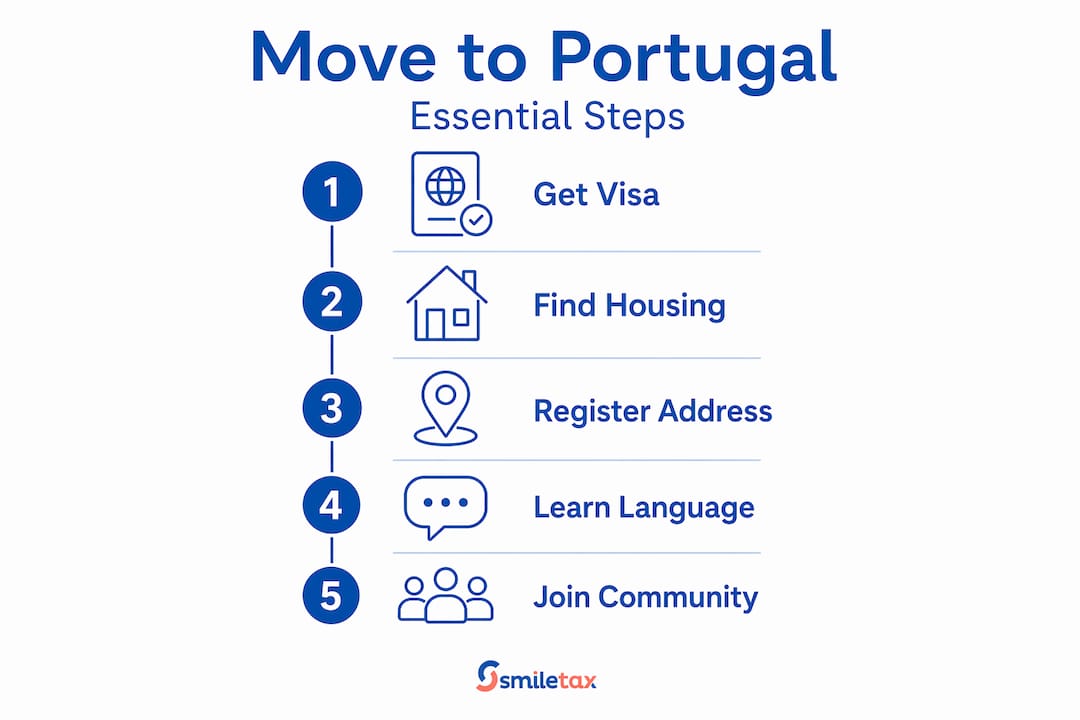
An American’s guide to Portugal’s visa requirements
Most Americans are surprised to learn that visa-free stays cap at 90 days within any 180-day period under Schengen rules. Overstaying is not a minor administrative issue. It can result in deportation and a multi-year ban from the entire Schengen zone. Starting in late 2026, Americans will also need to obtain an ETIAS travel authorization before visiting, costing €20 and valid for three years. Think of ETIAS as a pre-screening step, not a visa, but it is one more thing to handle before you travel.
For Americans who want to actually live in Portugal, two visas dominate the conversation.
The D7 Visa (Passive Income Visa)
This visa is designed for retirees, remote workers with foreign income, and anyone living off savings, pensions, or investments. The 2026 income thresholds are:
- €920 per month for a single applicant
- €1,380 per month for a couple
- €1,656 per month for a couple with one child
These figures are tied to the Portuguese minimum wage and adjust periodically, so confirm current numbers with a licensed immigration attorney before applying.
The D8 Visa (Digital Nomad Visa)
The D8 targets remote workers employed by or contracting with companies outside Portugal. Income requirements are higher than the D7, and you will need to demonstrate consistent remote work arrangements. This visa has become popular among American freelancers and tech workers.
Common pitfalls Americans run into
- Confusing the visa (issued by the Portuguese consulate in the US) with the residence permit (issued by AIMA in Portugal). These are two separate documents with two separate processes.
- Applying too late. Portuguese consulates in the US are backlogged, and processing can take months.
- Underestimating document requirements. You will need apostilled documents, criminal background checks, proof of income, and health insurance, among other items.
💡 Tip: Start your consulate application at least six months before your planned move date. The earlier you begin, the more buffer you have for delays.
Securing your residence permit after you arrive
Here is something that catches many Americans off guard. The visa only grants entry into Portugal. The residence permit, which grants actual legal residency and access to services, is a separate application made through AIMA (Agência para a Integração, Migrações e Asilo) after you arrive. You have four months from your entry date to complete this step.
Follow these steps to stay on track:
- Get your NIF immediately. The NIF (Número de Identificação Fiscal) is Portugal’s tax identification number. You need it for almost everything: opening a bank account, signing a lease, and registering with AIMA. You can obtain it at a local tax office (Finanças) or through a fiscal representative while still in the US.
- Open a Portuguese bank account. Most landlords require a local bank account, and AIMA will need proof of your financial situation. Having a NIF in hand makes this step straightforward.
- Book your AIMA biometric appointment early. This is where many Americans hit a wall. AIMA appointments are scarce, especially in Lisbon and Porto. Check the online booking portal early in the morning and refresh frequently. Smaller cities like Braga, Évora, or Setúbal tend to have more availability.
- Gather your documents. Requirements vary by visa type but generally include your valid passport, visa, proof of address in Portugal, proof of income, criminal background check, health insurance, and passport photos.
- Attend your appointment and keep your receipt. Processing times often extend from six weeks to over three months. While you wait, AIMA issues a digital document called a comprovativo with a QR code.
That comprovativo matters more than most people realize. The digital comprovativo functions as legal proof of your residency status while you wait for the physical card. Banks, landlords, and employers accept it. Do not lose it.
💡 Tip: If your four-month window is approaching and you cannot secure an AIMA appointment, consult an immigration lawyer immediately. Legal remedies exist, but you need professional guidance to use them correctly.
Cost of living, housing, and lifestyle changes
Portugal is genuinely more affordable than most US cities, but the gap is narrowing in prime areas. Housing in Lisbon and Porto has risen 40 to 60 percent since 2015, and a one-bedroom apartment in central Lisbon now runs approximately €800 to €1,200 per month. That is still cheaper than San Francisco or New York, but it is no longer the bargain it once was.

Here is a realistic snapshot of monthly costs by region:
| Region | Estimated Monthly Budget (Single) | Notes |
|---|---|---|
| Central Lisbon | €2,500 to €3,500 | Higher rent, dining, and transport costs |
| Porto | €1,800 to €2,800 | Slightly more affordable than Lisbon |
| Algarve | €2,000 to €3,000 | Seasonal price spikes in tourist areas |
| Rural/Interior | €1,200 to €1,800 | Lowest costs, fewer English speakers |
Initial setup costs for the move itself typically range from €5,000 to €15,000, covering flights, shipping, deposits, legal fees, and the first few months of living expenses. Budget conservatively and you will thank yourself later.
Beyond the numbers, lifestyle in Portugal moves at a different pace. Shops close for lunch. Bureaucratic offices keep limited hours. Customer service operates on Portuguese time, which is rarely urgent. Americans who arrive expecting the speed and convenience of US daily life often struggle in the first few months. The adjustment is real, but most expats describe it as ultimately freeing once they settle in.
Portugal ranks as the 4th safest country in the world, which is a significant quality-of-life factor for families and solo travelers alike. Healthcare is another genuine advantage. The public system (SNS) is accessible to legal residents, and private health insurance is remarkably affordable compared to US standards, often running €50 to €150 per month for solid coverage.
Language is the one area where Americans consistently underestimate the effort required. English is widely spoken in Lisbon and tourist areas, but rural Portugal and government offices are a different story. Starting Portuguese lessons before you arrive is not optional if you want to feel genuinely at home.
Cultural integration and building your community
Reverse culture shock is one of the most underestimated challenges for Americans relocating to Portugal. You expect culture shock when you arrive in a foreign country. What you do not expect is the disorientation that comes from missing things you never thought you would miss: 24-hour pharmacies, efficient customer service, the ability to resolve a problem with one phone call. These small frustrations compound.
The Americans who adapt fastest share a few common traits:
- They engage with local communities, not just expat bubbles
- They learn at least conversational Portuguese within the first year
- They set realistic expectations about bureaucratic timelines
- They find a mix of local and expat social connections
- They treat cultural differences as features, not obstacles
Portugal has a thriving expat community across Lisbon, Porto, and the Algarve. Facebook groups, Meetup events, and local language exchanges are genuinely useful for meeting people. But the most satisfied long-term expats are those who also build relationships with Portuguese neighbors, colleagues, and shopkeepers. Those connections make Portugal feel like home rather than an extended vacation.
One practical note on bureaucracy: patience is not just a virtue here, it is a survival skill. Government offices move slowly. Documents get lost. Appointments get rescheduled. Americans who treat every delay as a crisis will burn out quickly. Build extra time into every administrative process and keep digital copies of every document you receive.
💡 Tip: Join a local language exchange group within your first month. You practice Portuguese, locals practice English, and you build genuine friendships outside the expat echo chamber.
My honest take on moving to Portugal
I have watched a lot of Americans plan this move, and the ones who struggle most are the ones who treated Portugal like a lifestyle upgrade they could simply purchase. They focused on the Instagram version: the pastéis de nata, the golden light, the affordable wine. What they did not prepare for was the AIMA backlog, the housing competition in Lisbon, or the emotional weight of rebuilding a social life from scratch at 45.
Portugal’s residency rules are changing rapidly, and that uncertainty is real. The Golden Visa real estate route has effectively closed. Citizenship timelines may extend. Anyone who tells you the path is simple is either selling something or has not done it recently.
That said, I genuinely believe Portugal rewards those who go in prepared and stay flexible. The AIMA process is frustrating, but it is navigable. The language barrier is real, but Portuguese is learnable. The pace of life is slower, but that slowness, once you stop fighting it, becomes the whole point.
Start early, document everything, build community intentionally, and do not expect Portugal to operate like America with better weather. It is its own place, with its own rhythms. The Americans who thrive there are the ones who actually wanted that.
— James
How SmileTax supports Americans living abroad
Moving to Portugal is a major life decision, and it comes with ongoing responsibilities back home that do not pause just because you crossed an ocean. SmileTax works specifically with Americans living and working abroad, including retirees, remote workers, and internationally employed professionals who need their US obligations handled accurately and without drama.
If you are in the planning stages or already settled in Portugal, SmileTax offers personalized expat consultations to help you understand what living abroad means for your ongoing US responsibilities. For those in specialized roles, the US filing support for foreign service page covers situations relevant to internationally employed Americans. You can also explore the SmileTax friends network for community resources built around expat life. SmileTax keeps things personal, clear, and built around how real expats actually live.
FAQ
How long can Americans stay in Portugal without a visa?
US citizens can stay up to 90 days within any 180-day period under Schengen rules. Staying longer requires a valid long-term visa and a residence permit from AIMA.
What is the difference between a D7 and D8 visa?
The D7 visa is for those with passive income such as pensions, investments, or savings. The D8 is for active remote workers employed by companies outside Portugal. Both require proof of sufficient income and are applied for at a Portuguese consulate in the US.
How do I get a residence permit after arriving in Portugal?
You must book a biometric appointment with AIMA within four months of arrival and submit required documents including proof of address, income, and a valid visa. Processing can take over three months, but the digital comprovativo serves as legal proof in the meantime.
What does it actually cost to live in Portugal as an American?
Monthly budgets range from roughly €1,500 in rural areas to €3,500 or more in central Lisbon. Initial relocation setup costs typically run between €5,000 and €15,000 depending on your situation.
Is Portugal safe for Americans moving abroad?
Yes. Portugal consistently ranks among the safest countries in the world, with low violent crime rates and a high quality of life. Public and private healthcare options are both accessible and affordable for legal residents.