

Spain is one of the most popular destinations for Americans considering a life abroad, and it is easy to see why. But an American’s guide to moving to Spain needs to cover more than sunshine and tapas. The visa requirements, residency rules, and tax obligations that await you are genuinely complex, and many Americans arrive underprepared. Whether you are a retiree looking for a slower pace, a teacher heading to an international school, or an NGO worker relocating for a mission, this guide walks you through what actually matters before you pack a single box.
Table of Contents
- Navigating Spain’s visa options for American expats
- Understanding Spanish residency and tax implications for Americans
- Essential legal steps upon arrival and settling in Spain
- Living well as an American expat in Spain: culture, community, and practical tips
- Why the non-lucrative visa and tax residency rules create unique challenges for Americans
- Find expert support for your move and tax needs
- Frequently asked questions
Key Takeaways
| Point | Details |
|---|---|
| Visa choice matters | Choosing the right Spanish visa depends on your income source and work plans while living abroad. |
| 183-day residency rule | Spending over 183 days in Spain each calendar year usually triggers tax residency and worldwide income declarations. |
| Obtain essential IDs early | Get your NIE and TIE soon after arrival to handle legal and financial transactions smoothly. |
| Cultural integration helps | Learning Spanish and joining communities eases life abroad and counters homesickness. |
Navigating Spain’s visa options for American expats
The first thing to understand about moving to Spain from USA is that Americans do not have an automatic right to live there long term. You get 90 days visa-free under Schengen rules, and after that, you need a formal visa to stay legally.
The most common path for retirees and people with passive income is the Non-Lucrative Visa (NLV). As Spain’s Non-Lucrative Visa requirements make clear, this visa lets you live in Spain without working, but it comes with strict financial conditions. You must show consistent, ongoing passive income, not just a healthy bank balance. A lump sum in savings does not satisfy the requirement.
Here is a quick breakdown of the main visa routes available to Americans:
- Non-Lucrative Visa (NLV): For retirees and those with passive income such as pensions, rental income, or investment returns. No work of any kind is permitted. For a single applicant, the current minimum is approximately €2,400 per month, tied to a multiple of Spain’s IPREM index. This threshold increases for each additional family member on the application.
- Digital Nomad Visa: Introduced in 2023, this allows remote workers employed by non-Spanish companies to live and work in Spain legally. Income thresholds apply. Currently around €2,646 per month, based on 200% of Spain’s minimum wage.
- Work Visa: Requires a Spanish employer to sponsor you. Less common for Americans moving independently.
- Self-Employment Visa (Autónomo): For those planning to run a business or freelance within Spain.
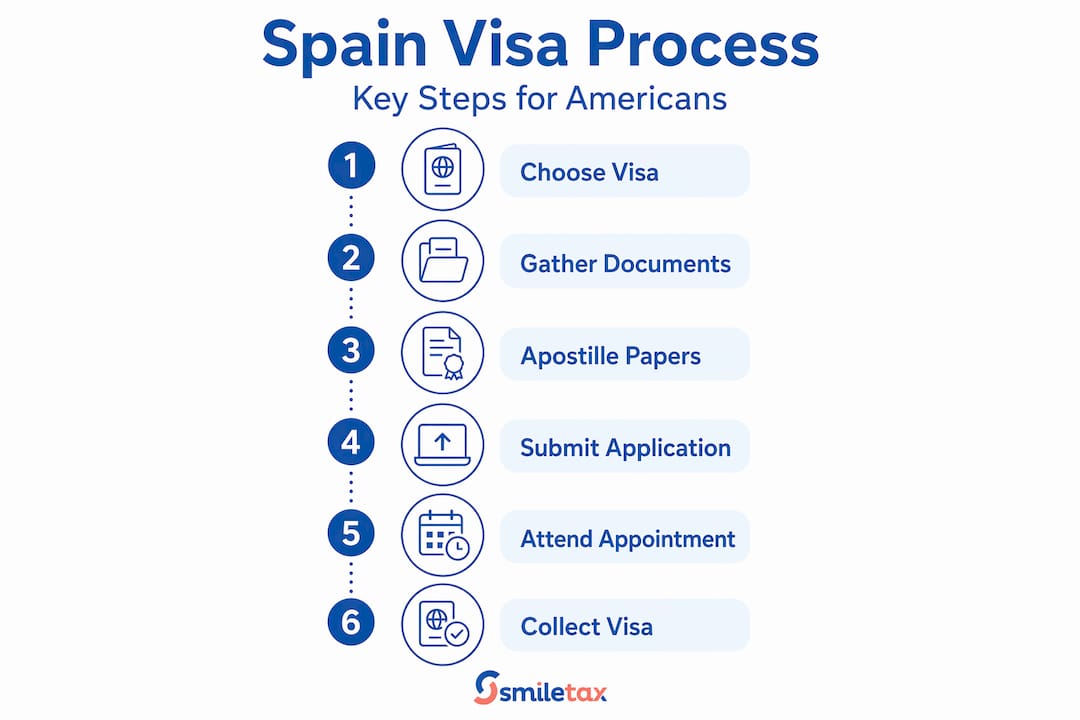
The practical steps to apply for any of these visas involve document apostilles (a formal authentication process recognized internationally), certified translations into Spanish, and submitting through the Spanish consulate with jurisdiction over your US state of residence. This last point trips people up. You cannot just walk into any consulate. Your home state determines where you apply.
Renewals are worth planning for early. The NLV renews in one-year and then two-year increments, and each renewal requires proof that you have been physically present in Spain and that your financial resources have grown in line with updated thresholds.
💡 Tip: Before you apply, review your moving abroad checklist carefully. Missing a single apostilled document can delay your application by months.
One thing to understand before you apply: once you are living in Spain, the days you spend there count toward the 183-day Spanish tax residency threshold. This matters for planning how long you stay each year and how your income is treated. That tension is worth understanding before you arrive, not after. There is a section later in this guide that covers it directly.
Understanding Spanish residency and tax implications for Americans
Residency in Spain is not just an immigration status. It is a financial trigger with real consequences for how and where you pay taxes. This is one of the most misunderstood parts of living in Spain as an American.
Spain uses a clear day-count test. According to how tax residency works in Spain, spending more than 183 days in Spain during a calendar year makes you a Spanish tax resident. But the 183-day rule is not the only factor.
“Having your main economic interests or your family based in Spain can also establish tax residency, even if you spend fewer than 183 days in the country.”
Here is how the residency assessment works in practice:
- Day count: Spain counts days in a calendar year, January through December. There is no official split-year treatment, so even partial years can count fully.
- Economic ties: If your primary source of income or business activity is based in Spain, you may be considered a resident regardless of days spent.
- Family ties: If your spouse or dependent children live in Spain, Spanish authorities may presume you are a resident too.
- Worldwide income reporting: Once you are a Spanish tax resident, you must declare all income globally to Spanish tax authorities, not just what you earn in Spain.
- Advance planning: Tracking your days carefully and understanding when you cross the threshold helps you avoid unexpected tax exposure.
Once you cross that threshold, both the US and Spain have a claim on your worldwide income — and managing that overlap requires planning that starts before you arrive, not after.
Essential legal steps upon arrival and settling in Spain
Once you land in Spain with your visa, the paperwork is not over. In fact, the post-arrival process is where many Americans lose momentum. Getting these steps done quickly protects your legal status and opens up everyday life.

The two most important documents to obtain are your NIE and your TIE. As this guide to moving to Spain as an American explains, the NIE (Número de Identificación de Extranjero) is your foreign identification number, and it is required for almost every official transaction, including signing a lease, opening a bank account, and registering a vehicle. The TIE (Tarjeta de Identidad de Extranjero) is your physical residency card, and you must apply for it within 30 days of arriving in Spain.
Here is what to prioritize in your first weeks:
- NIE application: Book your appointment at the nearest Oficina de Extranjería (foreigners’ office) or national police station as soon as possible. Slots fill up fast.
- TIE card: Apply within 30 days of arrival. Bring your passport, visa, passport photos, and proof of address.
- Empadronamiento: This is your local address registration at the town hall (Ayuntamiento). It sounds minor but it is required to access public healthcare, enroll children in school, and prove residency for renewals.
- Bank account: Open a Spanish bank account early. Many landlords and utility companies require a local account for direct debits.
- Health insurance: The NLV requires private health insurance. Confirm your policy is active and covers Spain fully.
If you are moving with children, researching schools early is essential. There are excellent options for American families, and exploring schools for US expats in Madrid can give you a head start on that process.
💡 Tip: Book your NIE and TIE appointments before you leave the US if possible. Some consulates allow pre-arrival scheduling, and early appointments can save weeks of waiting after you land.
Living well as an American expat in Spain: culture, community, and practical tips
Beyond the paperwork, the real question is whether you will thrive. Spain relocation tips from people who have actually done it tend to focus less on logistics and more on mindset.
Spain operates on a different clock. Lunch happens at 2 or 3 pm. Dinner rarely starts before 9 pm. Shops close for a midday break in many cities. Resisting this rhythm makes daily life harder than it needs to be. Leaning into it makes you feel at home faster.
“Language is the single biggest lever for expat integration. Even basic Spanish, enough to greet neighbors, order food, and handle simple transactions, changes how locals receive you and how you experience the country.”
A few practical tips for building a good life in Spain:
- Learn Spanish, even imperfectly. Apps, local classes, and conversation exchanges all work. You do not need fluency to benefit.
- Find your expat community. Facebook groups, Internations events, and local expat associations are active in most Spanish cities. They share practical knowledge and reduce isolation.
- Explore beyond the obvious cities. Madrid and Barcelona are magnets for American expats in Spain, but Valencia, Seville, Malaga, and the Basque Country offer strong expat communities with lower costs and distinct cultures.
- Expect culture shock. It is normal and temporary. Homesickness hits most expats around the three-month mark, regardless of how excited they were to move.
- Use Spain’s public spaces. Parks, plazas, markets, and neighborhood festivals are genuinely social. Showing up is how you meet people.
For a broader look at where Americans tend to settle happily, exploring best places for US expats can help you think through the regional choices before committing to a city.
Why the non-lucrative visa and tax residency rules create unique challenges for Americans
Here is something most expat guides do not tell you plainly: the Non-Lucrative Visa and Spanish tax residency rules are in genuine tension with each other, and that tension catches Americans off guard more often than it should.
The NLV requires you to live in Spain to renew it. But living in Spain means accumulating days toward the 183-day tax residency threshold. Many people apply for the NLV thinking they will spend part of the year in Spain and part in the US, only to discover that their renewal depends on proving physical presence, while their tax situation depends on managing how many days they actually spent there. These two requirements pull in opposite directions.
Then there is the remote work issue. Consulates frequently reject NLV applications when applicants disclose remote work intentions or when their financial proof looks like active income rather than passive income. This happens even when the applicant genuinely believes they qualify. The line between passive income and remote work income is not always obvious, and consulates do not give you the benefit of the doubt.
The practical lesson here is that long-term planning matters more than getting the first visa approved. If your situation involves any form of ongoing work, even remote work for a US employer, the Digital Nomad Visa is almost certainly the right route, not the NLV. Choosing the wrong visa at the start creates complications that are difficult and expensive to fix later.
Document everything from day one. Keep records of your income sources, your days in Spain, and your financial statements. These records protect you at renewal time and if Spanish tax authorities ever ask questions.
Find expert support for your move and tax needs
Moving to Spain is exciting, but your US tax obligations follow you there. SmileTax works specifically with Americans living abroad — teachers, retirees, NGO workers, and long-term expats who need their US filing handled accurately. If you need more time to settle in, we offer an automatic extension service to keep you compliant while you find your footing.
Frequently asked questions
What is the easiest visa option for Americans wanting to retire in Spain?
The Non-Lucrative Visa is the most common route for retirees who can support themselves with passive income and do not plan to work in Spain.
How long can US citizens stay in Spain without a visa?
US citizens can stay visa-free in Spain for up to 90 days within any 180-day period under Schengen rules before needing a long-stay visa.
When is a person considered a Spanish tax resident?
A person is considered a Spanish tax resident if they spend more than 183 days in Spain during the calendar year, or if their main economic interests or family are based in Spain.
Can Americans work remotely while on the Non-Lucrative Visa?
No. Work, including remote work, is not permitted under the NLV, and disclosing remote work intentions typically results in visa denial at the consulate level.
Recommended
- Checklist for Moving Abroad: A Handy Guide for Americans Moving to Europe – SmileTax
- Teaching in Europe: A Guide to Successful Expat Living – SmileTax
- Thinking of moving abroad? Here are some great places to live for US expats – SmileTax
- How to Manage Culture Shock When Moving from the US to Europe – SmileTax