

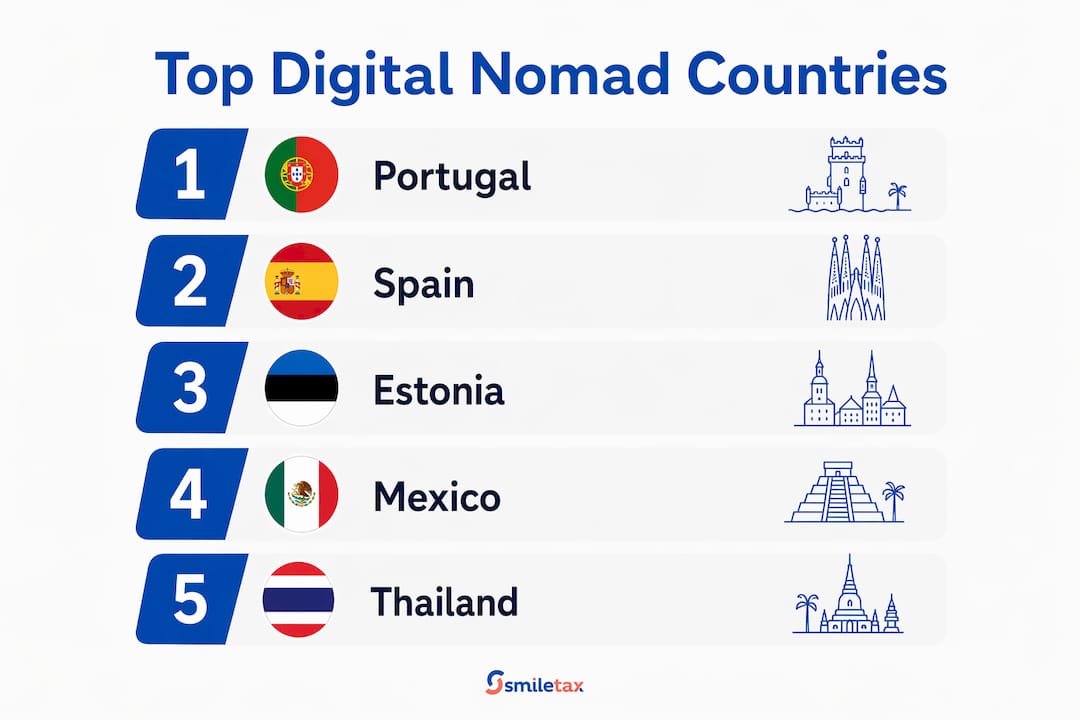
For most American remote workers, a strong starting shortlist includes several countries known for offering clear visa paths, reliable internet in major cities, real expat communities, and financially sensible costs of living. Each offers a clear visa path, reliable internet in its major cities, a real expat community, and a cost of living that makes the move financially sensible. Portugal and Spain offer EU access and long-term residency pathways. Mexico and Colombia keep you close to US time zones with relatively low overhead. Thailand delivers the best value-per-quality-of-life ratio in Southeast Asia, particularly for solo nomads.
Here is why each earns its place on the shortlist:
- Portugal — the D8 digital nomad visa offers a genuine path to EU residency, and Lisbon and Porto consistently rank among the best cities for remote workers in Europe.
- Mexico — no long-haul flight, minimal time-zone friction, and a Temporary Resident Visa that is straightforward to obtain and renew.
- Spain — a formal Digital Nomad Visa launched in 2023 with a preferential income tax rate for the first four years, and excellent infrastructure in Madrid and Barcelona.
- Colombia — Medellín has become one of the most talked-about nomad hubs in Latin America, with low costs and a growing coworking scene.
- Thailand — the Long-Term Resident Visa introduced in 2022 gives high earners a 10-year option; budget nomads still use Chiang Mai as a reliable, affordable base.
Always verify current visa requirements on official government immigration pages before committing to any destination. Rules change, income thresholds shift, and what applied in 2024 may not apply today.
Tip: Pick two countries to research seriously, not five. Choose one conservative option (strong visa, familiar infrastructure, manageable time zone) and one experimental option (lower cost, different culture, longer-term potential). That pairing gives you a backup and a stretch goal without spreading your research too thin.
Table of Contents
- How do the top destinations compare at a glance?
- How to choose the right country for your situation
- Region-by-region country guide for American nomads
- What applying for a digital nomad visa actually looks like in 2026
- Practical logistics every American nomad needs to sort before moving
- Key Takeaways
How do the top destinations compare at a glance?
The table below covers the eight most-requested destinations among American nomads in 2026. Cost bands reflect a single person’s typical monthly spend including rent, food, transport, and utilities, but not international health insurance or private schooling.
| Country | Visa length & main eligibility | Monthly cost band | Internet (top cities) | Best US time zones served | Community & coworking | Ease of application | Language barrier | Healthcare / safety |
|---|---|---|---|---|---|---|---|---|
| Portugal | D8: 1 year renewable; significant monthly remote income | $1,600–$2,200 | 100–300 Mbps (Lisbon, Porto) | EST/CST overlap possible | Strong; Lisbon & Porto well-served | Moderate; 4–8 weeks processing | Low; English widely spoken | Good public hospitals; safe |
| Spain | DNV: 1 year renewable; ~€2,500+/month income | $2,000–$2,800 | 100–500 Mbps (Madrid, Barcelona) | EST/CST partial | Strong; Madrid & Barcelona | Moderate; 4–8 weeks | Low–moderate | Excellent public healthcare; safe |
| Mexico | TRV: 1–4 years; proof of stable income/savings | $1,100–$1,600 | 50–200 Mbps (CDMX, Oaxaca) | EST/CST/MST/PST ideal | Very strong; CDMX, Oaxaca, Mérida | Easy; 2–4 weeks | Low in expat areas | Variable by city; private clinics good |
| Colombia | Digital Nomad Visa: 2 years; minimum monthly remote income | $1,200–$1,800 | 50–150 Mbps (Medellín, Bogotá) | EST/CST ideal | Strong; Medellín especially | Easy–moderate; 3–5 weeks | Low in expat areas | Improving; private care recommended |
| Thailand | LTR Visa: 10 years; $80,000+/year or $250,000 assets | $1,000–$1,800 | 50–200 Mbps (Bangkok, Chiang Mai) | PST partial overlap | Very strong; Chiang Mai, Bangkok | Moderate; 4–8 weeks | Moderate; English in tourist/nomad areas | Good private hospitals; safe in most areas |
| Estonia | DNV: 1 year; ~€4,500/month income | $2,000–$2,800 | 100–500 Mbps (Tallinn) | EST overlap (UTC+3) | Moderate; Tallinn tech scene | Fast; ~30 days | Low; English widely spoken | Excellent; EU healthcare standards |
| Croatia | DNV: 1 year renewable; proof of remote income | $1,500–$2,200 | 50–150 Mbps (Zagreb, Split) | EST/CST partial | Growing; Split & Zagreb | Moderate; 4–6 weeks | Low–moderate | Good; EU-standard care |
| Vietnam | 90-day e-visa (extendable); no formal DNV | $800–$1,400 | 50–150 Mbps (Ho Chi Minh City, Hanoi) | PST partial overlap | Strong; Ho Chi Minh City | Very easy; online | Moderate–high outside cities | Good private hospitals in major cities |
Cost band key: Low = under $1,500/month; Medium = $1,500–$2,500; High = over $2,500. Time-zone shorthand: EST = Eastern, CST = Central, MST = Mountain, PST = Pacific.
How to choose the right country for your situation
The biggest mistake nomads make is filtering by cost first. Cost matters, but the friction that actually derails a move is almost always something else: a time zone that forces 11 PM client calls, a visa that expires before you feel settled, or a city where you cannot find a reliable coworking space. Start with what would cause the most disruption to your work and life, then filter down.
Step 1: Set your nonnegotiables. Write down three things you cannot compromise on. Common ones include: overlap with US business hours, access to international schools, reliable fiber internet, or proximity to a major airport. If you are a remote employee on US Eastern hours, you need to be within roughly seven hours of EST, which rules out most of Southeast Asia for synchronous work.
Step 2: Filter by visa path and intended stay length. Are you testing the lifestyle for six months, or are you planning a two-to-three-year base? A 90-day tourist visa works for a scouting trip but not for a serious relocation. If you want a path to permanent residency, Portugal and Spain are the clearest options in Europe. For the Americas, Colombia and Mexico offer accessible long-stay options.
Step 3: Shortlist by cost and internet. Once you have two or three visa-eligible countries, compare realistic monthly budgets. Remember that low headline costs can be offset by hidden costs of moving abroad that most guides undercount: international health insurance, imported groceries, private schooling, and housing deposits.
Step 4: Sanity-check community and language. A country with a strong nomad community makes the first three months dramatically easier. Check Meetup.com, local Facebook groups for long-term residents (not tourists), and coworking space calendars before you commit.
Decision shortcuts by profile:
- Solo freelancer on flexible hours — Thailand or Colombia; low cost, strong communities, and enough time-zone flexibility for async work.
- Remote employee on US Eastern hours — Mexico, Colombia, or Portugal (with early mornings); all keep you within a workable overlap window.
- Family with school-age kids — Spain or Portugal; EU-standard healthcare, international schools in major cities, and stable long-term visa paths.
- Early retiree testing the water — Costa Rica or Mexico; accessible visa options, English-friendly expat communities, and short flights home.
Tip: If you work with US clients and need live video calls, prioritize countries within −7 to +2 hours of Eastern Time. That range covers all of Latin America and Western Europe, and keeps your mornings free for focused work before the US day begins.
Region-by-region country guide for American nomads
Europe
Europe remains the most popular long-term destination for Americans who want a stable visa, strong infrastructure, and a path to residency. The trade-off is cost: Western European cities run $2,000–$3,000/month for a comfortable lifestyle. Secondary cities, though, often cut that figure by 20–30% without sacrificing internet quality or safety.
Tip: Consider secondary cities in Europe before defaulting to capitals. Porto costs noticeably less than central Lisbon. Smaller Algarve towns offer slower pace and lower rents than Faro. In Spain, Valencia and Seville are significantly cheaper than Madrid or Barcelona, with comparable infrastructure.
| Country | Visa program | Income threshold | Visa length |
|---|---|---|---|
| Portugal | D8 Digital Nomad Visa | significant monthly remote income (commonly reported around €3,480–€3,680/month) | 1 year, renewable |
| Spain | Digital Nomad Visa | income threshold around €2,500+/month | 1 year, renewable |
| Estonia | Digital Nomad Visa | income threshold around €4,500/month | Up to 1 year |
| Croatia | Digital Nomad Residence Permit | Proof of remote income | 1 year, renewable |
| Greece | Digital Nomad Visa | remote income threshold | 1 year, renewable |
| Italy | Digital Nomad Visa | monthly remote income requirement | 1 year, renewable |
| Malta | Nomad Residence Permit | monthly remote income requirement | 1 year, renewable |
| Cyprus | Digital Nomad Visa | remote income threshold | 1 year, renewable |
## 1. Portugal
Visa basics: Portugal’s D8 Digital Nomad Visa requires demonstrating a significant monthly remote income, commonly reported around €3,480–€3,680/month. It is valid for one year and renewable, with a clear path to permanent residency after five years and EU citizenship after five years of legal residency. The application goes through the Portuguese consulate in your home state.

Best cities: Lisbon for infrastructure and nightlife; Porto for a quieter, more affordable base; the Algarve for coastal living. Lisbon and Porto both appear consistently in top remote-worker city rankings.
Monthly cost: $1,600–$2,200 for a single person, including rent in a decent neighborhood.
Internet: 100–300 Mbps fiber is standard in Lisbon and Porto. Coworking spaces are plentiful and well-equipped.
Pros: EU access, English widely spoken, strong expat community, excellent food and quality of life, clear residency pathway. Cons: Lisbon rents have risen sharply; D8 income threshold is meaningful; consulate processing can be slow.
Seasonal note: Summers in the Algarve are crowded and expensive. Lisbon and Porto are year-round livable, with mild winters.
Official visa page: exteriores.gob.es (Spain’s page for reference format; Portugal’s official page is at the Portuguese Immigration and Borders Service, SEF/AIMA).
## 2. Spain
Visa basics: Spain’s Digital Nomad Visa, launched in 2023, requires demonstrating a qualifying monthly remote income, with the threshold commonly set around €2,500+/month. It is valid for one year, renewable for up to five years total. Americans apply through the Spanish consulate in their district. The visa also carries a preferential flat income tax rate for the first four years.
Best cities: Madrid for infrastructure and international connections; Barcelona for lifestyle and coast access; Valencia and Seville for lower costs with comparable quality of life.
Monthly cost: $2,000–$2,800 in Madrid or Barcelona; noticeably less in Valencia or Seville.
Internet: Among the best in Europe, with 100–500 Mbps widely available in major cities.
Pros: Excellent healthcare system, vibrant culture, strong coworking scene, lower income threshold than Estonia or Portugal’s D8. Cons: Spanish bureaucracy can be slow; language barrier outside tourist areas; Barcelona housing is tight and expensive.
Seasonal note: August in Madrid and Barcelona is hot and quiet; many locals leave. Coastal cities are crowded in summer. Spring and fall are ideal for settling in.
Official visa page: exteriores.gob.es
## 3. Estonia
Visa basics: Estonia’s Digital Nomad Visa is one of the fastest-processing in Europe, with some applicants receiving approval in around 30 days. The income threshold is commonly cited at around €4,500/month, making it the highest bar on this list. It grants up to one year of legal stay and gives access to the Schengen Area.
Best cities: Tallinn is the only realistic base; it is compact, walkable, and has a well-developed tech and startup scene.
Monthly cost: $2,000–$2,800, comparable to Western Europe despite being in Eastern Europe.
Internet: Tallinn consistently ranks among Europe’s best-connected cities, with speeds of 100–500 Mbps standard.
Pros: Fast processing, EU and Schengen access, English widely spoken, strong digital infrastructure, e-Residency program for business registration. Cons: High income threshold, cold and dark winters, small expat community outside the tech sector.
Seasonal note: Winters are long and dark. If you are sensitive to limited daylight, plan to travel south from November through February.
## 4. Croatia
Visa basics: Croatia’s Digital Nomad Residence Permit is valid for one year and renewable. It requires proof of remote income from outside Croatia, valid health insurance, and accommodation evidence. The application is submitted to the Croatian Ministry of Interior. Americans can find the official application form at mup.gov.hr.
Best cities: Split for coastal lifestyle and a growing nomad scene; Zagreb for urban infrastructure and lower costs than Split in peak season; Dubrovnik for short stays (but expensive and crowded in summer).
Monthly cost: $1,500–$2,200, with Split running higher in summer.
Internet: 50–150 Mbps in Zagreb and Split; connectivity in smaller coastal towns can be inconsistent.
Pros: Stunning Adriatic coast, EU member state, growing coworking scene, reasonable cost outside peak season. Cons: Summer crowds in coastal cities drive up prices; limited English outside tourist areas; smaller nomad community than Portugal or Spain.
Seasonal note: Avoid Dubrovnik in July and August unless you enjoy crowds. Split and Zagreb are far more livable year-round.
## 5. Greece
Visa basics: Greece’s Digital Nomad Visa requires meeting a remote income threshold, valid health insurance, and proof of accommodation. It is valid for one year and renewable for a second year.
Best cities: Athens for infrastructure and international flights; Thessaloniki for a more local, affordable experience; Crete and the islands for lifestyle, though connectivity varies.
Monthly cost: $1,600–$2,400 in Athens; lower in Thessaloniki and most islands outside peak season.
Internet: Athens has solid fiber coverage; island connectivity can be patchy, especially in smaller villages.
Pros: Mediterranean climate, rich culture, lower cost than Western Europe, improving coworking infrastructure in Athens. Cons: Greek bureaucracy is notoriously slow; island internet is unreliable; language barrier outside tourist areas.
Seasonal note: Greek islands are extremely crowded from June through August and nearly empty from November through March. Athens is a year-round base; islands work best as a spring or fall option.
## 6. Italy
Visa basics: Italy’s Digital Nomad Visa requires meeting a remote income threshold, valid health insurance, and proof of accommodation. It is valid for one year.
Best cities: Milan for business infrastructure; Rome for culture and international connections; Bologna and Florence for a more manageable pace and lower rents.
Monthly cost: $2,000–$3,000 in Milan or Rome; $1,600–$2,200 in Bologna or Florence.
Internet: Milan and Rome have strong fiber coverage; rural areas and smaller towns lag behind.
Pros: Exceptional food and culture, strong international flight connections, improving visa clarity since the formal DNV launch. Cons: Italian bureaucracy is complex; language barrier is real outside major cities; higher cost than Portugal or Spain.
Seasonal note: August in Italian cities is quiet but hot; many businesses close. Spring and fall are the best times to arrive and settle.
## 7. Malta
Visa basics: Malta’s Nomad Residence Permit requires meeting a remote income threshold. and valid health insurance. It is valid for one year and renewable.
Best cities: Valletta and Sliema are the main hubs; St. Julian’s has the most active expat and nightlife scene.
Monthly cost: $2,000–$2,800, higher than many expect for a small island.
Internet: Strong fiber in Valletta and Sliema; one of the better-connected small nations in the EU.
Pros: English is an official language (no language barrier), EU member state, warm Mediterranean climate, compact and easy to navigate. Cons: Small island with limited space; housing is expensive and competitive; limited cultural variety compared to mainland Europe.
Seasonal note: Summers are very hot and crowded with tourists. The shoulder seasons (April–May, October–November) are the most comfortable for settling in.
## 8. Cyprus
Visa basics: Cyprus’s Digital Nomad Visa requires meeting a remote income threshold. and valid health insurance. It is valid for one year and renewable for a second year.
Best cities: Limassol for the most active expat and business community; Nicosia for a more local experience; Paphos for a quieter coastal lifestyle.
Monthly cost: $1,800–$2,600, with Limassol running at the higher end.
Internet: Good fiber coverage in Limassol and Nicosia; rural areas are less consistent.
Pros: English widely spoken, EU member state, warm climate nearly year-round, lower cost than Malta, growing tech and finance expat community in Limassol. Cons: Divided island creates some political complexity; limited public transport; smaller cultural scene than mainland Europe.
The Americas
Latin America is the natural choice for American nomads who need to stay close to US time zones. The entire region runs EST to PST, which means you can work normal US hours without any schedule gymnastics. Cost of living is low to medium across the board, and the expat communities in Mexico City, Medellín, and Buenos Aires are among the most established anywhere.
| Country | Visa program | Income threshold | Visa length |
|---|---|---|---|
| Mexico | Temporary Resident Visa | Proof of stable income/savings | 1–4 years |
| Colombia | Digital Nomad Visa | minimum monthly remote income | 2 years |
| Costa Rica | Rentista Visa | $2,500/month passive income | 2 years, renewable |
| Brazil | Digital Nomad Visa | ~$1,500/month | 1 year, renewable |
| Argentina | Rentista / Temporary Residency | Proof of regular income | 1 year, renewable |
## 9. Mexico
Visa basics: Mexico’s Temporary Resident Visa (TRV) is one of the most practical long-stay options for Americans. It requires proof of stable income or sufficient savings, is valid for one to four years, and is renewable. Americans can apply at a Mexican consulate before arrival. The official consulate page at consulmex.sre.gob.mx outlines current requirements. Many nomads also enter on a 180-day tourist card initially while preparing their TRV application.

Best cities: Mexico City (CDMX) for infrastructure, culture, and the largest nomad community in Latin America; Oaxaca for a slower pace and creative scene; Mérida for safety, affordability, and a growing expat base; San Miguel de Allende for a well-established American expat community.
Monthly cost: $1,100–$1,600 for a comfortable lifestyle, making it one of the most affordable countries for American expats anywhere.
Internet: 50–200 Mbps in CDMX and major cities; fiber is expanding rapidly. Coworking spaces are plentiful in CDMX and Oaxaca.
Pros: No time-zone friction, short flights home, enormous expat community, excellent food, low cost. Cons: Safety varies significantly by city and neighborhood; private healthcare is recommended; air quality in CDMX can be poor in spring.
Seasonal note: CDMX is pleasant year-round. Oaxaca’s dry season (October–April) is the most comfortable. Coastal areas like Puerto Escondido are hot and humid in summer.
## 10. Colombia
Visa basics: Colombia’s Digital Nomad Visa is available for remote workers earning a qualifying monthly income and is valid for an extended period. The Pensionado Visa requires just $750/month in pension income. Colombia is also one of the faster paths to citizenship in Latin America, with five years of residency qualifying you to apply. Official immigration information is available through Colombia’s Cancillería.
Best cities: Medellín for the most active nomad and coworking scene in Latin America; Bogotá for urban infrastructure and international connections; Cartagena for coastal lifestyle (though more expensive and touristy); Santa Marta for a lower-key beach base.
Monthly cost: $1,200–$1,800 in Medellín; higher in Bogotá and Cartagena.
Internet: 50–150 Mbps in Medellín and Bogotá; Medellín’s El Poblado and Laureles neighborhoods have dense coworking options.
Pros: Low income threshold for the DNV, EST time zone, strong nomad community in Medellín, improving safety in major cities, fast citizenship pathway. Cons: Safety outside established neighborhoods requires awareness; healthcare quality varies; language barrier outside expat areas.
Seasonal note: Medellín’s “City of Eternal Spring” reputation is accurate; temperatures hover around 70–75°F year-round. Bogotá is cooler and rainier.
## 11. Costa Rica
Visa basics: Costa Rica’s Rentista Visa requires meeting a specified passive income level.; the Pensionado Visa requires $1,000/month in verified pension income (Social Security qualifies). Americans enter visa-free for 90 days, making it easy to scout before applying. Foreign income is not taxed in Costa Rica.
Best cities: San José for infrastructure and international flights; Tamarindo and Nosara for surf-and-work lifestyle; Santa Teresa for a quieter beach base; La Fortuna for nature lovers.
Monthly cost: $1,400–$2,000 for a comfortable lifestyle, though beach towns run higher.
Internet: Reliable in San José and major towns; rural and coastal areas can be inconsistent. Coworking spaces have expanded significantly in beach communities.
Pros: Stable democracy, English widely spoken in expat areas, no military (peaceful reputation), beautiful nature, no foreign income tax. Cons: Higher income threshold for the Rentista Visa; infrastructure outside cities is limited; healthcare in rural areas is basic.
Seasonal note: The dry season (December–April) is peak time for beach areas. The rainy season (May–November) brings lush scenery but can limit outdoor activities.
## 12. Brazil
Visa basics: Brazil’s Digital Nomad Visa requires a qualifying remote income and is valid for one year, renewable for a second year. It is one of the newer formal DNV programs in Latin America. Official details are available through Brazil’s Federal Police immigration portal.
Best cities: São Paulo for business infrastructure; Rio de Janeiro for lifestyle (with safety awareness); Florianópolis for a beach-and-tech hybrid community; Recife for a lower-cost, growing nomad scene.
Monthly cost: $1,200–$2,000 depending on city and lifestyle.
Internet: Strong in São Paulo and Florianópolis; Rio de Janeiro is improving. Coworking spaces are well-established in São Paulo and Florianópolis.
Pros: Enormous country with diverse lifestyle options, growing nomad community in Florianópolis, Portuguese is learnable for Spanish speakers, vibrant culture. Cons: Safety concerns in Rio and parts of São Paulo require neighborhood-level awareness; Portuguese language barrier is real; bureaucracy can be complex.
Seasonal note: Brazil’s seasons are reversed from the US. Southern cities like Florianópolis have warm summers (December–March) and mild winters.
## 13. Argentina
Visa basics: Argentina offers a Temporary Residency path for those with proof of regular income. The Rentista category requires demonstrating a regular income stream. Official immigration details are available at migraciones.gov.ar and argentina.gob.ar. Americans can enter visa-free for 90 days.
Best cities: Buenos Aires for infrastructure, culture, and the largest nomad community in Argentina; Mendoza for wine country and a slower pace; Bariloche for outdoor lifestyle.
Monthly cost: $1,000–$1,800 in Buenos Aires, though currency dynamics mean costs can shift; always budget in USD and use official exchange channels.
Internet: Good fiber coverage in Buenos Aires; speeds of 50–150 Mbps are typical in well-connected neighborhoods.
Pros: Sophisticated urban culture in Buenos Aires, low cost in USD terms, strong arts and food scene, EST time zone. Cons: Economic instability and currency complexity require financial planning; bureaucracy is slow; political environment can be unpredictable.
Seasonal note: Buenos Aires summers (December–February) are hot and humid. Spring (September–November) and fall (March–May) are the most comfortable seasons for arriving.
Asia and the Middle East
Asia offers the lowest cost of living on this list, but the time-zone gap from the US is significant: most of Southeast Asia runs 11–13 hours ahead of Eastern Time, which works well for async-first roles but is genuinely difficult for anyone who needs live US business hours. The UAE sits in a middle ground, with a time zone that overlaps partially with European business hours and a world-class infrastructure.
| Country | Visa program | Income threshold | Visa length |
|---|---|---|---|
| Thailand | LTR Visa | $80,000+/year or $250,000 assets | 10 years |
| Vietnam | 90-day e-visa | None (no formal DNV) | 90 days, extendable |
| UAE (Dubai) | Virtual Working Program | $5,000+/month | 1 year, renewable |
## 14. Thailand
Visa basics: Thailand’s Long-Term Resident Visa, introduced in 2022, offers a 10-year renewable visa for remote workers earning $80,000+/year or holding $250,000+ in assets. Budget nomads typically chain 60-day tourist visas with border runs, though the LTR is now the most stable long-term option. The Thailand Elite Visa ($15,000 upfront) grants 20-year residency for those who prefer a simpler path.
Best cities: Chiang Mai for the most established budget nomad community in Asia; Bangkok for infrastructure, international connections, and urban lifestyle; Koh Lanta and Koh Phangan for beach-based slower living.
Monthly cost: $1,000–$1,800 in Chiang Mai; $1,400–$2,200 in Bangkok.
Internet: 50–200 Mbps in Bangkok and Chiang Mai; coworking spaces are abundant and well-priced in both cities.
Pros: Exceptional value, world-class food, strong nomad community (especially in Chiang Mai), excellent private hospitals, warm climate. Cons: Large time-zone gap from US (11–13 hours ahead of EST); language barrier outside tourist areas; LTR income threshold is high.
Seasonal note: Chiang Mai’s smoke season (February–April) is a real quality-of-life issue; air quality can be poor. The cool season (November–February) is the most comfortable time to be there.
## 15. Vietnam
Visa basics: Vietnam offers a 90-day e-visa for US citizens that can be extended. There is no formal digital nomad visa; long-termers rely on renewable visas or business registration. This makes Vietnam better suited for medium-term stays than permanent relocation.
Best cities: Ho Chi Minh City (Saigon) for infrastructure and the largest expat community; Hanoi for a more traditional Vietnamese experience; Da Nang for a beach-and-city hybrid lifestyle; Hoi An for a slower, more cultural base.
Monthly cost: $800–$1,400, making it one of the most affordable options on this list.
Internet: 50–150 Mbps in Ho Chi Minh City and Hanoi; Da Nang is improving. Coworking spaces are well-established in all three cities.
Pros: Extremely low cost, excellent food, warm climate, growing nomad community, beautiful country. Cons: No formal long-stay visa path; large time-zone gap from US; language barrier is significant outside expat areas; visa uncertainty for long-term planners.
Seasonal note: Vietnam’s climate varies dramatically by region. Da Nang and Hoi An have a rainy season from October through December that can be disruptive.
## 16. United Arab Emirates (Dubai)
Visa basics: Dubai’s Virtual Working Program (also called the Remote Work Visa) requires approximately $5,000/month in income and is valid for one year, renewable. It includes health insurance and allows family members to join. Applications are processed through the General Directorate of Residency and Foreigners Affairs.
Best cities: Dubai is the primary hub; Abu Dhabi is quieter and more affordable. Dubai’s Marina, JLT, and Downtown neighborhoods have the densest coworking and expat infrastructure.
Monthly cost: $3,000–$5,000 for a comfortable lifestyle; Dubai is the most expensive destination on this list.
Internet: Among the fastest in the world, with 200–500 Mbps standard in major areas.
Pros: World-class infrastructure, zero personal income tax, English widely spoken, excellent private healthcare, central location between Europe and Asia. Cons: Very high cost of living, cultural restrictions require awareness, extreme summer heat (June–September), high income threshold for the visa.
Seasonal note: Summers in Dubai are genuinely extreme, with temperatures regularly exceeding 110°F. The best time to be there is October through April.
What applying for a digital nomad visa actually looks like in 2026
Most digital nomad visas share a common document core. Getting that paperwork right the first time is what separates a smooth approval from a frustrating back-and-forth with a consulate.
The typical document checklist includes:
- Valid US passport with at least six months of validity beyond your intended stay
- Proof of remote income — bank statements (usually three to six months), employer letters explicitly stating the work is remote and for clients outside the destination country, or contractor agreements
- Health insurance with coverage in the destination country; many consulates specify minimum coverage amounts
- Police clearance certificate from any country where you have lived in the past five years (processing times vary; start early)
- Proof of accommodation — a signed lease, hotel booking, or notarized letter from a host
- Completed application forms and passport-size photos per consulate specifications
- Application fee payment — fees vary by country and consulate location
Processing timelines differ significantly. Estonia’s DNV can move in around 30 days. Portugal’s D8 and Spain’s DNV typically take four to eight weeks through the consulate. Some countries allow in-country applications after entry on a tourist visa; others require the full application before you arrive. Always confirm the current process on the official consulate website for your US state of residence, since different consulates sometimes have different procedures.
Common pitfalls that cause delays or rejections:
- Name mismatches between your passport, bank statements, and employer letters
- Bank statements that show income but do not clearly demonstrate it is remote-sourced
- Employer letters that describe your role without explicitly stating you work remotely for clients outside the destination country
- Underestimating police clearance timelines (some countries take four to six weeks)
- Misunderstanding renewal rules and overstaying a visa category
Tip: If the consulate requires certified translations, use a certified translator (not a bilingual friend) and have documents notarized before submission. Inconsistent or uncertified translations are one of the most common reasons for processing delays.
How this shortlist was built
The countries and rankings in this guide were selected using six primary criteria: visa clarity and path durability, internet and infrastructure quality in top nomad cities, realistic cost of living for a single person or small family, time-zone fit for US-based clients and employers, healthcare access and safety profile, and the strength of the existing nomad and expat community.
Sources consulted include official government immigration pages (linked throughout), city-level remote-worker rankings that weight connectivity, safety, and price together, 2026 digital nomad visa roundups tracking income thresholds and program changes, and firsthand nomad community reports from established forums and coworking networks. Cost bands reflect reported ranges for a single person and should be treated as starting points, not guarantees.
A note on rankings: No single country is the best for everyone. The shortlist reflects what works for the widest range of American nomads in 2026, weighted toward visa clarity, infrastructure, and time-zone fit. Your nonnegotiables may shift the ranking entirely. Treat this as a starting framework, not a final answer, and always verify current rules on official government immigration pages before applying.
Practical logistics every American nomad needs to sort before moving
Visa approval is step one. The logistics that follow, banking, healthcare, mobile connectivity, and housing, are what determine whether the first three months feel manageable or chaotic. Plan these before you land, not after.
Banking: US banks with international ATM fee reimbursements (Charles Schwab’s checking account is the most widely recommended among long-term expats) solve the cash access problem in most countries. For local banking, requirements vary: some countries require a local address and tax ID before opening an account; others allow it with just your passport and visa. Research the local banking process for your destination before you arrive. Tracking your spending across currencies is easier with a dedicated tool; managing foreign currency spending from day one prevents budget surprises at month’s end.
Health insurance: International health insurance is non-negotiable for most digital nomad visas and for your own protection. Providers like Cigna Global, Aetna International, and SafetyWing (for budget-conscious nomads) offer plans designed for long-term travelers. Verify that your plan meets the destination country’s minimum coverage requirements before submitting your visa application.
Mobile and SIM: Buy a local SIM on arrival in most countries; it is almost always cheaper than international roaming. In Europe, an EU SIM (from Portugal, Spain, or Estonia) works across Schengen countries. In Southeast Asia, buy country-specific SIMs. Google Fi works as a backup in many countries but is expensive for primary use.
Housing: For the first month, use Airbnb or a furnished short-term rental to get oriented. Then move to a six-to-twelve-month lease once you know which neighborhood suits your work and lifestyle. Facebook groups for long-term residents (search “[city name] expats” or “[city name] digital nomads”) are consistently the best source for off-market rentals and honest neighborhood advice. A practical international budgeting framework helps you plan housing costs alongside all the other moving parts.
Schooling for families: International schools exist in every major city on this list. In Europe, look at the European Council of International Schools (ECIS) database. In Latin America and Asia, the International Schools Services (ISS) directory is the most comprehensive.
Community: The fastest way to build a local network is to show up at coworking events, not just work from a coworking space. Most established coworking spaces in nomad hubs run weekly social events, skill-share sessions, or community dinners. Joining a hobby group (language exchange, hiking club, cooking class) gets you into a local social network faster than any expat Facebook group.
Tip: Book your first coworking day pass before you arrive. Most spaces let you reserve online. Walking in on day one with a desk booked and a Wi-Fi password ready removes the biggest source of first-week anxiety.
Key Takeaways
For American digital nomads in 2026, the strongest moves combine a clear visa path with realistic infrastructure and time-zone fit — no single country wins on every dimension, but Portugal, Mexico, Spain, Colombia, and Thailand cover the widest range of profiles.
| Point | Details |
|---|---|
| Start with nonnegotiables | Time-zone overlap, healthcare access, and visa length matter more than headline cost when choosing a base. |
| Top picks by profile | Portugal and Spain for EU residency paths; Mexico and Colombia for US time-zone fit and low cost; Thailand for value and long-term visa stability. |
| Document preparation | Most digital nomad visas require three to six months of bank statements, a remote-work employer letter, and valid health insurance — prepare these before applying. |
| Hidden costs add up | International health insurance, private schooling, and housing deposits can significantly raise the real monthly cost above the headline figure. |
| SmileTax for Americans abroad | SmileTax supports US citizens living overseas with the practical and administrative side of expat life — explore resources at smile.tax. |
The case for testing before committing
The most common regret among American nomads is not choosing the wrong country. It is committing too quickly to one without testing it first. A city that looks perfect in a blog post can feel isolating in November, when the tourist infrastructure closes, the nomad community thins out, and the weather turns. Seasonality shapes the experience more than most guides acknowledge.
A four-to-eight-week scouting trip, taken during the season you actually plan to live there, reveals things no amount of online research can: whether the neighborhood-level internet holds up, whether the coworking community is active or just a Slack channel, whether the healthcare clinic you identified is actually accessible. City-level data is a starting point; neighborhood-level reality is what you will live in.
The lifestyle trade-offs that matter most over time tend to be the ones that sound minor upfront. Language barriers become exhausting after six months if you are not actively learning the local language. A 12-hour time-zone gap from your primary clients is manageable for a month and genuinely difficult for a year. Infrastructure that feels adequate during a scouting trip can reveal its limits when you are on a deadline during a regional power outage. None of these are reasons to avoid moving abroad. They are reasons to test your shortlist before signing a 12-month lease.
SmileTax: a resource for Americans living abroad
Moving abroad involves a lot of moving parts, and the administrative side of expat life does not stop once you land. SmileTax is built specifically for Americans living and working overseas, offering practical support and country-specific resources for expats at every stage of an international move. Whether you are still comparing destinations or already settled in your new city, the SmileTax living-abroad resource hub is a useful starting point for the questions that come up after the visa is approved.
Useful sources and official visa links
Use these to verify current requirements before applying. Rules and income thresholds change; always check the official source for your destination.
- Spain Digital Nomad Visa — exteriores.gob.es — official Spanish consulate page; verifies income threshold, application documents, and processing steps.
- Mexico Temporary Resident Visa — consulmex.sre.gob.mx — official Mexican consulate page; verifies income/savings requirements and renewal process.
- Croatia Digital Nomad Permit — mup.gov.hr — official Croatian Ministry of Interior application form; verifies documentation requirements.
- Croatia Embassy Directory — mvep.gov.hr — find the Croatian embassy or consulate in your US state.
- Argentina Immigration — migraciones.gov.ar — official Argentine immigration portal; verifies residency categories and income requirements.
- Argentina Residency — argentina.gob.ar — official government residency page; verifies Rentista and Temporary Residency requirements.
- Georgia Business Registration — registration.gov.ge — relevant for nomads using Georgia’s Remotely from Georgia program to register legally.
- Montenegro Digital Nomad Legal Status — digitalnomads.gov.me — official Montenegrin government page for nomad legal status (useful if considering the Balkans as an alternative).
- Settleguru 2026 Digital Nomad Visa Rankings — comprehensive roundup of income thresholds and program details for 40+ countries.
- TravelDealForge Remote Worker City Rankings 2026 — city-level data on internet speed, cost, safety, and coworking for top nomad cities.
- StatRanker Top 100 Cities for Remote Workers 2026 — combined index ranking cities by connectivity, safety, and price.
Always verify current requirements directly with the official consulate or immigration authority for your destination country before submitting any application. Rules, income thresholds, and processing procedures change regularly.
This article is general information for planning purposes only. It is not legal or immigration advice. Confirm current visa rules with the relevant government authority or a qualified immigration professional before applying.