

Italy is genuinely cheaper than the United States in 2026, and the gap is wide enough to matter for your monthly budget. GlobalCostData’s 2026 index-based comparison puts Italy roughly 32% cheaper overall than the U.S., while Expatistan’s June 2026 country comparison reports a 24% overall advantage. The difference between those two figures comes down to methodology, but both point in the same direction: Americans who relocate to Italy tend to spend noticeably less each month.
Here are the baseline monthly budget ranges to anchor your planning (all figures in euros, with approximate USD equivalents at the June 2026 rate of €1 = $1.08):
- Single person, southern town (e.g., Lecce): €1,200–€1,600/month (~$1,296–$1,728), including a modest one-bedroom apartment outside the center
- Single person, Rome or Florence: €1,800–€2,400/month (~$1,944–$2,592), city-center one-bedroom included
- Couple, Milan: €3,000–€3,800/month (~$3,240–$4,104), comfortable city-center two-bedroom
- Family of four, Rome: €3,500–€4,500/month (~$3,780–$4,860), two-bedroom apartment, public schools assumed
ISTAT’s household expenditure data put average Italian household spending at roughly €2,755–€2,800 per month, a useful national baseline. Your actual number will land above or below that depending on city, lifestyle, and whether you’re earning in USD or euros.
Key Takeaways
| Point | Details |
|---|---|
| Italy is cheaper overall | GlobalCostData puts Italy 32% cheaper; Expatistan reports 24% cheaper than the U.S. in 2026. |
| Housing drives the gap | Rent in southern Italy can run €500–€700/month for a two-bedroom; Milan city-center runs €1,500–€2,200 for a one-bedroom. |
| North–south divide is significant | ISTAT data confirms southern regions can be 35–40% cheaper on everyday spending than northern hubs. |
| Budget upfront for setup costs | Deposits, permit fees, and utility connections mean you need a two-to-three month buffer before monthly costs stabilize. |
| SmileTax for U.S. filing | SmileTax supports Americans in Italy with straightforward U.S. filing, handled by a real tax professional. |
Table of Contents
- How Italy’s costs compare to the U.S. by major category
- What you’ll actually spend by region: sample monthly budgets
- A detailed look at each spending category
- Practical things Americans need to know before moving
- How these numbers were put together
- SmileTax keeps U.S. filing simple for Americans in Italy
- Primary sources and further reading
- Sources
How Italy’s costs compare to the U.S. by major category
Numbeo’s 2026 country comparison shows the U.S. running meaningfully higher than Italy across most spending categories, with the rent gap being the most dramatic. The table below summarizes the key deltas.
| Category | Italy vs. U.S. | Notes |
|---|---|---|
| Overall cost (excl. rent) | Italy ~13% cheaper | Numbeo 2026 index |
| Overall cost (incl. rent) | Italy ~32% cheaper | GlobalCostData 2026 index |
| Rent / housing | Italy roughly 32% cheaper | Expatistan June 2026 |
| Groceries / food | Italy roughly 24% cheaper | Expatistan June 2026 |
| Utilities & energy | Roughly comparable; can be higher in Italy | Seasonal and building-age dependent |
| Public transport | Italy cheaper | Monthly passes €35–€50 vs. U.S. city averages |
| Healthcare (public) | Italy cheaper for residents | SSN enrollment required |
| Internet & mobile | Italy cheaper | Fibre plans from ~€25–€35/month |
| Purchasing power | Italy lower for local earners | Eurostat/OECD labour data |
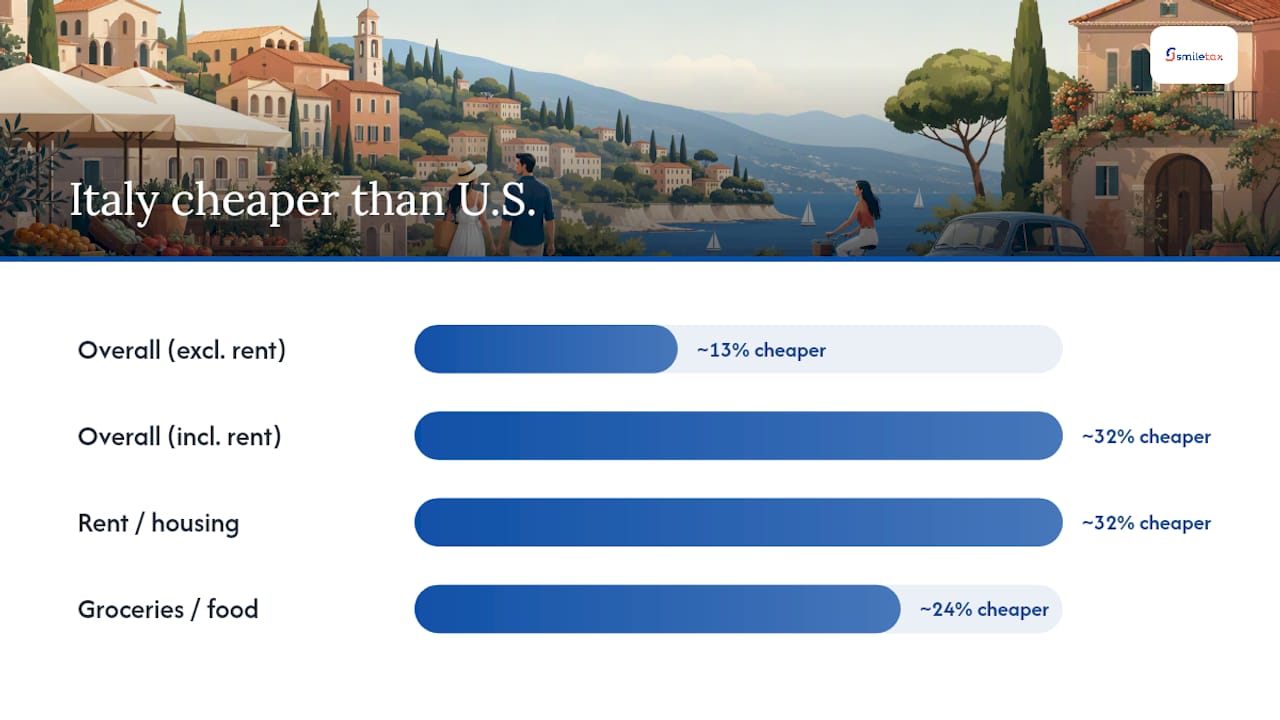
The biggest savings for Americans are in housing and dining out. A restaurant meal in Italy that would cost $25–$35 in a mid-tier U.S. city often runs €12–€18. The categories where Italy can surprise you on the upside: fuel (petrol is taxed heavily across the EU), and utilities in older apartments with poor insulation.
One important caveat: these are national averages. ISTAT’s data documents a pronounced north–south divide in household spending, and the real-world gap between Milan and a small Sicilian town is far larger than any national figure suggests.
What you’ll actually spend by region: sample monthly budgets
The north–south divide is the single most important variable in budgeting for Italy. Idealista’s January 2026 city-level data and Movingto’s 2026 breakdown both confirm that southern cities can be 35–40% cheaper than northern hubs on everyday spending. Here’s how that plays out across three region tiers.
Northern Italy: Milan
Milan is Italy’s most expensive city. A one-bedroom apartment in the city center runs €1,500–€2,200/month; outside the center, expect €1,000–€1,400. The metro is excellent, so many residents skip a car entirely.
| Household | Rent (assumed) | Other monthly costs | Total estimate |
|---|---|---|---|
| Single | €1,200 (outside center, 1BR) | €500–€700 | €1,800–€2,400 |
| Couple | €1,600 (city center, 1BR) | €1,000–€1,300 | €3,000–€3,800 |
| Family of four | €2,000 (outside center, 2BR) | €1,500–€1,800 | €3,500–€3,800 |
Assumptions: “comfortable” means dining out 2–3 times per week, one public transport pass per adult, standard grocery shopping, no private school fees.
Central Italy: Rome and Florence
Rome offers more neighborhood variety than Milan. Prati, Pigneto, and Ostiense give you a real Roman life at significantly lower rents than the historic center. Florence is compact and walkable but tourist-center premiums are steep; living in Oltrarno or near Campo di Marte cuts costs sharply.
Southern Italy and smaller towns: Palermo, Lecce
This is where Italy’s affordability becomes genuinely striking for Americans. Rent for a two-bedroom apartment in Lecce or Palermo can run €500–€800/month. Groceries, dining, and services all track lower. The trade-off is fewer English-speaking professional services and, in some areas, slower internet infrastructure.
A few things to keep in mind across all regions:
- Seasonal utility costs vary significantly. Winter heating in Milan pushes utility bills higher than the annual average; summer air conditioning in Palermo does the same in July and August.
- Older apartment buildings, common in historic centers, often lack modern insulation, which amplifies both heating and cooling costs.
- Living 15–30 minutes outside a city’s tourist core typically yields more space for the same rent, sometimes considerably more.
A detailed look at each spending category
Housing
Rent is the biggest variable in any Italian budget, and it’s also where Americans save the most compared to U.S. cities. Milan’s city-center rent per square meter runs roughly €20–€28/m²; Rome sits at €15–€22/m²; southern cities like Palermo or Bari come in at €7–€12/m². A 60m² (roughly 650 sq ft) apartment in Rome’s mid-zone costs around €1,000–€1,300/month. The same size in Lecce: €500–€700.
Expect to pay a security deposit of two to three months’ rent upfront. Agency fees, when applicable, typically run one month’s rent. Budget these as part of your relocation costs, not your ongoing monthly spend.
Utilities and energy
A standard monthly utility bill (electricity, gas, water) for a one-bedroom apartment runs roughly €80–€150 in mild months, rising to €150–€250 in winter for northern cities or summer in the deep south. Older buildings with single-pane windows and no central heating control are the main culprit for high bills. If you’re apartment hunting, ask specifically about the building’s energy class (classe energetica).
Internet and mobile
Home fibre broadband from providers like TIM, Fastweb, or Vodafone Italy typically costs €25–€35/month for speeds of 1 Gbps. Mobile data plans are among the cheapest in Europe: expect €7–€15/month for a SIM with generous data from operators like Iliad or Ho. Mobile. This is one area where Italy is noticeably cheaper than the U.S.
Groceries
A single person spending thoughtfully at a supermarket (Esselunga, Conad, Carrefour) can cover a week’s groceries for €40–€60. A family of four typically spends €300–€450/month on food at home. Shopping at local markets (mercati rionali) for produce and cheese cuts costs further and is one of the genuine pleasures of daily life in Italy.
Sample prices to orient your planning:
- Espresso at a bar: €1.00–€1.50
- Bottle of local wine (supermarket): €4–€8
- Chicken breast (per kg): €7–€10
- Fresh pasta (500g): €1.50–€3.00
- Loaf of bread: €1.50–€2.50
Transport
Monthly public transport passes cost roughly €35 in most cities (Rome’s Metrebus pass runs about €35/month; Milan’s ATM pass is around €39/month). Taxis start at €3–€5 for the flag fall. Fuel runs approximately €1.70–€1.90 per liter, which is meaningfully higher than U.S. pump prices.
Car ownership in city centers adds parking costs (€100–€200/month in Rome or Milan) and the complication of ZTL zones (Zona a Traffico Limitato), restricted traffic areas that cover most historic centers. Many American expats in major cities find they don’t need a car at all.
Healthcare
Italy’s national health service, the Servizio Sanitario Nazionale (SSN), is available to legal residents. Registering with the SSN gives you access to a general practitioner, specialist referrals, and hospital care at little or no direct cost. The registration process is handled through your local ASL (Azienda Sanitaria Locale) office and is one of the first administrative steps after establishing residency.
Many Americans also carry supplementary private health insurance for faster specialist access and English-speaking providers. Private insurance premiums for a healthy adult typically run €50–€150/month depending on coverage level. For a fuller picture of insurance options, the SmileTax guide to health insurance abroad covers the public vs. private trade-offs in detail.
Entertainment and dining out
A sit-down lunch at a local trattoria (the classic Italian worker’s lunch, often a fixed-price menu) runs €10–€15 per person including wine. Dinner at a mid-range restaurant is €25–€45 per person. An aperitivo, which in many cities includes a generous spread of snacks, costs €8–€12. Cinema tickets run €8–€12. A gym membership is typically €30–€60/month.
💡 Tip: Choosing an apartment in a residential neighborhood rather than a tourist-heavy zone cuts your rent, your grocery prices (local shops are cheaper than tourist-area alimentari), and your daily noise level all at once.
Practical things Americans need to know before moving
Currency and exchange-rate sensitivity
The USD/EUR rate directly affects your purchasing power every month. At $1.08 per euro (June 2026 rate), a €2,000/month budget costs you about $2,160. If the dollar weakens to $1.15/euro, that same budget costs $2,300. A 10-cent swing in the exchange rate can shift your effective monthly cost by €150–€300 on a typical expat budget.
Americans earning in USD and spending in euros benefit when the dollar is strong. Those earning locally in euros and sending money home face the reverse. Check rates regularly through your bank or a service like Western Union, which many Americans use as a reference point for USD-to-EUR transfer rates and fees. Transfer fees and exchange-rate spreads can add up to 1–3% on each transaction, so it’s worth comparing options before settling on a regular transfer method.
Banking
Opening an Italian bank account (conto corrente) typically requires your codice fiscale (Italian tax ID number), a valid ID, and proof of address. Major banks include Intesa Sanpaolo, UniCredit, and BancoPosta. Monthly account fees run €5–€15 for basic accounts. Many expats use a combination: a local Italian account for rent and utilities, plus a U.S.-based card with no foreign transaction fees (such as those offered by Charles Schwab or Capital One) for day-to-day spending.
ATM withdrawals with a foreign card typically incur a fee of €2–€5 per transaction from the Italian bank, plus whatever your U.S. bank charges. Minimizing ATM visits and using a no-fee card for purchases reduces this friction considerably.
Earning in USD vs. earning locally
Americans who continue earning in USD while living in Italy generally find their purchasing power stretches further, particularly outside Milan. A remote income of $4,000/month converts to roughly €3,700 at current rates, which covers a comfortable lifestyle in Rome or a generous one in the south. Local Italian salaries are lower on average than U.S. equivalents for many professional roles, so Americans who shift to local employment may find the cost advantage narrows.
Administrative setup: what to budget upfront
The first few months in Italy involve a cluster of one-time costs that catch many new arrivals off guard. Budget for:
- Codice fiscale: Free to obtain at the Agenzia delle Entrate; allow a few days.
- Residency registration (iscrizione anagrafica): Free, but requires an appointment at your local Comune. Processing can take 4–8 weeks.
- Permesso di soggiorno (residence permit): Fees vary by permit type; expect €100–€300 in government fees plus a postal kit fee of around €30. Processing times range from 2–6 months depending on the permit category and local office workload.
- SSN health registration: Free once residency is established; handled at your local ASL office.
- Utility setup: Connection fees for electricity and gas typically run €50–€150 per utility if you’re setting up a new contract. Allow 1–3 weeks for activation.
- Rent deposit and agency fees: Two to three months’ rent as deposit, plus potentially one month’s rent as an agency fee.
Practitioners consistently advise new arrivals to hold a buffer of two to three months of living expenses in addition to deposit funds before the move. The administrative timeline alone means you may be spending before any local income or banking is fully in place.
💡 Tip: Get your codice fiscale before you arrive if possible. Italian consulates in the U.S. can issue one, and having it in hand speeds up almost every other administrative step.
For a broader look at the relocation process, the SmileTax guide to moving to Italy from the U.S. covers lifestyle, culture, and practical steps in detail.
How these numbers were put together
The figures in this guide draw on six primary sources, cross-checked for consistency.
- ISTAT (latest household expenditure series): Italy’s national statistics institute. Used for the national average household spending figure (~€2,755/month) and the north–south regional divide.
- Idealista (January 2026): Italy’s largest property portal. Used for city-level rent €/m² figures and sample monthly budgets.
- Expatistan (June 2026): Itemized category comparison. Used for the 24% overall cheaper figure and food/housing deltas.
- GlobalCostData (2026): Index-based comparison. Used for the 32% overall cheaper headline figure.
- Movingto (2026): Per-category ranges and city budgets used to cross-check rent, grocery, and utility figures.
- Eurostat and OECD: Used for purchasing-power and wage context.
Exchange rate used: €1 = $1.08 (June 2026). All USD equivalents in this guide use this rate. Exchange rates fluctuate; verify the current rate before making financial decisions.
What’s included and excluded: Sample budgets include rent, utilities, groceries, transport, and modest entertainment. They exclude private school tuition, car purchase/lease costs, travel outside Italy, and any U.S.-side financial obligations. Figures are per-household, not per-person, except where labeled “single.” Rent figures assume unfurnished apartments unless noted; furnished apartments typically run 10–20% higher.
National and city averages mask significant neighborhood-level variation. A budget that works in Rome’s Pigneto district may fall short in Parioli. Use these figures as a starting framework, then refine with current listings from Idealista or Immobiliare.it for your specific target area.
SmileTax keeps U.S. filing simple for Americans in Italy
Living in Italy is one thing. Staying on top of your U.S. filing obligations from abroad is another. SmileTax works directly with Americans living overseas, including expats in Italy, handling U.S. returns with the kind of personal attention that generic software and large impersonal firms rarely provide. Every client works one-on-one with an experienced U.S. tax professional, and pricing is transparent and flat-fee. If you’re settling into life in Italy and want your U.S. obligations handled properly and without drama, SmileTax is built for exactly that.
Primary sources and further reading
- ISTAT: Italy’s official statistics institute. Household expenditure series and regional spending data. Most recent published series used.
- Idealista January 2026: City-level rent €/m² and sample monthly budgets for singles, couples, and families.
- Expatistan June 2026: Itemized category comparison; overall 24% cheaper figure.
- GlobalCostData 2026: Index-based comparison; 32% cheaper headline.
- Movingto 2026: Per-category monthly ranges and city budget cross-checks.
- Eurostat labour market database: Wage and purchasing-power context for Italy vs. broader Europe.
- Impatria city-by-city guide: Aggregated ISTAT and market rent data with city-specific budget estimates.
Exchange rate reminder: All USD figures in this guide use €1 = $1.08 (June 2026). City-level averages are starting points; verify current rents on Idealista or Immobiliare.it for your target neighborhood before finalizing your budget.
This article provides general lifestyle and cost-of-living information. It is not financial, legal, or tax advice. Verify current rates, fees, and administrative requirements with official Italian sources or a qualified professional before making relocation decisions.
This article is general information, not a substitute for advice from a qualified financial advisor. Consult a qualified financial professional about your own circumstances before acting on anything here.
Sources
- ISTAT
- Italy vs United States 2026: Italy 32% Cheaper (GlobalCostData)
- How much money do you need to live comfortably in Italy (Idealista)
- Cost of living in Italy is 24% cheaper than United States (Expatistan)
- Cost of Living in Italy 2026: Complete Monthly Breakdown (Movingto)