

For most Americans, Mexico is genuinely, materially cheaper than the United States. Across 2026 cost-of-living reports, Mexico runs roughly 35–60% cheaper than the United States overall, with the largest savings in housing, healthcare, and daily dining. A single person living comfortably in Mérida or Guadalajara can do so for a moderate monthly budget. That same lifestyle in a premium CDMX colonia like Condesa or Roma Norte costs noticeably more. The drivers are straightforward: rent is dramatically lower, a doctor’s visit costs a fraction of US cash rates, and eating well is cheap whether you cook at home or eat out daily.
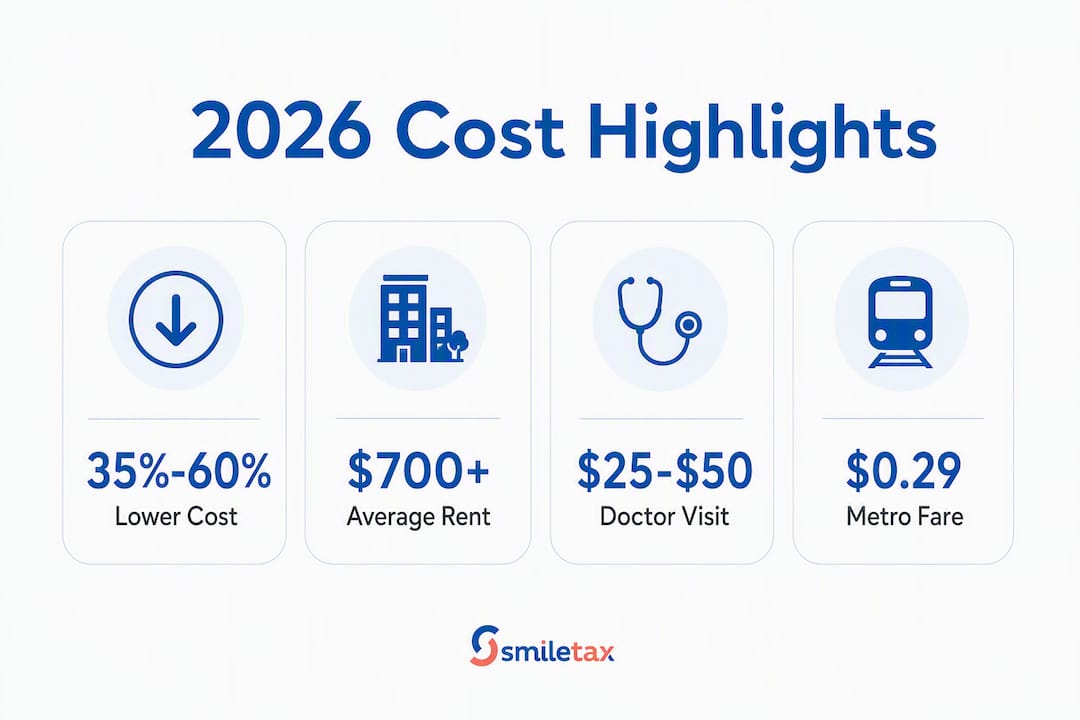
According to Numbeo, the cost of living in Mexico is on average significantly lower than in the United States, and rent is substantially lower. Those figures hold up across city-level data. The gap is real, and it’s consistent enough to plan around.
Table of Contents
- What do the 2026 numbers actually look like?
- How the cost of living breaks down by category
- What does rent actually cost across Mexican cities?
- What do groceries and dining out cost in Mexico?
- Getting around: public transit, ride-hailing, and car ownership
- Healthcare costs and how expats typically access care
- Electricity, water, gas, and internet: what to budget monthly
- Which cities cost the most and which are cheapest?
- Sample monthly budgets for a single person, couple, and family
- Initial moving costs, banking, and sending money
- What experienced American expats report
- What’s cheaper in Mexico and what isn’t?
- High-level residency pointers for Americans moving to Mexico
- Key Takeaways
- An honest perspective on planning your move
- Living in Mexico while keeping your US filing simple
- Useful sources and further reading
What do the 2026 numbers actually look like?
The table below uses an exchange rate of approximately MXN 17.5 per USD, which reflects mid-2026 rates from major currency services. Numbers are drawn from Numbeo, Tolatam, and WhereNext city guides. Sample budgets include rent, food, transport, utilities, and basic healthcare. They exclude flights, debt service, US health insurance premiums, and large one-off purchases.
| Category | Low budget (USD / MXN) | Comfortable (USD / MXN) | Expat enclave (USD / MXN) |
|---|---|---|---|
| Single person/month | — | $1,400 | — |
| Family of four/month | $1,800 | — | — |
| 1BR rent (budget city) | $300 | $500 | — |
| 1BR rent (CDMX premium) | $700 | — | — |
| Groceries/month (single) | $150 | $250 | — |
| Public transit/month | $15 | $30 | — |
Exchange rate: ~MXN 17.5 per USD (mid-2026). Sources: Numbeo, Tolatam, WhereNext 2026 city guides.
Numbeo’s own country-level data puts the estimated monthly costs for a single person at $722.9 (MXN 12,541) excluding rent, and for a family of four at $2,682.9 (MXN 46,546) excluding rent. Add a mid-range 1BR apartment and the single-person total lands comfortably under $1,400 in most cities outside resort zones.
How the cost of living breaks down by category
Housing and healthcare are where Americans save the most. Rent alone runs 54% lower than the US average according to Numbeo, and out-of-pocket medical costs are often 70–90% lower than comparable US cash rates. Dining out is similarly affordable: a full sit-down lunch at a local restaurant typically costs $4–$8. Those three categories together account for the bulk of most household budgets, which is why the overall savings are so consistent.
The categories where savings shrink or disappear:
- Imported goods and electronics: A MacBook or a name-brand appliance often costs more in Mexico than in the US due to import duties.
- Cars: Purchase prices and insurance run higher than many Americans expect; fuel is cheaper, but the vehicle itself is not.
- Branded US groceries: Costco and Walmart exist in major cities, but imported cereals, cheeses, and packaged goods carry a premium.
- Coastal and tourist hubs: Puerto Vallarta, Los Cabos, and Tulum price many services at near-US levels for the tourist market.
Inland cities consistently offer the best value. Mérida, Guadalajara, San Miguel de Allende, and Oaxaca City all deliver a high quality of life at costs well below what you’d spend in any comparable US metro.
What does rent actually cost across Mexican cities?
Rent varies sharply by neighborhood and city. The same $700/month that rents a modest studio in Condesa (Mexico City) gets you a spacious, furnished 2BR apartment in Mérida or a comfortable 1BR in Guadalajara’s Providencia neighborhood.
City rent comparison
| City / Area | Studio | 1BR | 2BR |
|---|---|---|---|
| CDMX: Condesa / Roma Norte | $700–$900 | $900 | $1,400 |
| CDMX: Narvarte / Del Valle | $450–$650 | $600 | $900–$1,300 |
| Guadalajara | $300–$450 | $400–$650 | $600 |
| Mérida | $280–$420 | $350–$600 | $550–$850 |
| Puerto Vallarta | $500–$750 | $700–$1,100 | $1,000–$1,600 |
| Smaller inland towns | $200–$350 | $280–$500 | $400–$650 |
Ranges reflect unfurnished to furnished; furnished units run 15–25% higher. Sources: Tolatam, WhereNext 2026.
Lease practices and what to expect
Mexican leases typically run 12 months, with a deposit of one to two months’ rent. Furnished apartments are common in expat-heavy neighborhoods and usually include basic appliances. Condo fees (cuota de mantenimiento) of $30–$80/month are standard in newer buildings and are sometimes not included in the advertised rent. Utilities are almost always separate.
First-month move-in budget checklist:
- First month’s rent
- Security deposit (one to two months’ rent)
- Furniture and household basics (if unfurnished): budget $500–$1,500 depending on how much you bring
- Utility connection fees (CFE electricity, water, internet setup): typically $50–$150 total
- Renter’s insurance (optional but recommended): $10–$25/month
Tip: Search for rentals on Facebook Marketplace groups and local Mexican portals like Inmuebles24 or Vivanuncios rather than expat-facing sites. Listings aimed at local renters are typically 20–40% cheaper for the same property. Visiting in person before committing is worth the trip — photos rarely capture noise levels, natural light, or neighborhood feel.
What do groceries and dining out cost in Mexico?
Cooking at home in Mexico is genuinely inexpensive, especially if you shop at local mercados rather than supermarkets. A weekly mercado run for one person typically costs MXN 400–700 ($23–$40), covering fresh produce, eggs, chicken, and staples.
Representative 2026 price examples (USD / MXN):
- Dozen eggs: $1.20–$1.80 / MXN 21–32
- 1 kg chicken breast: $2.50–$3.50 / MXN 44–61
- 1 liter milk: $0.90–$1.20 / MXN 16–21
- Avocados (4 pack): $1.00–$1.50 / MXN 18–26
- Street tacos (each): $0.50–$1.00 / MXN 9–18
- Comida corrida (set lunch, 3 courses): $3.50–$6.00 / MXN 61–105
- Coffee at a local café: $1.50–$2.50 / MXN 26–44
Monthly grocery budgets break down roughly as follows. A thrifty shopper buying mostly at mercados and local tiendas spends $150–$200/month. A mixed approach (some supermarket, some mercado) runs $200–$300. Convenience-focused shopping at Walmart or Chedraui with occasional imported items lands at $300–$400.
Dining out adds another $150–$350/month for most expats, depending on how often they eat at restaurants versus street food stalls. A couple eating out four nights a week at mid-range local restaurants typically spends $200–$300/month on dining, not counting drinks.
Getting around: public transit, ride-hailing, and car ownership
Mexico City’s metro system is one of the best transit deals anywhere. The flat fare sits at MXN 5 (about $0.29) per ride, and the Metrobús runs at MXN 6–7. A full month of daily commuting in CDMX costs under $20. Guadalajara’s SITEUR light rail and bus network is similarly affordable, with fares under MXN 10. Mérida has limited public transit and most residents rely on ride-hailing or personal vehicles.

Intercity buses through ADO and similar carriers are comfortable, air-conditioned, and inexpensive. The CDMX–Mérida overnight route, for example, costs roughly $40–$60 one-way, making car ownership unnecessary for many expats who travel between cities occasionally.
Typical monthly transport costs:
- CDMX metro commuter: $15–$25/month
- Guadalajara transit user: $20–$35/month
- Mérida (ride-hailing dependent): $60–$120/month
- Uber/DiDi 5 km urban trip: $2.50–$5.00 in most cities
- Fuel (per liter): approximately MXN 22–25 ($1.26–$1.43)
Car ownership makes sense in smaller towns or cities with limited transit. Budget roughly $150–$250/month for insurance, parking, and occasional maintenance, plus fuel. Importing a US vehicle involves significant paperwork and fees; buying locally is usually simpler.
Healthcare costs and how expats typically access care
Private healthcare in Mexico costs a fraction of US cash rates. A GP visit at a private clinic runs $25–$50. A specialist consultation is typically $40–$80. Dental cleaning costs $30–$60, and a root canal at a reputable private dentist runs $200–$400, compared with $1,000–$1,500 in the US.
| Service | Mexico (USD) | Typical US cash rate (USD) |
|---|---|---|
| GP visit (private clinic) | $25–$50 | $150–$300 |
| Specialist consultation | $40–$80 | $200–$500 |
| Dental cleaning | $30–$60 | $100–$200 |
| Root canal | $200–$400 | $1,000–$1,500 |
| Private health insurance (healthy adult, monthly) | $80–$200 | $400–$700+ |
IMSS (Instituto Mexicano del Seguro Social) offers voluntary enrollment for legal residents at a modest annual fee, giving access to Mexico’s public healthcare network. Many expats use IMSS as a safety net for hospitalizations while paying out of pocket for routine private clinic visits, which are fast, convenient, and still very affordable.
Tip: A practical approach for many expats is to carry a basic private insurance policy ($80–$150/month) for emergencies and major procedures, then pay cash for routine GP and dental visits. This combination typically costs less per month than a US employer plan’s employee contribution alone.
Electricity, water, gas, and internet: what to budget monthly
Utility costs in Mexico are low by US standards, with one important caveat: electricity in hot-climate cities can spike significantly in summer months.
Mexico’s state electricity provider, CFE, uses a tiered billing system. Households that stay within subsidized consumption bands pay very little, often $15–$30/month in temperate cities like Guadalajara or Mexico City. But in Yucatán, coastal Oaxaca, or Veracruz, heavy air conditioning use can push a household into the high-consumption DAC tier, where bills can climb to $100–$200 or more during peak summer months. Budget for this before choosing a city.
Typical monthly utility ranges:
- Electricity (temperate city, no A/C): $15–$30
- Electricity (hot coastal city, heavy A/C, summer): $80–$200
- Water: $5–$15
- Gas (LP cylinder or piped): $15–$30
- Fiber internet (50–100 Mbps): $25–$40
- Mobile data (unlimited plan): $15–$25
Many expats also hire a weekly cleaning person (approximately $20–$35 per visit) and use a local laundry service (lavandería) for $5–$10 per load. These services are affordable enough that most expats use them regularly, and they free up time considerably.
Which cities cost the most and which are cheapest?
The city you choose has more impact on your monthly budget than almost any other decision.
| City | Monthly budget, single (USD) | Typical 1BR rent | Transit | Healthcare access | Best for |
|---|---|---|---|---|---|
| Mérida | $900–$1,400 | $350–$600 | Limited | Good private clinics | Retirees, families |
| Guadalajara | $950–$1,500 | $400–$650 | Good | Excellent | Digital nomads, teachers |
| CDMX (Narvarte) | $1,200–$1,800 | $600 | Excellent | Excellent | All profiles |
| CDMX (Condesa/Roma) | $1,600–$2,500 | $900 | Excellent | Excellent | Expat enclave seekers |
| Puerto Vallarta | $1,500–$2,500 | $700–$1,100 | Limited | Good | Retirees, beach lifestyle |
| Smaller inland towns | $700–$1,100 | $280–$500 | Minimal | Basic | Budget-focused retirees |
A few notes on each profile:
- Mérida suits retirees and families who want a slower pace, colonial architecture, and low costs. The heat is real, and A/C bills reflect it.
- Guadalajara is Mexico’s second city and arguably the best all-around choice for digital nomads and international teachers: good infrastructure, a large expat community, and costs well below CDMX.
- CDMX Narvarte/Del Valle offers the metro’s convenience at prices noticeably lower than the trendy colonias a few kilometers north.
- Puerto Vallarta is beautiful but prices in tourist zones approach US levels. Living a few blocks off the tourist strip cuts costs considerably.
- Smaller inland towns (Oaxaca City, San Cristóbal de las Casas, Guanajuato) offer the lowest costs and a rich cultural life, but with fewer international services and limited English-language healthcare.
Sample monthly budgets for a single person, couple, and family
These budgets use mid-2026 price data from WhereNext and Numbeo. They include rent, groceries, transport, utilities, basic healthcare, entertainment, and a miscellaneous buffer. They exclude flights home, US health insurance premiums, debt payments, and large one-off purchases.
| Expense | Single (low) | Single (comfortable) | Couple (comfortable) | Family of four (comfortable) |
|---|---|---|---|---|
| Rent | $350 | $600 | $800 | $1,100 |
| Groceries | $160 | $250 | $380 | $550 |
| Dining out | $80 | $180 | $280 | $350 |
| Transport | $25 | $50 | $80 | $100 |
| Utilities + internet | $60 | $90 | $110 | $130 |
| Healthcare (out-of-pocket + insurance) | $50 | $120 | $200 | $280 |
| Entertainment / misc | $75 | $150 | $250 | $350 |
| Total | $800 | $1,440 | $2,100 | $2,860 |
Can you retire in Mexico on $3,000/month?
Yes, comfortably. A couple living in Mérida, Guadalajara, or a mid-tier CDMX neighborhood on $3,000/month has roughly $900 left over after covering all core expenses at the comfortable tier. That buffer covers flights home, entertainment upgrades, or savings. A single retiree on $3,000/month in most Mexican cities outside resort zones lives very well, with room for travel and occasional splurges.
Social Security income of $1,800–$2,500/month, which many American retirees receive, covers a comfortable single-person budget in most cities. Remote USD income stretches further still. The math works, and it works reliably.
Initial moving costs, banking, and sending money
Move-in costs are consistently higher than first-time movers expect. A realistic first-month budget for a single person includes:
- Visa or residency appointment fee (varies by consulate; budget $50–$150 for initial processing)
- First month’s rent plus deposit (two to three months’ rent total)
- Furniture and household setup if moving into an unfurnished unit ($500–$1,500)
- Utilities connection and initial internet setup ($50–$150)
- Initial grocery and household stock ($150–$250)
- Health insurance first payment ($80–$200)
- Emergency buffer: two to three months of living expenses
That puts a realistic first-month total at $3,000–$6,000 for most single movers, before ongoing monthly costs.
Banking and sending money:
Opening a Mexican bank account (Banamex, BBVA, Santander) is straightforward once you have legal residency. Without it, options are more limited. Many expats use Wise for regular USD-to-MXN transfers, which typically offers rates close to the mid-market rate with transparent fees. Western Union remains one of the most widely used services for sending money to Mexico, with a large network of pickup locations across the country.
Tip: Avoid exchanging cash at airport kiosks or hotel desks. The spread on those transactions can cost you 5–8% compared with a mid-market transfer. Set up a Wise account before you arrive, and use a local ATM on a debit card with low foreign transaction fees (Charles Schwab’s debit card reimburses ATM fees globally) for day-to-day cash needs.
What experienced American expats report
The most consistent finding across expat accounts is that neighborhood choice determines whether the savings are real or illusory. Living in a primarily Mexican neighborhood in Guadalajara or Mérida delivers the full 35–60% cost advantage. Moving into an expat enclave in Roma Norte or a beachfront condo in Puerto Vallarta narrows that gap considerably, sometimes to 15–20%.
Business Insider’s reporting on Americans who retired early in Mexico highlights that quality-of-life gains go beyond pure dollars. Affordable domestic help, fresh local food, and a slower pace of daily life contribute to a sense of value that doesn’t show up in a budget spreadsheet.
Common items that expats underbudget:
- Air conditioning costs in hot-climate cities (Mérida, Puerto Vallarta, coastal Oaxaca): summer bills can double or triple the baseline estimate.
- Imported goods and US-brand groceries: the premium adds up quickly if you shop at expat-oriented stores regularly.
- The expat premium on rent: landlords in high-demand expat neighborhoods often price in a foreigner markup. Negotiating in Spanish and searching on local platforms reduces this.
- Domestic help and services: affordable, but easy to undercount when building a monthly budget.
The expats who report the highest satisfaction tend to share a few habits: they learned enough Spanish to handle daily transactions, they shopped at local markets, and they chose their neighborhood based on a multi-week scouting visit rather than a weekend trip.
What’s cheaper in Mexico and what isn’t?
A quick reference for Americans comparing categories:
- Housing/rent: 50–60% cheaper than the US average, more in smaller cities.
- Groceries (local produce, meat, staples): 40–60% cheaper when shopping at mercados and local supermarkets.
- Dining out (local restaurants, street food): 60–80% cheaper than comparable US casual dining.
- Healthcare (out-of-pocket, private clinics): 70–90% cheaper for routine care and many procedures.
- Public transit: dramatically cheaper; CDMX metro fares are among the lowest of any major city globally.
- Utilities (temperate cities): 50–70% cheaper; hot-climate cities narrow this gap in summer.
- Domestic services (cleaning, laundry): 60–80% cheaper.
- Cars (purchase price): often equal to or higher than US prices due to import structures.
- Electronics and imported appliances: frequently more expensive than US retail prices.
- Luxury imported food and wine: comparable to or higher than US prices.
The rule of thumb: anything grown, made, or serviced locally in Mexico is cheaper, often dramatically so. Anything imported or priced for the tourist market is not.
High-level residency pointers for Americans moving to Mexico
Most Americans enter Mexico as tourists on a 180-day visitor permit (FMM), which is issued at the border or airport. This works for short stays and extended visits, but it does not allow you to open a local bank account, enroll in IMSS, or sign long-term leases easily.
The three main pathways:
Legal residency makes daily life significantly easier. Consulate appointment lead times can run several months, so start the process well before your planned move date.
Official resources:
- Mexican Consulate network (US) for visa applications and requirements
- Instituto Nacional de Migración (INM) for in-country residency processing
- IMSS voluntary enrollment information for healthcare access
This is general information only, not legal advice. Confirm current requirements and forms directly with the Mexican consulate or INM before applying.
Key Takeaways
Mexico offers Americans a genuine cost advantage versus the US, with the largest savings in rent, healthcare, and daily dining, and the city you choose matters more than almost any other single decision.
| Point | Details |
|---|---|
| Overall cost gap | Mexico runs 35–60% cheaper than the US overall; rent alone averages 54% lower per Numbeo. |
| City selection matters most | Mérida and Guadalajara offer the best value; CDMX premium colonias and resort towns narrow the gap significantly. |
| Retirement on $3,000/month | A couple can live comfortably in most Mexican cities on $3,000/month, with room for travel and savings. |
| Watch the electricity bill | Hot-climate cities (Mérida, Puerto Vallarta) can see summer electricity bills of $100–$200 due to CFE’s tiered DAC billing. |
| SmileTax for US filing | Americans living in Mexico still have US filing obligations; SmileTax handles them simply and professionally. |
An honest perspective on planning your move
The 35–60% savings figure is real, but it’s also the number most likely to mislead people who haven’t done the city-level math. The gap is widest in inland cities where expats live like locals. It narrows fast in beach towns and trendy urban neighborhoods where landlords and restaurants have priced in the foreign demand.
The more useful question isn’t “Is Mexico cheaper?” It’s “Which version of Mexico am I actually planning to live in?” A retiree in Mérida’s historic center, shopping at the Lucas de Gálvez market and eating comida corrida for lunch, is living in a genuinely different economic reality than someone renting a furnished apartment in Condesa and eating at the same restaurants that appear in travel magazines.
The other thing that surprises people is how much the first three months cost. Deposits, furniture, insurance setup, and the inevitable “I didn’t realize I’d need that” purchases add up. A two-to-three month buffer beyond your first month’s rent is not overcautious; it’s the difference between a smooth landing and a stressful one.
Healthcare deserves more planning than most people give it. Mexico’s private clinics are excellent and affordable for routine care, but a serious illness or accident without adequate insurance can be expensive anywhere. Getting a basic private policy in place before you arrive is worth every dollar.
Finally, the expats who thrive long-term in Mexico are almost always the ones who made a genuine effort with Spanish. Not fluency, but enough to handle a landlord conversation, a pharmacy visit, or a mercado negotiation. That one investment pays dividends in lower costs, better relationships, and a richer daily experience that no budget spreadsheet can capture.
Living in Mexico while keeping your US filing simple
Americans living in Mexico still have US filing obligations abroad, and managing them from abroad doesn’t have to be complicated. SmileTax is built specifically for Americans overseas, including retirees, digital nomads, international teachers, and locally employed professionals who want their US filing handled properly without the cost or impersonality of a large firm.
Every SmileTax client works directly with an experienced US tax professional. No software handoffs, no unknown preparers. If you’re settling into life in Mexico and want the peace of mind of knowing your US obligations are covered, see how SmileTax supports Americans abroad.
Useful sources and further reading
The numbers in this guide are drawn from the following sources. Where figures are expressed in USD, the conversion uses an approximate mid-2026 rate of MXN 17.5 per USD.
- Numbeo — Cost of Living in Mexico: crowd-sourced price index; used for percent-cheaper comparisons vs. the US and category-level price data.
- Western Union — Cost of Living in Mexico vs. the United States: family-of-four monthly cost benchmark and remittance context.
- Business Insider — How I Retired Early in Mexico at 50: expat quality-of-life reporting and retirement scenario context.
- Wikipedia — American immigration to Mexico: demographic background on the US expat population in Mexico.
- SmileTax — Resources for Americans Abroad: practical support for Americans managing life and obligations overseas.
This article provides general cost-of-living information for planning purposes. It is not financial, legal, or tax advice. Confirm current prices, visa requirements, and regulations with official sources or qualified professionals before making decisions.