

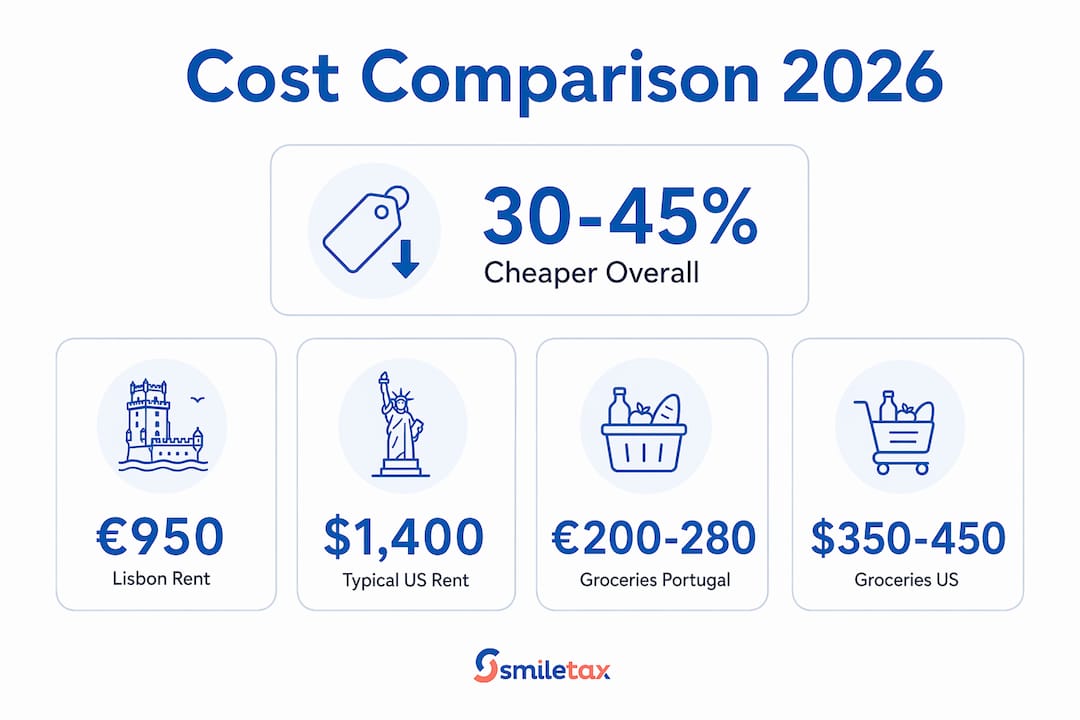
As of 2026, Portugal is 30–45% cheaper than comparable U.S. coastal metros, with city-level differences mattering most. A single person can live comfortably in Lisbon on €2,300–3,200 per month, while Porto ranges from €1,400–2,100 and smaller interior towns generally require less. This gap changes lifestyle and real spending patterns. A couple in the Algarve and a family of four in Porto using public schools also have distinct budget ranges reflecting local costs. The savings come primarily from four categories: housing (still cheaper outside Lisbon), healthcare (private insurance costs a fraction of U.S. employer plans), groceries, and public transit. Numbers throughout this guide draw on Portugalguru, LiveInPT, Relocate.World, and INE (Portugal’s national statistics office) for macro context. USD figures use an approximate €1 = $1.08 conversion rate; always check current exchange rates before finalizing a budget.
Table of Contents
- How does Portugal’s cost of living compare to the US in 2026?
- What does a realistic monthly budget look like by city?
- What should you know about finding housing in Portugal in 2026?
- How does healthcare work for Americans living in Portugal?
- What changed in 2026 that affects your Portugal budget?
- How much income do you actually need to live in Portugal?
- What are the real downsides Americans should know about?
- Your pre-move checklist and monthly budget template
- Key Takeaways
- What Americans actually experience after moving to Portugal
- SmileTax keeps your U.S. filing simple while you focus on Portugal
- Useful sources and methodology
How does Portugal’s cost of living compare to the US in 2026?
The category-by-category comparison is where the real picture emerges. Rent is the most variable line item, healthcare is the most dramatic difference, and groceries and transit are reliably cheaper across the board.
| Category | Portugal (monthly) | Typical U.S. metro (monthly) |
|---|---|---|
| 1BR rent, city center | a range of monthly rent prices | a range of monthly rent prices |
| 2BR rent, city center | a range of monthly rent prices | a range of monthly rent prices |
| Monthly groceries (1 person) | a range of monthly grocery costs | a higher range of grocery costs |
| Dining out (3x/week) | a range of dining out costs | a higher range of dining out costs |
| Monthly transit pass | a range of transit pass prices | a higher range of transit pass prices |
| Utilities + internet | a range of utility costs | a higher range of utility costs |
| Private health insurance (single) | a range of private health insurance costs | a higher range of private health insurance costs |
| Monthly total (single, comfortable) | a range of total monthly costs | a higher range of total monthly costs |
Rent is the biggest variable. Lisbon 1BR apartments in decent neighborhoods like Graça or Anjos run approximately €950–€1,400 with equivalent USD values per month. Porto’s equivalent neighborhoods come in at approximately €700–€1,100 with equivalent USD values. Interior towns like Castelo Branco or Évora still offer 1BRs from approximately €450–€650 with equivalent USD values. By comparison, a 1BR in New York City averages a higher range of 1BR rents, and even Denver runs a mid-range 1BR rent.

Groceries at Pingo Doce or Continente (Portugal’s two main supermarket chains) cost a single person roughly €200–€280 (a range of monthly grocery costs) per month for a varied, quality diet. Shopping at Lidl trims that by about 15%. Imported American products are the exception: peanut butter, certain cereals, and U.S. brand snacks can cost two to three times what you’d pay at a U.S. grocery store.
Healthcare is where the numbers get striking. Private health insurance for a healthy adult in Portugal typically runs a range of private health insurance costs per month through providers like Médis, Multicare, or AdvanceCare. A comparable U.S. employer-sponsored plan costs a higher range of private health insurance costs per month in employee premiums alone, before deductibles.
Utilities carry a surprise: Portugal has some of the EU’s highest household electricity rates, around electricity rates around €0.17–€0.21 per kWh. Summer air conditioning and winter electric heating push bills higher than many expats expect. Budget a range of combined utility costs for electricity, gas, water, and building fees.
Transit in Lisbon and Porto is genuinely cheap. The Navegante unlimited monthly pass covers metro, bus, and tram for around approximately €44 for a transit pass. Car ownership in both cities is largely unnecessary and adds significant cost: petrol runs around €1.70–€1.85 per liter, and mandatory insurance, road tax, and tolls add up fast.
Tip: If you’re moving to Lisbon or Porto, skip the car for the first six months. The transit network covers most of the city, and the monthly pass pays for itself within a week. Reassess once you know your actual movement patterns.
What does a realistic monthly budget look like by city?
Location choice is the single biggest lever on your Portugal budget. The table below shows low, comfortable, and high monthly spending estimates for a single person in USD, based on verified 2026 city-level data.
| City | Low ($/month) | Comfortable ($/month) | High ($/month) | Notes |
|---|---|---|---|---|
| Lisbon | varied monthly budget ranges reflecting different spending levels | International hub; highest rents in Portugal | ||
| Porto | varied monthly budget ranges reflecting different spending levels | Best value among major cities | ||
| Algarve (Faro/Tavira) | varied monthly budget ranges reflecting different spending levels | Seasonal pricing; Lagos pricier than Faro | ||
| Braga / Coimbra | varied monthly budget ranges reflecting different spending levels | University cities; authentic, underappreciated | ||
| Interior (Évora / Castelo Branco) | $900 | — | $1,500 | Best value; fewer English-language services |
Lisbon offers the most international job market, the best English-language infrastructure, and the most active expat community. The tradeoff is rent: Lisbon budgets run approximately €2,300–€3,200 for a single person, matching the most recent city-level cost breakdowns by Portugalguru and confirming the current 2026 premium versus other Portuguese cities.
Porto is where the math works best for most Americans. Porto single-person budgets come in at roughly €1,400–€2,100, with a genuine city feel, strong food and culture scene, and rents that are meaningfully lower than Lisbon. The city has been catching up in popularity, but it still offers real value.

The Algarve is attractive for retirees and remote workers who want sun and coast. Faro and Tavira are the practical choices for year-round living; Lagos and Albufeira carry tourist premiums. Seasonal pricing is real: short-term rentals flood the market in summer, which can make finding long-term housing harder between May and September.
Braga and Coimbra are the hidden-value picks. Both are university cities with good services, active social scenes, and 1BR rents starting around €550–€800. They’re often overlooked by Americans who default to Lisbon, and that’s precisely why they still offer genuine savings.
Interior towns like Évora and Castelo Branco represent Portugal at its most affordable. Rents start around €450–€650 for a 1BR. The tradeoff is real: less English spoken, fewer expat-oriented services, and specialist healthcare typically requires a drive to a larger city.
What should you know about finding housing in Portugal in 2026?
Housing is the most volatile part of any Portugal budget, and the 2026 market requires more patience than guides from 2020 or 2021 suggested. Rent in Lisbon has roughly doubled since 2018, and Porto has followed with a lag. Interior towns remain the exception, holding relatively stable.
Practical steps to find a long-term rental:
- Start your search 2–3 months before your intended move date; good apartments in Lisbon and Porto move quickly.
- Use Idealista Portugal and Imovirtual as the two primary listing platforms; both have English-language interfaces.
- Filter explicitly for “arrendamento” (rental) and “longa duração” (long-term) to avoid short-term holiday listings masquerading as residential rentals.
- Work with a local real estate agent (imobiliária) for the mid-to-upper market; agents typically charge one month’s rent as a fee, paid by the tenant.
- Expect to provide proof of income, a copy of your passport, and sometimes a Portuguese NIF (tax identification number) before signing.
- Standard deposits run one to two months’ rent, plus the first month upfront. Budget three months’ rent as your move-in cash requirement.
- Lease terms are typically 12 months minimum, with renewal options. Confirm the lease is registered with Finanças (the Portuguese tax authority) for your legal protection as a tenant.
The lease registration step matters. An unregistered lease offers you fewer protections if a dispute arises, and it’s a common gap in informal arrangements. Ask your landlord or agent to confirm registration before you sign.
Tip: Avoid searching for long-term housing between June and September. Tourist demand drives up short-term prices and reduces available stock. Plan to arrive in October or November for the best selection and negotiating position.
How does healthcare work for Americans living in Portugal?
Portugal’s public health system, the Serviço Nacional de Saúde (SNS), is available to legal residents and provides subsidized care at the point of use. Most Americans who establish residency can register with a local health center (centro de saúde) and access primary care for minimal co-pays. The practical reality is that SNS specialist wait times can be long, which is why most expats add private insurance as a supplement rather than a replacement.
Private health insurance in Portugal is genuinely affordable compared to U.S. standards. For context on healthcare options for American expats, the monthly cost difference is substantial.
| Household type | Private insurance (monthly, Portugal) | Comparable U.S. plan (monthly) |
|---|---|---|
| Single adult (under 40) | a range of private health insurance costs | — |
| Family of four | $200–$280 | — |
| Single adult | — | $500–$900+ |
Providers operating in Portugal include Médis, Multicare, and AdvanceCare, as well as international plans from providers like Cigna Global for Americans who want coverage that travels with them across Europe.
Steps to arrange coverage on arrival:
- Register with your local centro de saúde as soon as you have a Portuguese address and NIF.
- Compare private plans from at least two local insurers; premiums vary by age, coverage level, and whether you want dental included.
- Start your private plan before your arrival date if possible, or within the first week. Coverage gaps during the first month are the most common and most avoidable mistake.
- Keep a small cash buffer for occasional private specialist consultations (typically €40–€120 per visit) even with insurance, as some specialists operate outside standard plan networks.
Tip: Time your private insurance start date to your flight date, not your lease start date. The two are often a week or two apart, and that gap is when people get caught without coverage.
What changed in 2026 that affects your Portugal budget?
The most material shift since earlier guides is the continued acceleration of housing costs in coastal metros. Lisbon and Porto rents have outpaced local wage growth, and thousands of residents have protested surging housing costs, reflecting how acute the pressure has become. For Americans, the practical implication is straightforward: the Portugal-vs.-U.S. savings story depends heavily on where you choose to live.
Groceries, transit, and dining out have remained relatively stable in real terms. Utilities have edged up with European energy prices but remain lower than many U.S. cities on a monthly basis. The categories that drive the headline 30–45% savings figure are still intact outside the coastal metros.
What to watch going into 2026 and beyond:
- Interest rate movements affecting mortgage availability and buy-vs.-rent calculations in Lisbon and Porto.
- Tourism season dynamics: high summer demand continues to reduce long-term rental stock in coastal areas.
- Visa and residency income thresholds (D7 passive income visa, D8 digital nomad visa) are subject to periodic adjustment by the Portuguese government. Always confirm current minimums with official Portuguese consulate sources or a licensed immigration attorney before finalizing your budget.
- INE publishes quarterly housing price indices and annual income data; checking these before you commit to a city gives you the most current picture.
For budgeting purposes, the figures in this guide were cross-referenced against Numbeo, Expatistan, and active 2026 listings on Idealista and Imovirtual. USD conversions use approximately €1 = $1.08; the WhereNext cost-of-living calculator lets you run a personalized comparison against your specific U.S. city.
How much income do you actually need to live in Portugal?
Three modelling examples give a practical sense of what income level supports what lifestyle. These assume private health insurance, no car in Lisbon/Porto, and a mix of eating in and dining out.
| Household type | City | Monthly budget (USD) | Annual income needed | Recommended buffer |
|---|---|---|---|---|
| Single remote worker | Porto | — | — | — |
| Single remote worker | Lisbon | — | — | — |
| Retired couple | Algarve | — | — | — |
| Family of four (public school) | Porto | — | — | — |
| Family of four (international school) | Porto | — | $63,600–$87,600 | $25,000–$35,000 |
The buffer column matters. Most financial planning guides for families moving abroad recommend holding 2–6 months of living costs in accessible savings before the move. Portugal’s setup costs are real: expect to spend €3,000–€6,000 on shipping household goods, roughly €1,500 on first-year visa and residency fees, and potentially €2,500–€4,000 on relocation support if you use a service.
Upfront relocation costs to budget:
- Shipping a household from the U.S.: €3,000–€6,000 depending on volume and origin city.
- Visa and residency application fees: approximately €1,500 for the first year.
- First and last month’s rent plus deposit: budget three months’ rent as move-in cash.
- Initial household setup (furniture, appliances if unfurnished): €1,500–€3,000.
- Emergency cash reserve: 3 months of your target monthly budget, held in a liquid account.
International school fees deserve a separate line if you have children. Private international schools in Porto and Lisbon typically run $900–$1,500 per child per month, which can more than double a family’s monthly outlay versus the public school scenario.
What are the real downsides Americans should know about?
The financial case for Portugal is strong, but the practical experience has friction points that affect both quality of life and actual costs. Being clear-eyed about these before you move saves money and frustration.
- Housing search difficulty: Finding a good long-term rental in Lisbon or Porto takes longer than most guides suggest. Expect 4–8 weeks of active searching, and budget for temporary accommodation while you look.
- Bureaucracy and wait times: Registering for the SNS, getting a NIF, opening a bank account, and completing residency paperwork all involve queues and paperwork. Some processes take weeks longer than expected.
- Language barrier: English is widely spoken in Lisbon, Porto, and tourist areas. Outside those zones, Portuguese is essential for navigating government offices, medical appointments, and everyday admin.
- Seasonal price swings in the Algarve: Summer rental demand from European tourists drives up short-term prices and reduces long-term stock. Year-round residents in coastal towns feel this acutely.
- Imported American goods: Familiar U.S. brands at specialty stores or expat-oriented supermarkets cost significantly more than at home. Building a diet around local Portuguese products is both cheaper and better.
- Car import costs: Importing a U.S.-registered vehicle to Portugal triggers ISV (Imposto Sobre Veículos), a vehicle registration tax that can add thousands to the cost. Most Americans find it more practical to buy locally.
- Winter heating: Older Portuguese apartments often lack central heating. Electric heaters or heat pumps are the norm, and they push electricity bills higher than the summer average.
Tip: Learning even basic Portuguese before you arrive pays dividends immediately. A few phrases for government offices and medical appointments reduces wait times, improves service quality, and signals to locals that you’re a resident, not a tourist.
Your pre-move checklist and monthly budget template
Getting organized before you leave makes the first month in Portugal significantly smoother. The steps below are sequenced by priority.
Before you move:
- Obtain your Portuguese NIF (tax identification number) through a Portuguese consulate or a local fiscal representative; you’ll need it for almost everything.
- Gather apostilled copies of key documents: birth certificate, marriage certificate if applicable, medical records, and proof of income or pension.
- Open a Portuguese bank account (Millennium BCP, Caixa Geral de Depósitos, and Banco Santander Portugal all have English-language services) or use a multi-currency account like Wise as a bridge.
- Begin your housing search 2–3 months out; secure a short-term rental for the first 4–6 weeks to give yourself time to find a long-term place.
- Confirm current D7 or D8 visa income thresholds with the Portuguese consulate in your region before finalizing your budget.
First month on arrival:
- Register your address with the local Junta de Freguesia (parish council).
- Register with your nearest centro de saúde for SNS access.
- Activate your private health insurance if not already started.
- Sign utility contracts in your name (electricity, internet, water).
- Secure your long-term rental and confirm lease registration with Finanças.
Monthly budget template (single person, Porto):
| Line item | Low (USD) | Comfortable (USD) |
|---|---|---|
| Rent (1BR) | $755 | $970 |
| Utilities (electricity, gas, water) | $115 | $175 |
| Internet + mobile | $45 | $65 |
| Groceries | $215 | $280 |
| Dining out | $150 | $250 |
| Transit (Navegante pass) | $47 | $47 |
| Private health insurance | $40 | $60 |
| Leisure + entertainment | $100 | $200 |
| Buffer / miscellaneous | $100 | $150 |
| Total | $1,567 | $2,197 |
Tip: Copy this template into a spreadsheet and replace the Porto rent figure with your target city’s current listing average from Idealista. That single swap gives you a city-specific baseline in under five minutes.
Key Takeaways
Portugal in 2026 is still 30–45% cheaper than U.S. coastal metros for most Americans, with savings especially concentrated outside Lisbon and in specific spending categories (mainly healthcare, transit, and groceries) rather than spread evenly across every line item.
| Point | Details |
|---|---|
| Headline savings range | Portugal is 30–45% cheaper than comparable U.S. coastal metros in 2026, driven by healthcare, transit, and groceries. |
| City choice is decisive | Lisbon rents have roughly doubled since 2018, premium budgets for singles are €2,300–3,200; Porto, Braga, and interior towns retain the strongest value with single budgets €1,400–2,100 and €450–650 in interior towns. |
| Healthcare cost difference | Private health insurance in Portugal costs much less per month for a single adult compared to typical premiums in the U.S. |
| Upfront relocation budget | Plan €3,000–€6,000 for shipping, ~€1,500 for visa fees, and three months’ rent as move-in cash. |
| SmileTax for Americans abroad | SmileTax helps Americans living in Portugal keep U.S. filing straightforward; see the Portugal relocation guide for complementary logistics. |
What Americans actually experience after moving to Portugal
Americans who make the move to Portugal often describe a genuine shift in how their money feels day-to-day. The savings on food and transit are immediate and tangible: a lunch at a local tasca, a monthly transit pass, a bottle of local wine with dinner. These aren’t marginal differences. They’re the kind of changes that show up in a bank account within the first 30 days.
The housing search is where the experience diverges from the brochure. Americans accustomed to online apartment hunting with same-week availability find Portugal’s rental market slower, more relationship-driven, and less transparent. Patience and local contacts matter more than they do in the U.S.
Social integration tends to follow a predictable arc. The first few months center on the expat community, which is large and welcoming in Lisbon and Porto. Over time, the Americans who report the most satisfaction are those who made deliberate efforts to connect with Portuguese neighbors, learn the language, and participate in local life rather than recreating a U.S. social bubble. That shift also tends to reduce costs: local markets, neighborhood restaurants, and community activities are consistently cheaper than expat-oriented alternatives.
For readers weighing Portugal against other options, the Portugal vs. Spain comparison covers the lifestyle and cost differences between the two most popular Iberian destinations for Americans.
SmileTax keeps your U.S. filing simple while you focus on Portugal
Moving to Portugal changes your daily life in dozens of ways. One thing that doesn’t change is your U.S. filing obligation as an American citizen. SmileTax works specifically with Americans living abroad, including those in Portugal, to handle U.S. returns accurately and without the complexity of large accounting firms or the uncertainty of DIY software. Every client works directly with an experienced U.S. tax professional who understands the realities of expat life.
If you’re planning a move or already settled in Portugal, visit SmileTax to learn how straightforward U.S. filing can be from abroad.
Useful sources and methodology
The figures in this guide were built from the following primary sources. Because exchange rates and rental markets move quickly, treat all USD figures as estimates based on approximately €1 = $1.08 and verify current listings before finalizing any budget.
- INE (Instituto Nacional de Estatística): Portugal’s national statistics office; publishes housing price indices, wage data, and inflation figures. Use for macro-level context and trend verification.
- Portugalguru: City-level cost breakdowns and American-focused monthly budgets for 2026; primary source for the headline 30–45% savings range and city budget ranges.
- LiveInPT: Practical city-by-city budget data including Lisbon and Porto single-person ranges.
- Relocate.World: Alternative budget estimates and methodology notes showing variation across data sources; useful for cross-checking figures.
- WhereNext cost-of-living calculator: Interactive tool for personalized U.S.-to-Portugal comparisons by city and spending category.
- Relocate Handbook: Upfront relocation cost ranges including shipping, visa fees, and first-year setup budgets.
- EscapeFromUSA: Detailed line-item budgets including utilities, transport, and dining; cross-referenced against active 2026 listings.
- Reuters: Reporting on housing cost protests in Portugal; context for the rent inflation trend.
- Idealista Portugal and Imovirtual: Active listing platforms used to verify rent ranges in real time. Check these directly before committing to any city budget.
Currency note: all USD figures use an approximate €1 = $1.08 conversion. Exchange rates fluctuate; use a live converter or the WhereNext tool for current figures. Rental prices in particular change faster than any guide can track — always cross-reference against current listings before finalizing your budget.
This article is general information for planning purposes, not professional financial or legal advice. Confirm visa income thresholds, residency requirements, and current market conditions with official Portuguese government sources or a qualified professional before making relocation decisions.