

Spain is roughly 36% cheaper than the United States overall in 2026, which means a lifestyle that costs $4,500 a month in a mid-size American city can often be replicated in Spain for around $2,900. That gap is real, and it shows up in nearly every spending category: groceries, utilities, dining out, and especially rent. A single person can live comfortably in a mid-size Spanish city for €1,300–€1,800 per month (roughly $1,430–$1,980 at a working exchange rate of €1 = $1.10). A couple typically needs €2,000–€2,800 ($2,200–$3,080), and a family of four should budget €2,600–€3,600 ($2,860–$3,960), according to ThinkSpain’s 2026 cost-of-living guide. These figures draw on data from Numbeo’s cost-of-living index, Spain’s national statistics institute (INE), and IPREM, Spain’s official public income reference indicator, set at €600 per month in 2026. All USD conversions throughout this article use a rate of €1 = $1.10.
Key Takeaways
| Point | Details |
|---|---|
| Spain vs. USA savings | Spain’s cost-of-living index sits around 64 vs. USA = 100, saving roughly 36% on everyday expenses. |
| Monthly budget ranges | Singles need €1,300–€1,800/month; couples €2,000–€2,800; families of four €2,600–€3,600, with wide city variation. |
| Rent drives the gap | Madrid and Barcelona rent runs 30–50% higher than Valencia or smaller towns; living outside the center cuts costs significantly. |
| $2,000/month viability | A single person can live comfortably on $2,000/month in Valencia or a smaller city; Madrid and Barcelona require more. |
| SmileTax for US filing | SmileTax supports Americans in Spain with straightforward, professional U.S. tax filing from abroad. |
Table of Contents
- How Spain’s cost of living compares to the USA in 2026
- How costs vary across Spain: Madrid, Barcelona, Valencia, and smaller towns
- What to expect from the Spanish rental market
- Groceries, utilities, and internet: building your monthly essentials budget
- Getting around: transport costs for expats in Spain
- Healthcare options and costs for Americans in Spain
- Sample monthly budgets by city and household type
- Can you live in Spain on $2,000 a month?
- One-time moving and setup costs to plan for
- Practical money tips for Americans managing finances in Spain
- How these budgets were built: sources, exchange rate, and key caveats
- Tax considerations for Americans living in Spain
- Lifestyle expenses beyond the basics: dining, leisure, and education
- SmileTax keeps your U.S. filing simple while you live in Spain
- Sources
How Spain’s cost of living compares to the USA in 2026
The clearest way to see the difference is through a cost-of-living index, on average. Groceries and restaurants show an even wider gap.
What does that mean in dollars? A $3,000 monthly U.S. USA comparison. That is not a rounding error. It is the difference between stretching a paycheck and having money left over at the end of the month.
One important caveat: these are national averages. Madrid and Barcelona push closer to Western European norms, while Valencia and smaller inland cities are noticeably cheaper. City choice is the single biggest lever you have on your total budget.
How costs vary across Spain: Madrid, Barcelona, Valencia, and smaller towns
Housing drives the regional cost gap more than any other factor. A one-bedroom apartment in central Madrid or Barcelona can cost twice what the same apartment costs in a smaller Andalusian or Castilian city. The table below uses per-square-meter asking rents from mid-2026 national data, where Madrid’s advertised median sits at approximately €23.70/m², compared to a national average of around €15.30/m².
Valencia consistently ranks as one of the most affordable major cities for expats, offering a large international community, good public transport, and a Mediterranean climate without the premium price tag of the two biggest cities.
What to expect from the Spanish rental market
Rent in Spain is advertised monthly, and most landlords expect a deposit of one to two months’ rent plus the first month upfront. Agency fees, when applicable, are typically one month’s rent. That means your move-in cash requirement for a one-bedroom in Madrid can easily reach €4,200–€5,700 (roughly $4,620–$6,270) before you buy a single piece of furniture.
- Furnished vs. unfurnished: Most long-term rentals are unfurnished. Furnished apartments exist but carry a 15–25% premium and are more common in short-term listings.
- Short-term vs. long-term: Airbnb-style or short-term furnished listings are significantly more expensive. Expats who arrive and rent short-term while searching for a long-term place often overpay for the first one to three months.
- Deposit norms: One month is the legal minimum; two months is common in Madrid and Barcelona.
- Utilities included: Rare in long-term rentals. Budget utilities separately.
For readers considering buying rather than renting, purchase prices in Madrid average around €4,000–€5,500/m² in central neighborhoods, with Barcelona similar and Valencia considerably lower at €2,000–€3,500/m². A detailed walkthrough of the buying process is available in Ben Cook Real Estate’s 2026 guide to buying a house in Spain.
💡 Tip: Search long-term listings on local Spanish portals like Idealista or Fotocasa rather than international short-term platforms. Locally advertised rentals are typically 30–50% cheaper than equivalent short-term furnished listings, according to expat practitioner guidance.
Groceries, utilities, and internet: building your monthly essentials budget
Spanish supermarkets, particularly Mercadona, Lidl, and Aldi, are genuinely affordable by American standards. The Local’s 2026 cost guide puts staple prices at approximately €1.05 per liter of milk, €1.20–€1.30 for a loaf of bread, and €2.50–€2.70 for a dozen eggs. A couple’s weekly grocery bill typically runs €130–€140.

Utilities deserve a seasonal note. Spain’s climate varies dramatically: Madrid winters are cold and dry, Andalusia summers are intense, and coastal regions are milder year-round. Electricity bills can spike in July–August and December–January. An 85 m² apartment averages around €135/month across the year, but summer or winter months can push that to €200 or more. Requesting recent utility bills from a prospective landlord before signing is one of the most practical steps you can take, particularly in older buildings without modern insulation.
Getting around: transport costs for expats in Spain
Spain’s major cities have excellent public transit, and for most Americans moving to Madrid, Barcelona, or Valencia, a car is genuinely unnecessary. Monthly public transport passes are strong value compared to most U.S. cities.
- Madrid Zone A monthly pass: approximately €32.70, covering the entire metro, bus, and commuter rail network within the core zone.
- Barcelona T-Casual card (10 trips): around €11.35; a monthly unlimited pass runs €40–€55 depending on zones.
- Valencia monthly pass: typically €35–€45 for combined metro, tram, and bus.
- Single-ride fares: €1.50–€2.50 across major cities.
The calculus changes completely if you move to a rural or coastal town. Public transit in smaller municipalities is limited or infrequent, and a car becomes a practical necessity. Annual car ownership costs in rural Spain, covering insurance, the annual road tax (impuesto de circulación), fuel, and basic maintenance, tend to run roughly half of comparable U.S. ownership costs, according to expat cost comparisons. Fuel prices in Spain hover around €1.60–€1.80 per liter. Budget €3,000–€5,000 per year for a modest used car with full running costs if you are outside a major city.
For occasional trips or weekend travel, car rental services and Spain’s high-speed rail network (Renfe AVE) are practical and affordable alternatives to ownership.
Healthcare options and costs for Americans in Spain
Americans living in Spain have two main paths to healthcare: access to the public system or private insurance. The route depends largely on your visa type and employment situation.
Employees working under a Spanish contract contribute to Social Security and gain access to the public health system (Seguridad Social) automatically. Retirees, remote workers, and those on Non-Lucrative visas typically need private insurance, which is also a visa requirement for several residency categories.
Prescription costs in Spain are low by American standards. Most common medications cost €3–€15 per prescription for those in the public system, and private patients typically pay full retail, which is still a fraction of U.S. pharmacy prices.
💡 Tip: Compare plans from Sanitas, Adeslas, and Asisa, the three largest private health insurers in Spain. Premiums vary by age and coverage tier, so getting quotes from all three before you arrive gives you a realistic baseline and often reveals meaningful price differences for the same coverage level.
Sample monthly budgets by city and household type
All figures below use the €1 = $1.10 exchange rate. These are realistic mid-range budgets, not bare-bones minimums or luxury estimates.
Single person
| Expense | Madrid (EUR) | Madrid (USD) | Valencia (EUR) | Valencia (USD) |
|---|---|---|---|---|
| Rent (1-bed, outside centre) | €1,100 | $1,210 | €750 | $825 |
| Groceries | €250 | $275 | €230 | $253 |
| Utilities + internet | €160 | $176 | €145 | $160 |
| Transport (monthly pass) | €33 | $36 | €40 | $44 |
| Healthcare (private) | €80 | $88 | €80 | $88 |
| Dining out + leisure | €250 | $275 | €200 | $220 |
| Total | €1,873 | $2,060 | €1,445 | $1,590 |
Couple
| Expense | Barcelona (EUR) | Barcelona (USD) | Smaller town (EUR) | Smaller town (USD) |
|---|---|---|---|---|
| Rent (2-bed, outside centre) | €1,500 | $1,650 | €700 | $770 |
| Groceries | €400 | $440 | €350 | $385 |
| Utilities + internet | €185 | $204 | €155 | $171 |
| Transport (2 passes) | €90 | $99 | €50 | $55 |
| Healthcare (2 plans) | €160 | $176 | €160 | $176 |
| Dining out + leisure | €400 | $440 | €250 | $275 |
| Total | €2,735 | $3,009 | €1,665 | $1,832 |
Family of four (two adults, two children)
| Expense | Madrid (EUR) | Madrid (USD) |
|---|---|---|
| Rent (3-bed, outside centre) | €1,800 | $1,980 |
| Groceries | €650 | $715 |
| Utilities + internet | €220 | $242 |
| Transport (2 adult passes + school) | €120 | $132 |
| Healthcare (family plan) | €280 | $308 |
| Dining out + leisure | €400 | $440 |
| School fees (concertado/public) | €0–€200 | $0–$220 |
| Total | €3,470–€3,670 | $3,817–$4,037 |
For families weighing school options in Madrid, the SmileTax guide to the best schools for US expats in Madrid covers public, concertado, and private international options with fee ranges.
Can you live in Spain on $2,000 a month?
Yes, in most cases, though the answer depends on where you live and whether you are single or part of a couple.
A single person living outside a city center in Valencia, Seville, Málaga, or a smaller inland city can live comfortably on €1,600–€1,800 ($1,760–$1,980) per month. That budget covers a decent one-bedroom apartment, groceries, utilities, private health insurance, and a modest dining-out allowance. Madrid and Barcelona are harder to manage on $2,000 as a single person unless you share accommodation or live well outside the center.
For a couple, $2,000 total is tight in any major city but workable in smaller towns, particularly if one or both partners have remote income in dollars.
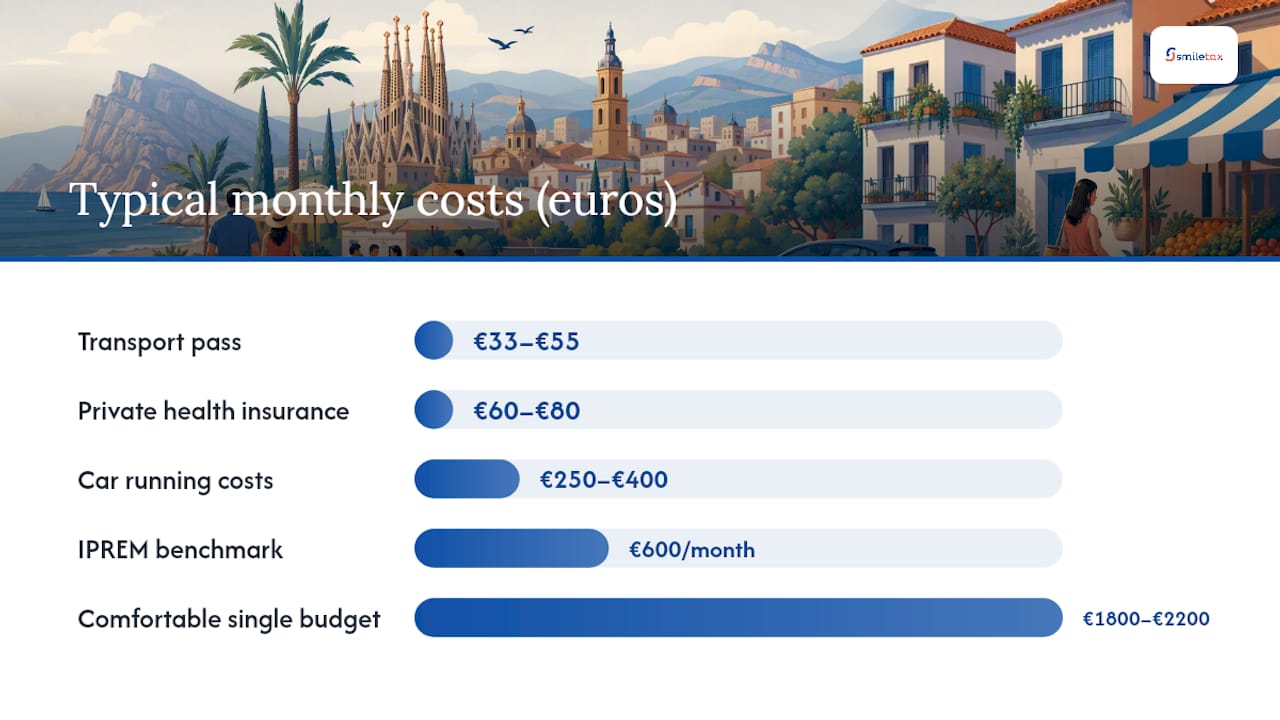
- Check your housing first. Rent is 50–60% of most expat budgets. If your rent is above €800 as a single person, the rest of your $2,000 gets tight quickly.
- Factor in healthcare. Private insurance is non-negotiable for most visa categories. Budget at least €60–€80 per person per month.
- Account for transport. A monthly pass in a major city costs €33–€55. A car in a rural area adds €250–€400/month in running costs.
- Consider schooling if you have children. Public and concertado schools are free or low-cost, but international schools can run €8,000–€20,000 per year.
- Assess income stability. A pension, remote salary, or passive income in USD benefits from the current exchange rate. A euro-denominated income at lower Spanish salary levels changes the math significantly.
“Comfortable” for a single person in Spain means a budget of around €1,800–€2,200/month ($1,980–$2,420). Below €1,300 ($1,430) is bare-bones in any city. IPREM at €600/month is an administrative benchmark used for visa income tests, not a livable figure for most Americans accustomed to a middle-class lifestyle.
One-time moving and setup costs to plan for
Before your first full month in Spain, you will spend money on things that do not appear in a monthly budget. Planning for these upfront costs prevents the common mistake of arriving with just enough for one month’s rent.
| Startup cost | Estimated range (EUR) | Estimated range (USD) |
|---|---|---|
| Deposit (1–2 months rent) | €900–€3,800 | $990–$4,180 |
| First month’s rent | €700–€1,900 | $770–$2,090 |
| Agency fee (if applicable) | €700–€1,900 | $770–$2,090 |
| Basic furniture / white goods | €800–€2,500 | $880–$2,750 |
| Utility connection fees | €100–€200 | $110–$220 |
| International shipping (partial) | €1,500–€4,000 | $1,650–$4,400 |
| Visa application fees | €80–€200 | $88–$220 |
| Total estimated startup | €4,780–€14,500 | $5,258–$15,950 |
A realistic timeline: allow four to eight weeks for apartment hunting after arrival (longer in Madrid and Barcelona during peak season), one to two weeks for utility setup, and register with your local town hall (empadronamiento) as soon as you have a fixed address. Empadronamiento is required for many administrative processes and costs nothing. The SmileTax moving to Spain guide covers the full administrative checklist, and the checklist for Americans moving to Europe is a useful companion for the logistics side.
Practical money tips for Americans managing finances in Spain
Getting your banking and transfer setup right before you arrive saves real money. The wrong card or the wrong transfer method can cost you hundreds of dollars a year in unnecessary fees.
- Open a Spanish bank account early. Most landlords require a Spanish account for direct debit rent payments. BBVA, Santander, and CaixaBank all have English-language online banking and are straightforward for foreigners to open with a NIE (foreigner identification number).
- Use a multi-currency account for transfers. Services like Wise (formerly TransferWise) or Revolut offer mid-market exchange rates with low flat fees, which is significantly cheaper than wiring money through a U.S. bank.
- Avoid dynamic currency conversion (DCC). When a Spanish ATM or card terminal asks if you want to pay in dollars, always choose euros. DCC locks in a poor exchange rate set by the terminal operator.
- Check your U.S. card’s foreign transaction fee. Many standard U.S. credit cards charge 2–3% on every foreign purchase. Cards from Charles Schwab (debit) and Capital One (credit) are popular with expats for their no-foreign-transaction-fee policies.
- ATM withdrawals: Use bank-affiliated ATMs rather than standalone machines in tourist areas. Standalone ATMs often charge flat fees of €3–€5 per withdrawal on top of your bank’s fee.
💡 Tip: Western Union and traditional bank wires are rarely the cheapest option for regular transfers from a U.S. account to Spain. Compare the total cost (fee plus exchange rate margin) rather than just the advertised fee, since the rate margin is often where the real cost hides.
How these budgets were built: sources, exchange rate, and key caveats
Transparency matters when you are making a major financial decision based on published numbers. Here is exactly how the figures in this article were constructed.
- Primary sources: — ThinkSpain’s 2026 cost-of-living guide, The Local’s 2026 average cost guide, Finorum’s 2026 Spain cost breakdown, and GlobalCostData’s Spain vs. USA index comparison.
- Cost-of-living index: — Spain ≈ 64 vs. USA = 100 on a NYC-baseline index, sourced from GlobalCostData.
Tax considerations for Americans living in Spain
Americans living in Spain remain obligated to file a U.S. federal tax return every year, regardless of where they live. The U.S. taxes its citizens on worldwide income, which means your Spanish salary, freelance income, or pension is reportable to the IRS even if it is also taxed in Spain.
Spain taxes residents on worldwide income at progressive rates. Residency for Spanish tax purposes is generally triggered after spending more than 183 days in Spain in a calendar year. Confirm your specific situation with a qualified tax professional, as the rules turn on individual circumstances.
Spain and the United States have a tax treaty that helps prevent double taxation, and the U.S. Foreign Tax Credit allows Americans to offset Spanish taxes paid against their U.S. tax liability in many cases. Social Security is a separate consideration: Spain and the U.S. have a Totalization Agreement that prevents dual contributions in most employment situations, though self-employed Americans should verify their specific obligations.
This is general information, not professional tax or legal advice. Confirm your obligations with a qualified tax professional familiar with both U.S. and Spanish tax law before you relocate.
Lifestyle expenses beyond the basics: dining, leisure, and education
Spain’s lifestyle costs are one of its most underrated advantages. The menú del día, a three-course lunch with wine or water served at most Spanish restaurants on weekdays, typically costs €10–€15 and is genuinely one of the best-value meals in Europe. A mid-range dinner for two with wine runs €40–€70 in Madrid or Barcelona, and noticeably less in smaller cities.
Entertainment is affordable. A cinema ticket costs around €8–€12. A gym membership runs €25–€50 per month at most mid-range facilities. Museum entry in Madrid’s world-class institutions (the Prado, Reina Sofía, Thyssen-Bornemisza) is free on certain evenings and discounted for residents. Coffee culture is central to Spanish daily life: a café con leche at a local bar costs €1.20–€1.80, compared to $5–$7 for a similar drink at a U.S. specialty café.
Education is a significant budget variable for families. Spanish public schools are free and teach in Spanish, which can be a language challenge initially but often accelerates children’s integration. Concertado schools (state-subsidized private schools) charge modest fees, typically €50–€200 per month. International schools offering English-language or American curricula charge €8,000–€20,000 per year, which is a major budget line for families who prioritize continuity of curriculum. For a detailed look at options in the capital, the SmileTax guide to schools for US expats in Madrid is a practical starting point.
SmileTax keeps your U.S. filing simple while you live in Spain
Living in Spain does not end your U.S. tax filing obligation, but it does not have to be complicated either. SmileTax works specifically with Americans abroad, including retirees, remote workers, international teachers, and families who have made the move to Spain. Every client works directly with an experienced U.S. tax professional, with no handoffs to unknown preparers and no generic software. If you want your U.S. filing handled accurately and without the stress, get started with SmileTax.
Sources
- Cost of living in Spain in 2026: How much do you really need?
- How much does it cost on average to live in Spain in 2026?
- Spain is approximately 36% cheaper than United States overall
- Cost of Living in Spain 2026: Prices and Monthly Expenses
- Spain vs USA Cost of Living: Honest 2026 Comparison for Americans
This article is general information, not a substitute for advice from a qualified financial advisor. Consult a qualified financial professional about your own circumstances before acting on anything here.