

Reverse culture shock is the emotional and psychological disorientation American expats experience when returning home after living abroad, often feeling more foreign in their own country than they ever did overseas. Over 70% of American expats experience some form of this upon returning, with 56% reporting moderate re-entry stress. The feeling catches most people off guard. You expect the hard part to be leaving. Nobody warns you that coming home can be harder.
What is reverse culture shock for American expats returning home?
Reverse culture shock is the recognized term for what happens when the person who left and the place they left behind have both changed, but in completely different directions. Psychologists and cross-cultural researchers define it as a four-phase process: honeymoon, crisis, adjustment, and mastery. Understanding these phases does not make them painless, but it does make them predictable.
- Honeymoon phase. The first weeks feel genuinely good. You are happy to see family, eat familiar food, and sleep in a comfortable bed. The relief is real.
- Crisis phase. The disorientation sets in. The pace of American life feels aggressive. Conversations feel shallow. You find yourself irritated by things that never bothered you before, from portion sizes to the relentless focus on productivity.
- Adjustment phase. You begin to find your footing. Routines form. The emotional swings become less frequent, though identity questions linger.
- Mastery phase. You integrate both versions of yourself. The experience abroad becomes part of who you are rather than a source of conflict.
Reverse culture shock phases typically span three to six months, though for long-term expats the process can stretch considerably longer. The psychological effects during the crisis and adjustment phases include grief, irritability, identity strain, and social disconnect. These are not signs of weakness. They are the normal cost of having grown.
Reverse culture shock is not a failure to readjust. It is evidence that your time abroad changed you in meaningful ways. The discomfort is proportional to the depth of the experience.
Returnees who integrated deeply into their host culture consistently report the hardest readjustment periods at home. The mismatch between a changed self and a static home environment is the core driver of distress. The more you grew abroad, the more you feel the gap.
How does reverse culture shock affect friendships and belonging?
The social dimension of returning home is where many expats feel the sharpest pain. You are physically surrounded by people who love you, yet you feel profoundly alone. That contradiction is one of the most disorienting parts of the whole experience.

The core problem is compression. Returnees struggle to compress complex, transformative experiences into digestible stories for friends and family. You spent three years navigating a foreign healthcare system, building friendships across language barriers, and developing a daily rhythm that felt genuinely yours. Reducing that to a five-minute answer at a dinner party feels impossible and a little insulting to the experience itself.
Friends and family have not stood still either. They have their own lives, their own references, and their own concerns. The shared cultural shorthand you once had may feel thinner than you remember. Conversations that used to flow easily now feel effortful.
- You miss the “third places” abroad: the neighborhood café where the owner knew your order, the weekend market, the expat community center where everyone understood the particular absurdity of living far from home.
- You feel identity dissonance between who you became abroad and who people at home expect you to be.
- You may find yourself editing your stories, downplaying experiences to avoid seeming like you are showing off or complaining.
- Social isolation can set in even when your calendar is full.
Joining a returnee community is the single most useful move for easing this kind of loneliness. Contact with others who share the transition provides emotional validation that friends and family, through no fault of their own, simply cannot offer. Online groups, local expat meetups, and international professional networks all serve this function.
Tip: Search for returnee groups on platforms like Meetup or Facebook using terms like “repatriation,” “expat returnee,” or your former host country. Even one monthly gathering with people who get it can significantly reduce the sense of isolation.
What practical challenges intensify the stress of moving home?
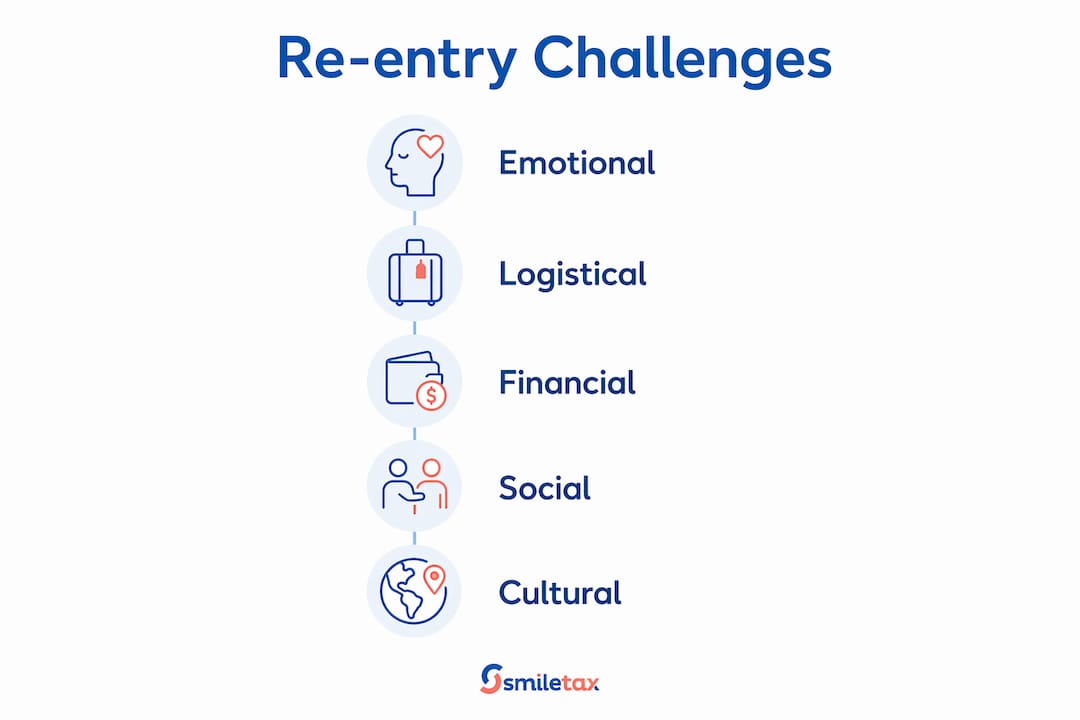
The emotional challenges of returning home do not arrive alone. They come packaged with a set of logistical and financial pressures that compound the stress considerably.
The financial reality of re-entry
Financial and logistical challenges such as security deposits, car costs, and healthcare complexity are significant contributors to re-entry stress. A cash buffer of $9,700 to $19,500 is often needed to cover relocation costs during the re-entry period alone. That figure does not include ongoing living expenses while you rebuild your financial footing.
Financial planning for re-entry should account for upfront costs well beyond normal living expenses. Many returnees underestimate these costs because they mentally compare re-entry to a regular domestic move rather than an international relocation. It is closer to the latter. You can also explore the hidden costs of moving that apply in both directions.
| Practical challenge | Why it hits harder on return |
|---|---|
| Housing deposits and setup costs | Credit history gaps and no recent US rental history complicate applications |
| Transportation | Many returnees sold or gave up vehicles; buying a car requires insurance history |
| Healthcare enrollment | US health insurance systems require active navigation with no grace period |
| Career reintegration | Resume gaps and international experience are often misread by US employers |
| Banking and credit | Accounts may be dormant; credit scores can drop during extended absence |
Work culture and daily pace
Cultural differences in pacing, communication style, and social norms between the US and host countries sharpen the dissonance returnees feel. If you spent years in a culture where lunch was two hours and evenings were genuinely off, the American always-on work culture can feel relentless. The expectation to be perpetually available, to optimize every hour, and to define yourself through productivity is a real cultural norm, not just a stereotype.
Re-entry success relies on redesigning your lifestyle intentionally rather than passively expecting to fit back in. That means setting deliberate boundaries around work hours, protecting time for the habits that kept you well abroad, and resisting the pressure to immediately perform normalcy.
What strategies actually help you cope with reverse culture shock?
Coping with reverse culture shock is not about speeding up the process. It is about moving through it with enough self-awareness to avoid making it worse.
- Set a realistic timeline. Reverse culture shock typically spans three to six months, but long-term expats often need longer. Giving yourself permission to still feel unsettled at month four removes a layer of unnecessary self-criticism.
- Preserve host-country habits. Maintaining routines from abroad eases integration and sustains a global mindset. Keep cooking the food, speaking the language, following the news. These habits are not nostalgia. They are continuity.
- Build a returnee community. Seek out others who have made the same transition. Their understanding is qualitatively different from what well-meaning friends and family can offer.
- Seek professional support when needed. Cognitive Behavioral Therapy (CBT) and Schema Therapy effectively address the distorted negative thinking patterns common in reverse culture shock. EMDR is also useful for processing disorienting or distressing memories tied to the transition. A therapist with cross-cultural experience is the most relevant choice.
- Intentionally close the chapter abroad. Returnees who prepared emotionally for re-entry, including consciously saying goodbye to their life abroad, report smoother transitions. If you left abruptly or under difficult circumstances, finding a ritual to mark the ending helps.
- Redesign your routines from scratch. Do not try to recreate your pre-departure life. Build something new that incorporates who you are now.
Tip: Keep a private journal during the first three months back. Writing down what feels strange, what you miss, and what surprises you creates a record of your adjustment that is genuinely useful to look back on. It also externalizes the emotional noise so it does not loop endlessly in your head.
The return process is a critical identity integration exercise. The goal is not to choose between who you were before and who you became abroad. It is to hold both.
Key takeaways
Reverse culture shock is a normal, well-documented psychological process that affects the majority of returning American expats, and it requires active, intentional effort to move through rather than passive waiting.
| Point | Details |
|---|---|
| Prevalence is high | Over 70% of returning American expats experience reverse culture shock in some form. |
| Four phases frame the process | Honeymoon, crisis, adjustment, and mastery typically span three to six months or more. |
| Social isolation is the sharpest pain | Returnees feel alone even around loved ones; joining returnee communities is the most effective remedy. |
| Financial re-entry costs are real | Budget $9,700 to $19,500 for upfront re-entry costs beyond normal living expenses. |
| Active redesign beats passive waiting | Re-entry success comes from intentionally rebuilding routines, not from expecting to slot back in. |
What I’ve learned about coming home after living abroad
The hardest thing about reverse culture shock is that nobody around you can see it. You look fine. You are home. From the outside, the hard part is over. But the internal experience is genuinely disorienting, and the absence of external validation makes it lonelier.
What we have found through years of conversations with returning expats, is that the people who adjust best are not the ones who try hardest to fit back in. They are the ones who stop trying to be the same person who left. That sounds simple. It is not. There is real grief in letting go of the life you built abroad, even when you chose to leave it.
Patience matters more than any specific strategy. The adjustment is not linear. You will have good weeks followed by weeks where you feel like a stranger in your own city. That is normal. It does not mean you made the wrong choice. It means you are doing the actual work of integration rather than performing it.
The expats who struggle most are often the ones who rush the process, who decide at month two that they should be over it by now. Give yourself the full timeline. Protect the habits that kept you grounded abroad. Find your people. And resist the pressure to compress a genuinely complex experience into a tidy story for people who were not there.
Coming home is its own kind of adventure. It is just one that nobody throws a going-away party for.
SmileTax is here for the practical side of coming home
Returning to the US brings a long list of logistics to sort out, and US tax filing is one of them. If you lived abroad for any length of time, your filing situation is almost certainly more nuanced than standard domestic software handles well. SmileTax works specifically with Americans abroad and returning expats, handling the filing side with accuracy and real human support. Every client works directly with an experienced US tax professional, not a call center or automated system. If you want the financial paperwork handled properly while you focus on settling back in, SmileTax is ready to help. You can also browse the SmileTax resource hub for practical guidance on the full range of expat financial transitions.
FAQ
What is reverse culture shock?
Reverse culture shock is the psychological and emotional disorientation that occurs when someone returns to their home country after living abroad. It results from the mismatch between the person’s changed identity and the expectations of their unchanged home environment.
How long does reverse culture shock last?
Reverse culture shock typically lasts three to six months, though long-term expats often experience adjustment periods that extend well beyond that. The depth of cultural integration abroad is the strongest predictor of how long re-entry takes.
Why do returning expats feel lonely around friends and family?
Returning expats struggle to translate complex, transformative experiences into stories that resonate with people who did not share them. The loss of shared social rituals and “third places” from abroad deepens the sense of disconnection, even when surrounded by loved ones.
What is the most effective way to cope with reverse culture shock?
Joining a returnee community is consistently identified as the most useful single step. Connecting with others who share the transition provides emotional validation that friends and family, despite good intentions, cannot replicate.
Do I need professional help for reverse culture shock?
Professional support is worth considering if emotional symptoms persist beyond six months or significantly affect daily functioning. Cognitive Behavioral Therapy and Schema Therapy are both effective for the negative thought patterns common in reverse culture shock.