

Getting health insurance abroad as an American expat means choosing coverage that works internationally, meets local visa requirements, and fills the gaps that US domestic plans leave wide open. Most Americans moving overseas assume their existing coverage will travel with them. It does not. Medicare offers virtually zero coverage outside the United States, and most employer plans terminate once you establish foreign residency. Providers like Cigna Global, SafetyWing, and BCBS Global Solutions exist precisely because standard American plans were never designed for life abroad. Understanding your real options before you land is the single most important step you can take.
Why US domestic insurance and Medicare don’t cover you abroad
The most dangerous assumption American expats make is that their US health plan will protect them overseas. Most US plans exclude routine care abroad entirely, and many cover only genuine emergencies, often requiring reimbursement rather than direct billing. That means you pay out of pocket first and fight for repayment later.

Medicare is even more limited. Coverage outside the United States is virtually nonexistent except in rare cases near the Canadian and Mexican borders. If you are retired and living in Portugal, Thailand, or Colombia, Medicare provides no meaningful protection.
Employer-sponsored plans vary, but most include a foreign residency clause. Once you establish a permanent address abroad, coverage typically ends. Even plans that technically extend overseas rarely offer direct billing with foreign hospitals, which creates serious cash flow problems during a medical event.
The reimbursement model is the hidden trap. You pay a hospital bill in euros or pesos, submit paperwork to a US insurer, and wait weeks for partial repayment. Dedicated expat health insurance solves this with direct billing overseas, so the insurer pays the provider directly.
Tip: Before canceling your US plan, request a certificate of creditable coverage. Some international insurers, including BCBS Global Solutions, require proof of prior coverage to cover pre-existing conditions without a waiting period.
What are your health insurance options abroad?
American expats have three main categories of coverage to consider: enrollment in a local public health system, local private insurance, and international expat health plans. Each fits different situations, and many expats combine two of them.
Local public health systems
Several popular expat destinations offer public health enrollment to legal residents. Spain’s public system costs around €60 per month for voluntary contributors. Costa Rica’s Caja Costarricense de Seguro Social runs approximately $80–$200 per month depending on income. These systems are affordable and cover a wide range of services, but they come with a significant catch.
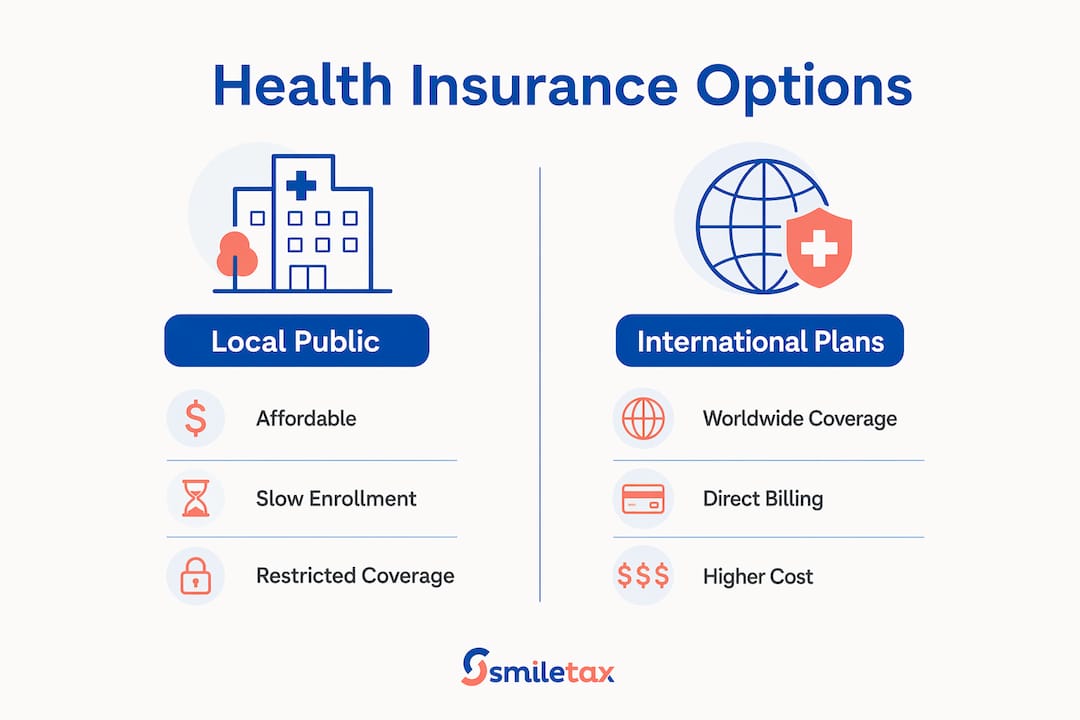
Enrollment in local public health can take months after arrival. During that waiting period, you have no coverage unless you arrange private insurance in advance. Long wait times for specialist appointments are also common in public systems across Spain, Portugal, and Costa Rica, which pushes many expats toward private care for anything beyond basic treatment.
Local private insurance
Local private insurance is purchased directly from an insurer in your destination country. It is often cheaper than international plans and works well if you plan to stay in one country long term. The downside is portability. If you move countries or travel frequently, local private coverage does not follow you.
International expat health plans
International plans from providers like Cigna Global and BCBS Global Solutions offer worldwide coverage, direct billing with hospitals in most countries, and medical evacuation benefits. Domestic plans rarely offer these features. International plans cost more than local options, but they remove the reimbursement hassle and work across borders.
| Plan type | Best for | Portability | Typical cost range |
|---|---|---|---|
| Local public system | Long-term residents in one country | None | Low (€60–$200/month) |
| Local private insurance | Single-country stays, budget-conscious expats | None | Low to moderate |
| International expat plan | Multi-country expats, frequent travelers | Worldwide | Moderate to high |
| Travel medical insurance | Stays under 6 months | Limited | Low |
Visa requirements and health insurance: what proof do you need?
Many countries require proof of private health insurance as a condition of granting a long-stay visa or residence permit. This is not optional paperwork. Missing the right coverage document can result in a denied visa application.
The Schengen Area sets a widely known benchmark. Travelers and long-stay applicants must show coverage of at least €30,000 for medical emergencies and repatriation. Spain’s non-lucrative visa, Portugal’s D7 visa, and similar long-stay permits across Europe all require private health insurance with no co-pays and no coverage gaps.
Digital nomad visas have added a new layer of complexity. Countries including Portugal, Costa Rica, and Germany have introduced these visas in recent years, each with its own insurance requirements. Visa and insurance rules have tightened recently, and requirements shift without much notice.
Key points to check before applying for any long-stay visa:
- Minimum coverage amount (often €30,000 or equivalent)
- Whether the policy must be from an EU-approved or locally recognized insurer
- Whether the policy can include co-pays or deductibles
- Proof format required (certificate, policy document, or letter from insurer)
- Policy start date relative to your visa application date
Tip: Always verify insurance requirements directly with the consulate or embassy for your specific visa type. Consulate requirements change frequently, and third-party summaries are often out of date.
Travel insurance vs. long-term health insurance: which fits your situation?
Travel medical insurance and long-term expat health insurance are not the same product. Confusing them is one of the most common and costly mistakes American expats make.
Travel medical insurance is designed for trips under six months. It covers acute emergencies, trip interruptions, and basic medical events. Plans like SafetyWing’s Nomad Insurance are popular with short-term travelers and digital nomads testing a new country. The premiums are low, but the coverage is limited. Preventive care, chronic condition management, and specialist visits are typically excluded.
Long-term expat health insurance is the right product for anyone establishing residency or staying more than six to twelve months. Here is how the two compare:
- Coverage scope. Long-term plans cover routine checkups, specialist visits, dental add-ons, and chronic condition management. Travel plans cover emergencies only.
- Pre-existing conditions. International plans from Cigna Global or BCBS Global Solutions can cover pre-existing conditions, often requiring consistent prior coverage to qualify. Travel plans almost always exclude them.
- Duration limits. Most travel insurance policies cap out at 6–12 months. Extending them beyond that limit voids key protections and creates gaps.
- Direct billing. Long-term expat plans typically include direct billing networks with hospitals abroad. Travel plans usually require upfront payment and reimbursement.
- Visa compliance. Long-term plans meet visa insurance requirements in most countries. Travel insurance often does not satisfy minimum coverage mandates for residence permits.
Travel insurance suits short stays under six months well. For anything longer, a dedicated expat health plan is the right choice.
How to find and secure health insurance abroad
Getting the right coverage before you move is a six-step process. Skipping steps creates gaps that are expensive and sometimes impossible to fix after arrival.
- Assess your health needs. List any pre-existing conditions, regular medications, and specialist care you use. This determines which plan types will actually cover you.
- Determine your stay length and destination. A one-year teaching contract in South Korea calls for a different plan than a three-month trial run in Mexico. Check whether your destination country has a public system you can join.
- Research visa insurance requirements. Confirm the exact requirements with the consulate for your visa type. Note the minimum coverage amount, approved insurer criteria, and required documentation.
- Compare your options. Run a side-by-side comparison of local private plans, public system enrollment costs, and international plans from providers like Cigna Global or BCBS Global Solutions. Use a broker who specializes in expat insurance to get accurate quotes.
- Purchase before departure. Buying insurance before arrival avoids waiting periods and prevents denied claims on pre-existing conditions. Do not wait until you land.
- Understand your claims process. Confirm whether your plan uses direct billing or reimbursement. Know your evacuation coverage limits, exclusions, and how to reach your insurer from abroad.
| Step | Action | Why it matters |
|---|---|---|
| Assess health needs | List conditions and medications | Determines which plans will actually cover you |
| Research visa rules | Check consulate requirements | Avoids visa denial for wrong coverage type |
| Compare plan types | Get quotes from local and international options | Finds the right balance of cost and coverage |
| Buy before departure | Purchase policy before leaving the US | Prevents waiting periods and coverage gaps |
| Review claims process | Confirm direct billing or reimbursement | Avoids surprise out-of-pocket costs abroad |
Tip: Use a broker who specializes in expat insurance, such as those listed on Expatriate Healthcare or Pacific Cross. They know which plans satisfy visa requirements in specific countries and can confirm pre-existing condition coverage in writing before you commit.
Key takeaways
Securing proper health insurance abroad requires acting before departure, not after, because waiting periods and visa requirements leave no room for last-minute decisions.
| Point | Details |
|---|---|
| US plans don’t travel | Medicare and most employer plans provide no meaningful coverage abroad. |
| Buy before you leave | Purchasing coverage before departure avoids waiting periods and pre-existing condition exclusions. |
| Visa compliance is mandatory | Many long-stay visas require specific minimum coverage amounts and approved insurer types. |
| Match plan to stay length | Travel insurance fits stays under 6 months; long-term expat plans are required for residency. |
| Verify consulate rules directly | Insurance requirements change frequently and must be confirmed with the issuing consulate. |
What I’ve learned watching expats get this wrong
The pattern repeats itself more than it should. An American moves abroad, assumes their Blue Cross plan or Medicare will cover them, and discovers the gap only when they need care. By then, they are either uninsured, paying out of pocket, or scrambling to find a plan that will accept them with a pre-existing condition already active.
The most overlooked issue is timing. Purchasing insurance after arrival sounds logical, but it creates real problems. Many plans impose waiting periods of 30–180 days before covering pre-existing conditions. Some insurers require proof of prior continuous coverage to waive those waiting periods entirely. If you cancel your US plan before securing international coverage, you may lose that continuity and face exclusions that last years.
The good news is that the options are genuinely solid. Countries with strong expat healthcare systems often have affordable local private plans that satisfy visa requirements and provide excellent care. International plans from established providers give you flexibility if you move between countries. The market for expat health insurance has matured significantly, and there is a plan that fits almost every budget and situation.
The only real mistake is waiting too long to sort it out.
SmileTax supports American expats living abroad
Living abroad comes with a long list of practical decisions, and health insurance is one of the most consequential. SmileTax is built specifically for Americans overseas, and the SmileTax resource library covers the practical side of expat life in depth. If you are weighing destinations based on healthcare quality, the guide to countries with the best healthcare for American expats is a strong starting point. For a broader picture of what overseas life actually costs, the hidden costs of moving abroad is worth reading before you finalize any budget. Americans with US tax filing obligations while living overseas can find dedicated support at SmileTax.
FAQ
Does Medicare cover me if I live abroad?
Medicare provides virtually no coverage outside the United States. Exceptions exist only in limited situations near the Canadian and Mexican borders.
Do I need health insurance to get a long-stay visa?
Most long-stay and digital nomad visas require proof of private health insurance. The Schengen Area mandates a minimum of €30,000 in coverage for medical emergencies and repatriation.
What is the difference between travel insurance and expat health insurance?
Travel insurance covers short-term emergencies for stays under six months. Expat health insurance covers routine care, chronic conditions, and specialist visits for long-term residents.
When should I buy health insurance before moving abroad?
Purchase coverage before you leave the United States. Buying after arrival risks waiting periods and exclusions on pre-existing conditions that can last months or longer.
Can expat health insurance cover pre-existing conditions?
Many international plans cover pre-existing conditions, but insurers often require documented proof of continuous prior coverage. Canceling your US plan before securing international coverage can trigger exclusions.