

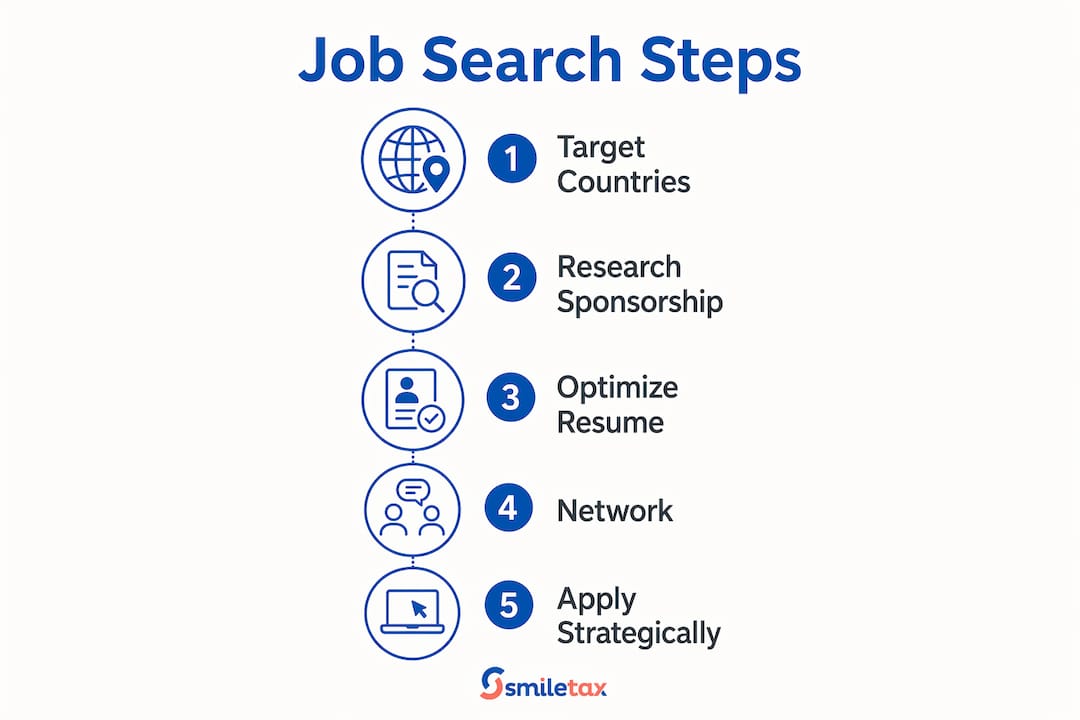
Finding a job abroad as an American is a deliberate process built on three pillars: targeting the right countries, understanding visa sponsorship, and using the right search tools. Random applications to dozens of countries rarely produce results. The Americans who succeed focus on 2–3 markets, identify industries with genuine demand for their skills, and approach the job application process overseas with the same preparation they would bring to any serious career move. This guide covers every step, from choosing your target market to tailoring your resume for a German recruiter.
How to choose the right countries for your skills
The single most common mistake in finding international employment is applying to too many countries at once. Spreading applications thin across multiple markets limits your ability to master local CV norms, visa frameworks, and recruitment seasons. Narrowing to 2–3 countries makes you a sharper, more credible candidate in each one.
Start with a data-first approach. Each country publishes official skills shortage lists that tell you exactly which professions face local shortages. Skills shortage lists in Canada, Australia, and EU countries consistently flag tech, healthcare, and engineering roles. If your profession appears on one of these lists, you face fewer visa hurdles and faster processing times.
Match your shortlist to realistic sponsorship odds. Consider the salary-to-cost-of-living ratio in each country, and research whether employers in your sector routinely sponsor foreign workers. The industries most likely to sponsor American workers include:
- Technology: Software engineering, cybersecurity, and data science roles in Germany, Canada, and Singapore
- Healthcare: Nursing and allied health professions in Australia, the UK, and the Gulf states
- Education: International school teaching across Asia, the Middle East, and Latin America
- Engineering: Civil, mechanical, and petroleum engineering in the UAE, Australia, and Norway
What are the most effective international job search strategies?
LinkedIn is the most powerful tool for an American expat job search, but most people use it incorrectly. Set your location to your target city, not your current US address. Search using keywords like “visa sponsorship” alongside your job title. Companies with international teams on LinkedIn are measurably more open to sponsoring foreign hires. Look at the “People” tab on a company’s LinkedIn page to see how many nationalities already work there.

LinkedIn alone is not enough. Local job boards consistently outperform global platforms for country-specific roles. Use Seek for Australia, StepStone for Germany, and Bayt for the Gulf region alongside your LinkedIn searches. Set up daily email alerts on each platform so new sponsor-friendly postings reach you immediately.
Networking closes more international offers than cold applications. Connect directly with recruiters who specialize in your target country. Message current employees at companies you admire and ask about their hiring process. A brief, specific message asking about their experience relocating for the role gets far more responses than a generic connection request.
Tip: Search LinkedIn for “[job title] + visa sponsorship + [city]” and filter by “Past month” to find active openings at companies already comfortable with international hires.
Employer of Record (EOR) services are an underused route worth knowing. Deel processed over 500,000 international contracts in 2025, handling visa sponsorship and payroll for companies that want to hire internationally without setting up a local legal entity. If a company you love has no overseas office, ask whether they use an EOR.
How does visa sponsorship actually work for Americans?
Visa sponsorship is the biggest bottleneck in the overseas job search for Americans. Most countries require a formal job offer before they will issue a work permit. The offer triggers the sponsorship process, and the employer files paperwork with the relevant immigration authority on your behalf.
Typical timelines run from 4–16 weeks for visa processing, with the full arc from first application to landing in your new country taking 6–12 months. Working holiday visas process fastest. EU Blue Cards and employer-sponsored permits take longer. Build this timeline into your planning so you are not caught off guard.
The four main visa categories for Americans working overseas are:
- Sponsored employment visa: Employer files on your behalf after a job offer. The most common route for professional roles.
- Working holiday visa: Available to Americans under 30 or 35 in countries like Australia, New Zealand, Japan, and Canada. Provides 12–24 months of casual work rights.
- Digital nomad or remote work visa: Available in over 60 countries, including Portugal, Spain, Germany, and Thailand. Requires proof of remote income from a non-local employer.
- Self-employment or freelance visa: Available in select countries for independent contractors and business owners.
To identify companies that can legally sponsor you, use official government databases. Licensed sponsor registers exist in the UK, Australia, and other major destinations. Cross-referencing these lists with your job search saves significant time and avoids applying to employers who lack sponsorship authorization.
Applying to a company that cannot legally sponsor foreign workers is the most common and most avoidable mistake in the international job search. Always verify sponsorship capability before investing time in an application.
What are the accessible entry paths for Americans starting out?
Not every American moving abroad has a specialized skill set that commands immediate visa sponsorship. Three entry paths work well for those who need a foothold first.
Teaching English abroad is the most accessible route for Americans with a bachelor’s degree. A TEFL (Teaching English as a Foreign Language) certification, which takes 4–12 weeks to complete online or in person, qualifies you for positions across Asia, Latin America, the Middle East, and Europe. Many international schools and language centers provide visa sponsorship as part of the employment package. The hidden costs of moving abroad are worth researching before you commit, since relocation expenses vary widely by country.
Remote work for a US employer combined with a digital nomad visa is currently the fastest route to living abroad legally. You keep your existing job and income while relocating to a country that welcomes remote workers. Over 60 countries now offer this visa category, making it a realistic option for anyone whose employer allows remote work.
Working holiday programs give Americans under 30 or 35 the right to live and work casually for 12–24 months in popular destinations including Australia, New Zealand, Japan, and Canada. These programs require no upfront career specialization and no employer sponsorship. They are an excellent way to test a country before committing to a full sponsored role.
These entry paths are not dead ends. Many Americans use a teaching contract or working holiday year to build local connections, learn the job market from the inside, and transition into a sponsored professional role within 1–2 years.
How should you tailor your application for international employers?
International employers judge your application in about 7 seconds of initial scanning. Recruiters spend roughly 7 seconds on a first pass, which means your format and headline must communicate fit immediately. A US-style resume submitted to a German employer signals a lack of local knowledge before the recruiter reads a single word.
Research the CV format standard for each target country before you apply. German CVs typically include a professional photo and detailed personal information. Australian resumes favor a clean two-page format with a strong summary. UK CVs omit photos entirely. Matching the local format signals professionalism and increases recruiter engagement.
Key adjustments to make for every international application:
- Headline and summary: State your relocation readiness and visa status clearly. “Open to relocation, eligible for sponsored work visa” removes ambiguity immediately.
- Cover letter: Address visa sponsorship directly and briefly. One sentence explaining that you understand the sponsorship process and are prepared to support it goes a long way.
- Credential recognition: If your qualifications require local recognition (common in healthcare and education), note that you have begun or completed the process.
- Language skills: Even basic proficiency in the local language signals commitment. List it honestly.
Tip: Use LinkedIn’s “Open to Work” feature with your target city selected. Recruiters in that market actively search this filter, and it costs nothing to turn on.
Key Takeaways
Focused, country-specific targeting combined with verified sponsorship research is the most reliable method for Americans to secure employment abroad.
| Point | Details |
|---|---|
| Target 2–3 countries | Narrowing your focus improves mastery of local job markets and visa rules. |
| Verify sponsorship capability | Use official sponsor registers to confirm employers can legally hire you before applying. |
| Use local job boards | Pair LinkedIn with country-specific platforms like Seek, StepStone, or Bayt for better results. |
| Plan for a 6–12 month timeline | Visa processing alone takes 4–16 weeks; build the full arc into your schedule. |
| Entry paths exist | Teaching English, remote work visas, and working holiday programs offer accessible starting points. |
What I’ve learned from watching Americans land jobs overseas
The Americans who succeed abroad are almost never the ones who apply to the most jobs. They are the ones who pick a market, learn it deeply, and show up as credible local candidates rather than hopeful outsiders. That distinction matters more than most people expect.
Networking is the hidden variable that most guides underplay. A connection inside a company does not just help you get an interview. It tells you whether the company actually sponsors visas, what the hiring manager values, and whether the role is genuinely open or already filled internally. That intelligence is worth more than fifty cold applications.
Patience is the hardest part. A 6–12 month timeline from first application to arrival feels long when you are eager to go. But rushing leads to poor country choices, weak applications, and avoidable visa mistakes. The Americans who treat this as a proper project, with research, a shortlist, and a realistic schedule, are the ones who actually get on the plane.
Finally, do not dismiss the entry-level paths. A year teaching English in South Korea or working on a New Zealand working holiday is not a detour. For many people, it is the most direct route to a long-term international career, because it puts you inside the market where the real opportunities are.
Working abroad comes with more than just a new job
Securing a role overseas is a major milestone. Once you land that offer, a new set of practical questions follows, and one of the most important involves your US tax obligations. Americans living and working abroad are still required to file US tax returns, regardless of where their income is earned.
SmileTax works specifically with Americans overseas, including teachers, NGO professionals, and locally hired workers, who need their US taxes handled accurately and without the complexity of large accounting firms. If you are preparing to make the move, US tax filing abroad is worth understanding early. Visit SmileTax to learn how the process works for Americans in your situation.
FAQ
How long does it take to find a job abroad as an American?
The full process from first application to arriving in your new country typically takes 6–12 months. Visa processing alone runs 4–16 weeks depending on the country and visa type.
Which industries sponsor visas for American workers most often?
Technology, healthcare, engineering, and international education are the sectors most likely to sponsor foreign workers. These professions also appear most frequently on official skills shortage lists in Canada, Australia, and EU countries.
Do I need a job offer before applying for a work visa?
For most sponsored employment visas, yes. The employer files the visa application on your behalf after extending a formal offer. Digital nomad visas and working holiday programs are exceptions that do not require a local job offer.
What is an Employer of Record and how does it help?
An Employer of Record (EOR) is a third-party company that employs you on behalf of a business that lacks a local legal entity. This allows international companies to hire Americans abroad without setting up a foreign office, and it handles visa sponsorship and payroll in the process.
Is teaching English a realistic path to working abroad?
Teaching English is one of the most accessible routes for Americans with a bachelor’s degree. A TEFL certification qualifies you for positions across Asia, the Middle East, Latin America, and Europe, and many employers include visa sponsorship as part of the package.