

Yes, you can get dual citizenship as an American through ancestry, and you do not have to renounce your U.S. passport to do it. The U.S. permits dual nationality and does not require citizens to choose between their U.S. citizenship and a foreign nationality acquired by descent. Many Americans are eligible through Irish, Italian, Polish, German, Hungarian, Greek, or Portuguese ancestry, and for many, it is the most affordable legal route to living, working, or retiring in Europe.
Your first move is simple: identify the qualifying ancestor, confirm their birthplace and key dates, and check whether they naturalized as a U.S. citizen before or after the next generation was born. That single date is often the difference between a clean claim and a broken chain.
Start by requesting these three documents:
- Your own long-form birth certificate (not the short abstract)
- Your ancestor’s birth record from their country of origin
- A U.S. naturalization certificate or a USCIS no-record letter confirming they never naturalized
Key Takeaways
Citizenship by descent is a realistic, affordable route to a second passport for millions of Americans, but eligibility hinges on an unbroken document chain and the specific generational rules of your target country.
| Point | Details |
|---|---|
| U.S. allows dual nationality | The U.S. does not require renunciation; you must enter and leave the U.S. on your U.S. passport. |
| Naturalization date is critical | If your ancestor naturalized before the next generation was born, the citizenship chain may be broken. |
| Italy tightened rules in 2025 | Italy now generally limits claims to one generation back; great-grandparent routes are largely closed for new filings. |
| Ireland and Poland remain accessible | Ireland accepts grandparent-level claims via the Foreign Births Register; Poland often confirms existing citizenship. |
| SmileTax supports Americans abroad | SmileTax provides country guides and personal support for U.S. citizens planning to live or work overseas. |
Table of Contents
- What does U.S. policy actually say about dual nationality?
- How to check whether you likely qualify by descent
- What documents do you need, and how do you get them legalized?
- Country-by-country eligibility: Ireland, Italy, Poland, and more
- How to apply: consulate route vs. filing in-country
- Common problems and how to fix them
- When does hiring a lawyer or genealogist make sense?
- Planning to live abroad after you get your second passport?
- Sources
What does U.S. policy actually say about dual nationality?
The State Department’s position is clear: the U.S. recognizes dual nationality but does not actively encourage it, because holding two nationalities can create conflicting legal obligations. There is no U.S. law that forces you to give up your passport when you acquire a second citizenship by descent.
That said, a few practical rules apply to every American with dual nationality:
- You must enter and leave the United States on your U.S. passport, always.
- When you are physically inside your other country of nationality, the U.S. may have limited ability to assist you. The Foreign Affairs Manual states that the other country may assert predominant jurisdiction over you while you are there.
- Both countries’ laws apply to you simultaneously, including military service obligations, jury duty, and local tax residency rules.
Before you travel on a second passport, check the entry requirements of both countries. Some nations require their own citizens to enter on a national passport, which can create complications at border control.
How to check whether you likely qualify by descent
Run through this sequence before spending a cent on documents or legal fees:
- Identify the ancestor. Write down their full name, birth country, approximate birth year, and the year they arrived in the U.S.
- Find the naturalization date. Did they naturalize before or after your parent (or you) were born? If they naturalized first, citizenship transmission may have been interrupted.
- Check the generational limit for your target country. Ireland accepts some grandparent-level claims; Italy now generally limits claims to one generation back (parent); Poland, Germany, Hungary, Greece, and Portugal each have their own rules.
- Confirm no voluntary renunciation occurred. An ancestor who formally renounced their original citizenship may have broken the chain regardless of naturalization timing.
- Check whether a parent registered your birth abroad. Some countries require registration within a set period after birth; missing that window can affect your claim.
💡 Tip: A single day on a naturalization certificate can make or break your eligibility. If you are unsure whether your ancestor naturalized, request a no-record search from USCIS before assuming the chain is intact. A no-record letter is often just as valuable as the certificate itself.
What documents do you need, and how do you get them legalized?
An unbroken chain of long-form vital records is the foundation of every ancestry citizenship application. Consulates are not flexible on this point.
Core documents for every person in the line (you, your parent, your grandparent):
- Long-form birth certificates (not abstracts or short-form versions)
- Marriage certificates for every name change in the line
- Death certificates where applicable
- Passports or travel documents if available
For the qualifying ancestor specifically:
- U.S. naturalization certificate (Form N-550/N-570) or a USCIS no-record letter
- Original foreign birth record from the ancestral country’s civil registry
Legalization steps:
- Obtain the original or certified copy from the issuing authority (vital records office, NARA, or USCIS).
- Attach an apostille from the Secretary of State of the issuing U.S. state (the Hague Apostille Convention covers most of the countries in this guide).
- Have every foreign-language document translated by a sworn or certified translator recognized by the target country’s consulate.
- Some countries require newly issued documents, not old copies. Italy, for example, typically requires birth certificates issued within the last six months.
NARA (the National Archives) holds many pre-1956 naturalization records. For records held by USCIS, submit a genealogy records request directly through their portal.
Country-by-country eligibility: Ireland, Italy, Poland, and more
Ancestry routes vary sharply by country, both in how many generations back you can claim and in what documents each consulate prioritizes. Here is a practical summary of the seven most popular options for Americans.
Italy’s 2025 rule change is the most significant recent development. Italy tightened its descent rules in 2025, introducing a two-generation cap and additional conditions. Americans who could previously claim through a great-grandparent now generally cannot, unless their case was filed and grandfathered before the cutoff. If you have Italian ancestry beyond a grandparent, consult an Italian immigration attorney before assuming you qualify.
Poland’s confirmation model is distinct from the others. Poland often treats this as confirming citizenship you already hold rather than granting something new, which means archival research into historical Polish law is central to the process.
How to apply: consulate route vs. filing in-country
Most Americans apply through the consulate in their U.S. jurisdiction. The alternative, filing in-country at the ancestral municipality or civil registry, is sometimes faster but requires travel and local language ability.
Typical consulate application steps:
- Assemble the full document dossier (all vital records, apostilles, translations).
- Book a consular appointment. Italy uses the prenot@mi online system, which has multi-year waitlists in some U.S. cities.
- Submit originals and certified copies at the appointment.
- Respond to any requests for additional documents.
- Receive the citizenship decree or registration confirmation, then apply for the foreign passport.
Processing times vary widely. Ireland’s Foreign Births Register currently runs around 12 months. Italian consulate queues in major U.S. cities can be very long, sometimes lasting multiple years. Poland and Portugal tend to move faster when the document chain is clean.
💡 Tip: If the Italian consulate in your jurisdiction has a multi-year backlog, you may be able to book an appointment at a different consulate in another U.S. city or apply directly at an Italian comune. Confirm current rules with the consulate before booking travel.
Common problems and how to fix them
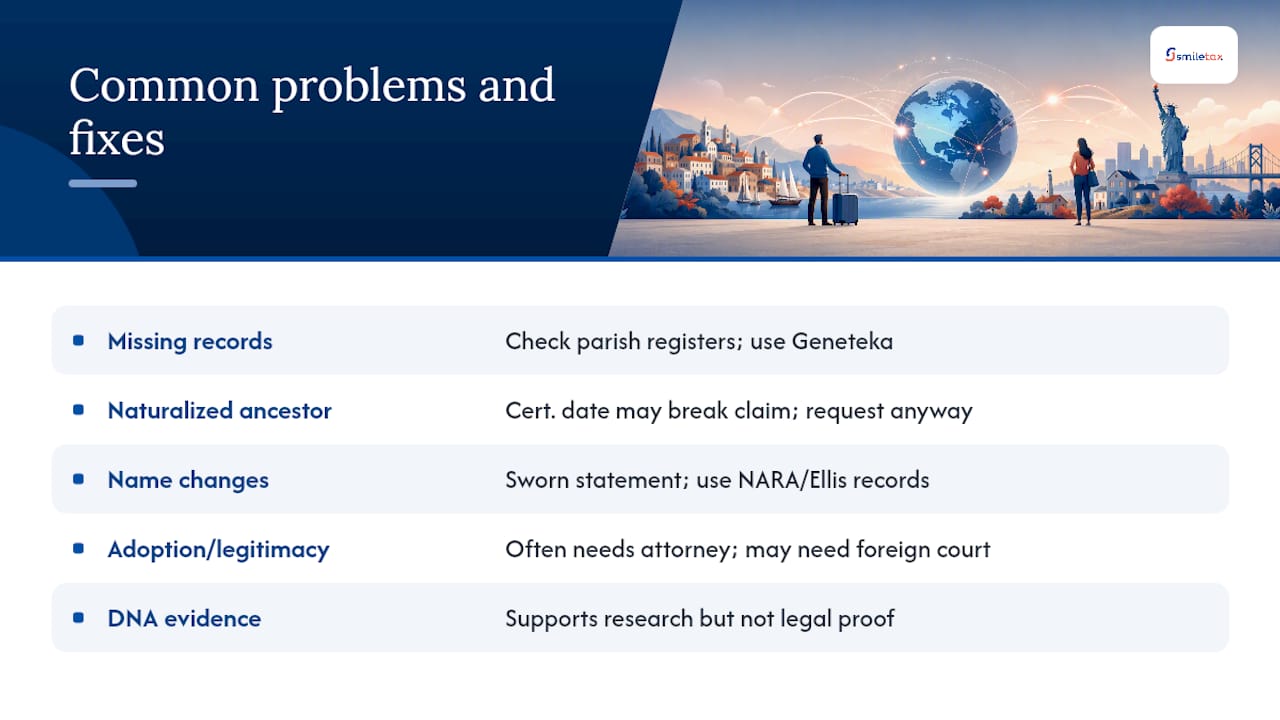
Missing or destroyed foreign records. Civil registries in rural Poland, southern Italy, and parts of Greece suffered significant losses during the 20th century. Church records (parish baptism and marriage registers) often survive where civil records do not. Contact the local parish directly or use genealogical databases like Geneteka for Polish records.
Ancestor naturalized before a child’s birth. This is the most common disqualifier. If the naturalization certificate shows a date before your parent’s birth, the chain is likely broken for most countries. Request the certificate anyway; sometimes the date on file is incorrect, and a correction can be pursued.
Name changes and spelling variations. Immigrant ancestors frequently had their names anglicized at entry. A sworn statement linking the two name forms, supported by immigration records from NARA or Ellis Island records, usually satisfies consulates.
Adoption and legitimacy questions. Some countries, particularly Italy for claims predating 1948, apply different rules to children born outside of marriage. These cases often require a specialist attorney and sometimes a court declaration in the ancestral country.
DNA evidence. Genetic testing can support genealogical research but is not accepted as legal proof of nationality by any of the seven countries in this guide. Consulates require civil records, not DNA results.
When does hiring a lawyer or genealogist make sense?
For a straightforward two-generation claim with intact records, many applicants handle the process themselves. Professional help becomes cost-justified in these situations:
- The chain involves more than two generations (especially for Italy pre-2025 grandfathering cases)
- Records are missing, destroyed, or held in foreign archives
- The ancestor’s naturalization status is unclear
- The claim involves a 1948 rule or sex-discrimination exception (Italy)
- You need a court declaration in the ancestral country
When evaluating a lawyer or genealogist, ask:
- How many successful cases have you completed for this specific country?
- What is your fee structure: flat fee or hourly?
- Will you provide copies of every document you obtain, with archive citations?
- What is a realistic timeline for my specific case?
- What happens if a record is unavailable?
Red flags include guarantees of success, vague timelines, and refusal to provide itemized document lists. Reputable genealogists provide full citations to every archive they access and deliver translated summaries alongside original copies.
Planning to live abroad after you get your second passport?
Securing dual citizenship opens the door to living, working, or retiring in Europe without a visa. Once you are ready to make the move, SmileTax resources offer practical country guides for Americans abroad, covering everything from healthcare and housing to the ongoing responsibilities that come with living overseas. For Americans working internationally, including international school teachers and NGO professionals, SmileTax provides direct, personal support from experienced U.S. tax professionals. Visit SmileTax to explore guides and services built specifically for Americans living abroad.
Sources
Use these official sources as your starting point for forms, current fees, and country-specific rules:
- Dual Nationality
- Citizenship and naturalization – USCIS
- Foreign Affairs Manual: dual nationality and consular protection
- How Americans can get dual citizenship to live, work, or retire abroad – CN Traveler
Always confirm current rules directly with the relevant consulate or civil registry. Eligibility rules, fees, and processing times change, and the consulate’s official guidance takes precedence over any third-party summary, including this one.
This article is general information, not a substitute for advice from a qualified lawyer. Consult a qualified legal professional about your own circumstances before acting on anything here.