
Learning a new language before moving abroad means building enough functional ability to handle daily life with confidence, not achieving perfect fluency. The goal is survival phrases, basic conversation, and the ability to get things done. According to CEFR standards, reaching a functional beginner level (A2) takes 150–200 study hours for European languages and 300–400 hours for Asian languages like Mandarin. That is achievable before your move if you start early and study consistently. This guide covers realistic timelines, the best study methods, and exactly which phrases to prioritize first.
How long does it realistically take to learn a language before moving abroad?
The honest answer depends on two things: the language you are learning and how much time you put in each day. Reaching A2 level takes 150–200 study hours for European languages like Spanish, French, or German. For Asian languages like Mandarin, Japanese, or Korean, expect 300–400 hours to reach the same point. That gap exists because those languages use different writing systems and sentence structures that take longer for English speakers to process.

A2 is the level where you can introduce yourself, ask for directions, order food, and handle basic transactions. That is exactly what you need for your first weeks abroad. Full professional fluency (C1 or C2) takes years. You do not need that before you move.
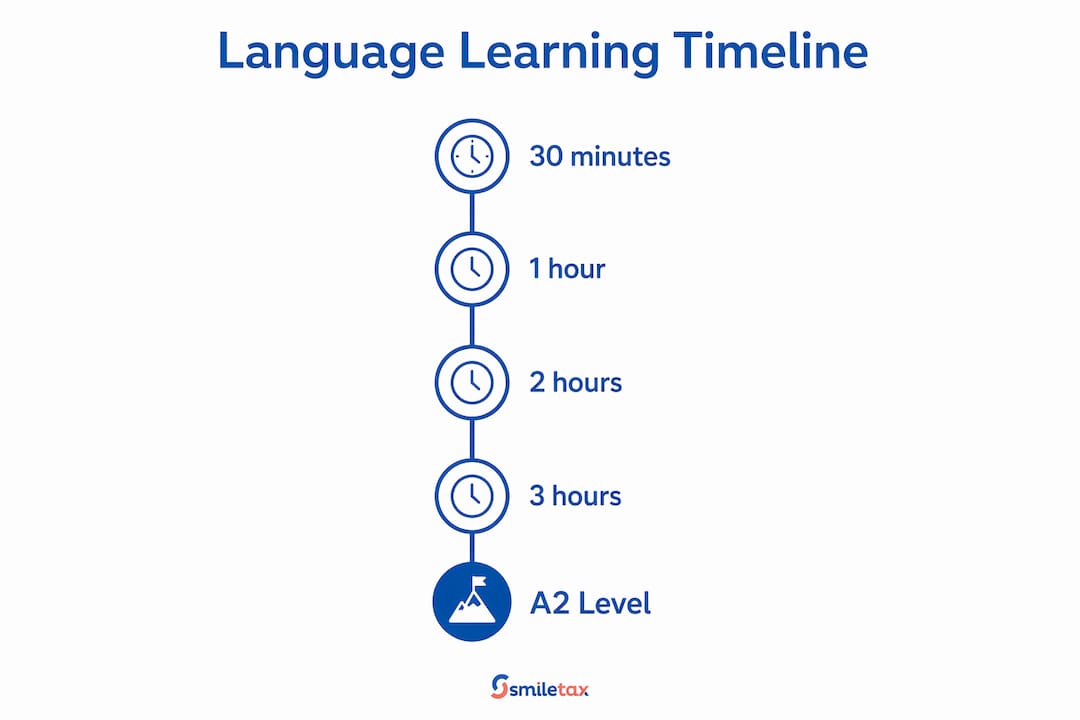
The table below shows realistic timelines based on daily study time.
| Daily study time | Hours per month | Months to A2 (European) | Months to A2 (Asian) |
|---|---|---|---|
| 30 minutes | 15 | 10–13 months | 20–27 months |
| 1 hour | 30 | 5–7 months | 10–13 months |
| 2 hours | 60 | 3–4 months | 5–7 months |
Consistency beats intensity. Thirty minutes every day produces better results than a three-hour session once a week. The brain needs repeated exposure to lock in new patterns. Spacing your practice across the week gives your memory time to consolidate what you have learned.
Tip: Set a fixed daily study window, even 20 minutes, and treat it like a meeting you cannot cancel. Habit formation matters more than session length.
What are the best methods to learn a language before your move?
No single method works for everyone, but the research is clear on one point: apps alone rarely develop speaking fluency. Apps are excellent for vocabulary reinforcement and building a daily habit, but they do not replicate real conversation. You need a mix of tools to cover all four skills: reading, writing, listening, and speaking.
Apps: good for vocabulary, limited for speaking
Apps like Duolingo, Babbel, and Anki are best used for vocabulary drilling and spaced repetition. Anki, in particular, uses a proven flashcard algorithm that surfaces words just before you forget them. That makes it one of the most efficient tools for building a core vocabulary. The weakness of apps is that they rarely put you under the pressure of a real conversation, which is where actual fluency develops.
Tutors and language exchange partners
A tutor gives you speaking practice with real-time feedback. Even one session per week makes a measurable difference in pronunciation and confidence. Online platforms connect you with native speakers for affordable one-on-one sessions. Language exchange partners, where you teach someone English in exchange for practice in your target language, cost nothing and add a social element that keeps motivation high.
Structured classes and immersion
Group classes work well for grammar structure and accountability. They also give you a peer group, which helps with motivation. Immersion, meaning surrounding yourself with the language through media, music, and podcasts, supports progress but immersion alone is insufficient for beginners. You need what researchers call “comprehensible input,” content that is slightly above your current level but still understandable. Graded readers, slowed podcasts, and children’s TV shows fit that description far better than native-level news programs.
The most effective pre-move approach combines three elements:
- Daily app use for vocabulary and spaced repetition (15–20 minutes)
- Weekly tutor sessions for speaking practice and pronunciation correction
- Passive immersion through graded podcasts or simplified video content during commutes or downtime
Which phrases and skills should you prioritize first?
Focus on the 1,000 most common words in your target language. Mastering those words gives you comprehension of roughly 80% of everyday conversation. That is a powerful return on a focused investment. You do not need to know every word. You need to know the right ones.
Within that vocabulary foundation, survival phrases come first. Aim to learn 50–100 core phrases within your first month of study. These are the phrases that handle the situations you will face every single day.
Survival phrases to prioritize:
- Greetings and polite expressions (hello, thank you, excuse me, sorry)
- Asking for directions and understanding basic responses
- Ordering food and asking about ingredients or allergies
- Numbers, prices, and basic shopping transactions
- Medical phrases (I need a doctor, I am allergic to, where is the pharmacy)
- Transportation phrases (where is the bus stop, one ticket to, does this stop at)
- Emergency phrases (I need help, call the police, I am lost)
Grammar comes later. Prioritize practical language chunks for communication over complex grammar rules early on. A phrase like “Where is the nearest pharmacy?” works perfectly even if you cannot explain why the sentence is structured that way. Functional communication is the goal, not grammatical perfection.
Spaced repetition is the most effective technique for locking in vocabulary. The method works by reviewing a word at increasing intervals, so you see it just as you are about to forget it. Anki and similar tools automate this process. Used consistently, spaced repetition can dramatically reduce the time it takes to move new words into long-term memory.
Tip: Learn your survival phrases in full sentences, not isolated words. “Where is the nearest pharmacy?” is more useful than memorizing “pharmacy” alone, because the full phrase is ready to use immediately.
Listening and speaking skills deserve more attention than reading and writing in the early stages. You will use spoken language every day from the moment you land. Reading and writing matter too, but they can develop more gradually once you are in the country.
How do you stay motivated and push through the hard parts?
Language learning has a predictable difficulty curve. Progress feels fast at first, then slows dramatically around the three-month mark. Language anxiety and plateaus typically peak around the third month after moving. The fix is not to study harder. It is to study differently. Switching from grammar drills to conversation practice, or from an app to a podcast, can break the plateau and reignite progress.
Adults bring real advantages to language learning. Success depends more on sustained exposure and memory capacity than raw intelligence. Adults have larger vocabularies in their native language to draw connections from, stronger study habits, and clearer motivation. The challenge is anxiety, specifically the fear of making mistakes in front of native speakers.
The most practical solution is to start speaking early, even badly. Waiting until you “feel ready” is a trap. Locals often switch to English at the first sign of struggle, which removes your practice opportunity entirely. Finding one conversation partner who commits to speaking only the target language with you is one of the highest-value steps you can take.
Here is a four-step approach to staying on track:
- Set a specific goal for each month. “Learn 50 survival phrases” is better than “get better at Spanish.” Specific goals are measurable and give you a clear win to celebrate.
- Mix your methods every few weeks. Rotating between apps, tutors, and media prevents burnout and ensures you are developing all four language skills.
- Track your hours. Knowing you have put in 80 hours toward your A2 goal makes the remaining 70–120 feel concrete and achievable, not abstract.
- Plan your in-country transition. Pre-move study builds the foundation. Once you arrive, speaking practice abroad accelerates everything. Plan to find a local language partner within your first two weeks.
Key Takeaways
The most effective way to learn a language before moving abroad is to combine daily vocabulary practice, weekly speaking sessions, and graded listening content, starting at least six months before your move date.
| Point | Details |
|---|---|
| Set a realistic fluency target | Aim for A2 functional level, not full fluency, before your move. |
| Study hours matter | European languages need 150–200 hours to reach A2; Asian languages need 300–400 hours. |
| Prioritize survival phrases | Learn 50–100 core phrases in your first month to handle daily transactions. |
| Mix your methods | Combine apps for vocabulary, tutors for speaking, and graded media for listening. |
| Speak early and often | Finding one conversation partner who won’t switch to English accelerates fluency faster than any app. |
What I have learned about language learning the hard way
The biggest mistake pre-move language learners make is treating it like an academic subject. You are not studying for a test. You are building a practical tool for daily survival. That shift in mindset changes everything about how you study.
Most people spend the first two months almost entirely on apps. Apps feel productive because they give you points and streaks. But speaking practice drives acquisition far more than passive exposure. The uncomfortable truth is that you need to have awkward, stumbling conversations with real people as early as possible. The embarrassment fades quickly. The progress does not.
The other thing worth saying plainly: you do not need to be fluent before you move. You need to be functional. There is a real difference. Functional means you can buy groceries, ask for help, and understand enough of what people say to get through the day. Fluency comes later, with time and immersion. Chasing fluency before your move leads to paralysis and discouragement.
Find a language partner who will not let you default to English. That single relationship, more than any app or textbook, will determine how fast you progress once you arrive. Expats who work at international schools or live in expat communities often find that colleagues and neighbors are the best language practice partners available.
Moving abroad involves more than language prep
Language learning is one piece of a much larger relocation picture. Americans moving abroad also face questions about healthcare, housing, banking, and yes, their US tax obligations. SmileTax works specifically with Americans living and working overseas, including international teachers, NGO professionals, and long-term expats. If you are heading abroad and want your US filing handled by a real person who understands expat life, SmileTax is worth a look. Visit smile.tax to learn more about how SmileTax supports Americans through every stage of life overseas, including those in education with specific filing needs.
FAQ
How long does it take to learn basic survival phrases?
Most learners can master 50–100 survival phrases within the first month of focused daily study. These phrases cover greetings, directions, food ordering, and basic transactions.
Are language learning apps enough to prepare for moving abroad?
Apps are effective for vocabulary building and daily habit formation, but they are not sufficient on their own for speaking fluency. Pairing apps with regular tutor sessions or conversation practice produces much better results.
What is the CEFR A2 level and why does it matter for expats?
A2 is the functional beginner level on the Common European Framework of Reference for Languages. At A2, you can handle basic daily interactions like shopping, asking directions, and introducing yourself, which covers most survival needs in a new country.
Which languages take the longest to learn for English speakers?
Asian languages like Mandarin, Japanese, and Korean require roughly 300–400 study hours to reach A2, compared to 150–200 hours for European languages like Spanish, French, or Italian. The difference comes down to writing systems and sentence structure.
How do you overcome the fear of speaking a new language?
Start speaking as early as possible, even imperfectly. Finding one dedicated conversation partner who commits to using only the target language removes the pressure of performing in front of strangers and builds confidence faster than any other method.