

Opening a bank account abroad as an American is entirely possible, but it requires specific documents, the right bank choice, and an understanding of why some foreign institutions hesitate with US citizens. Whether you are relocating for work, teaching at an international school, or settling into retirement overseas, having a local bank account is not optional. Local accounts are essential for daily life abroad since landlords and employers frequently require local IBANs or bank transfers for rent and payroll. This guide covers the documents you need, the best banking options for Americans abroad, and practical steps to get your account open without unnecessary delays.
What documents do Americans need to open a bank account abroad?
Americans opening a local bank account abroad must typically provide a valid US passport, proof of local residency, a local tax identification number, and proof of income. That is the baseline. The exact combination varies by country, but these four categories cover the vast majority of situations worldwide.
Core documents you will need
- Valid US passport. This is your primary identity document in every country. Some banks also accept a national ID, but your passport is always accepted.
- Proof of local residency. A signed lease agreement, a recent utility bill, or an official letter from your employer confirming your local address. A hotel booking or Airbnb confirmation is almost never accepted.
- Local tax identification number. Spain requires an NIE, Portugal uses an NIF, Mexico issues an RFC, and Germany uses a Steueridentifikationsnummer. You must apply for this separately before visiting the bank in most cases.
- Proof of income or employment. A recent pay stub, an employment contract, or a letter from your employer works in most countries. Retirees can use pension statements or investment account summaries.
- FATCA-related forms. Many foreign banks ask US citizens to complete a W-9 form and provide their Social Security Number. This is a standard compliance step, not a red flag.
Residency status matters more than most people expect
Most countries require legal residency, not just a tourist visa, to open a local bank account. Germany, France, and Spain all require a valid residence permit plus a local tax ID. A tourist stamp in your passport will not be enough in these countries. Exceptions exist. Mexico, Thailand, and Georgia allow tourists to open accounts with a passport alone, making them popular first stops for digital nomads and new expats testing the waters.
Some banks also require you to appear in person at a branch to complete identity verification under Know Your Customer rules. This is standard practice in many countries and cannot be bypassed by sending documents by mail or email.
Tip: Get your local tax identification number sorted before you visit the bank. In Spain, for example, you cannot open most accounts without an NIE, and obtaining one takes time. Starting this process on your first week abroad saves weeks of frustration.
Document notarization and apostille must be completed before you leave the US. Embassy-based notarizations are an option if you are already abroad, but they take longer and cost more. Failing to prepare notarized documents is one of the most common reasons American expats face delays in getting their accounts open.
Local banks vs. international expat banks: which is right for you?
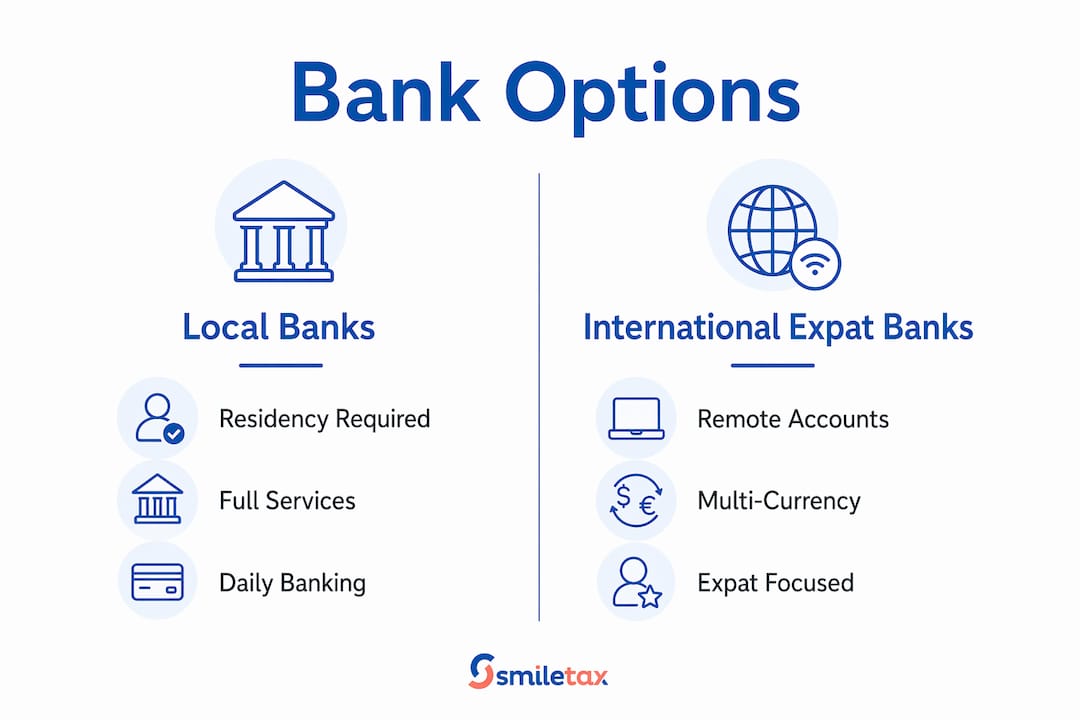
The two main traditional options for Americans abroad are local country banks and specialized international expat banks. Each has real advantages and real limitations.
Local banks
Local banks are the most common choice for day-to-day banking. They offer full services including savings accounts, debit cards, direct deposit, and bill payment in the local currency. The trade-off is that they require residency documentation and can have longer processing times. Branch staff may not speak English, and policies can vary significantly from one branch to the next. Country-specific examples of local banks that have worked well for American expats include BBVA in Mexico, DBS in Singapore, and HSBC in the UK.
International expat-friendly banks
Specialized international banks like HSBC Expat and Lloyds International offer multi-currency accounts, remote account opening in some cases, and English-language support. The catch is the entry bar. HSBC Expat requires either £75,000 in savings or a £120,000 annual salary for its top-tier services. Lloyds International has lower minimums but charges monthly fees if your balance drops below a set threshold.
HSBC Expat accounts are FSCS-protected up to £85,000 and offer multi-currency options for international clients who meet the eligibility criteria. Lloyds International accounts carry the same FSCS protection. That level of deposit insurance matters when you are holding significant savings in a foreign account.
Side-by-side comparison
| Feature | Local banks | International expat banks |
|---|---|---|
| Residency required | Yes, in most countries | No, often remote opening available |
| Minimum deposit | Varies, often low | £5,000–£100,000 depending on tier |
| Multi-currency support | Rarely | Standard feature |
| English-language service | Not guaranteed | Yes |
| Deposit insurance | Varies by country | FSCS up to £85,000 (UK-based) |
| Best for | Daily local expenses | Savings, international transfers |
The right choice depends on your situation. If you are settling in one country long-term, a local bank handles daily life most efficiently. If you move frequently or hold savings in multiple currencies, an international expat bank provides more flexibility.
What digital multi-currency accounts work best for Americans abroad?
Digital multi-currency accounts are the fastest banking solution available to Americans abroad. They require no local residency, open in minutes, and work from day one of your arrival.
Wise operates in over 150 countries, supports over 40 currencies, and charges transparent conversion fees of around 0.3%–0.7%. That is significantly lower than most traditional bank conversion rates. Wise provides local bank account details for the US, UK, EU, and Australia, meaning you can receive salary payments or transfers in local currency without needing a local bank account first.
Revolut is another widely used option among expats. It offers multi-currency spending, instant transfers, and budgeting tools. Both Wise and Revolut are available to US citizens and can be set up before you leave the country.
What digital accounts do well
- Instant setup with no minimum deposit
- Mid-market exchange rates with low, transparent fees
- Local bank details for receiving payments in multiple currencies
- Available without local residency or a local tax ID
Where digital accounts fall short
- They are not full banks. Most do not offer lending, overdrafts, or credit products.
- Deposit insurance is limited or absent compared to traditional banks.
- Some landlords and employers in certain countries require a local bank account, not a digital account.
Using a digital account as a hub for daily expenses alongside a traditional bank for savings and security is the approach most experienced expats recommend. The two work well together. SmileTax has a dedicated page on using Wise for international transfers that covers how this setup works in practice.
Tip: Open your Wise or Revolut account before you leave the US. You will have a working multi-currency account ready the moment you land, which removes the pressure of needing a local bank immediately.
What are the practical steps to open a bank account overseas?
Getting your account open requires preparation and persistence. Here is a clear process that works across most countries.
- Gather your core documents. Collect your US passport, proof of address, employment contract or income proof, and any country-specific tax ID you have already obtained. Have physical copies and digital backups of everything.
- Get notarizations done before you leave. Notarization and apostille must be completed in the US or at a US embassy. Do not assume you can handle this after arrival. It is a frequent cause of delays.
- Research your target bank. Check whether the bank accepts US citizens and what their specific document requirements are. Call ahead or check their website. Requirements vary by branch and by individual staff member.
- Apply to more than one bank at the same time. Many foreign banks reject US citizens due to FATCA-related compliance concerns. Applying to two or three banks simultaneously protects you from a single rejection derailing your plans.
- Visit the branch in person. Most countries require physical presence for identity verification. Bring originals and copies of every document. Dress professionally. First impressions matter at branch level.
- Follow up consistently. Account opening can take days or weeks in some countries. Follow up by phone or email every few days until you receive confirmation.
Why some banks say no to Americans
Foreign banks view US customers as a regulatory burden because of FATCA reporting requirements. This is not personal. It is a compliance cost calculation. Some banks have a blanket policy against US citizens. Others handle it case by case. Expat forums like Expat Forum and InterNations are useful for finding current, country-specific information on which banks are currently accepting American applicants.
Maintaining at least one active US bank account while living abroad is also worth doing. Global banking regulations have tightened, making it harder to keep home-country accounts active as a tax resident abroad, but they remain important for credit history, pension payments, and receiving funds from the US.
Tip: When completing bank applications abroad, use your local foreign address rather than a US address where the form allows. Applications listing a US address can trigger automatic compliance flags at some institutions.
Key takeaways
Opening a bank account abroad as an American is achievable with the right preparation, the right bank choice, and a clear understanding of the obstacles specific to US citizens.
| Point | Details |
|---|---|
| Documents are non-negotiable | Prepare your passport, local tax ID, proof of residency, and income proof before visiting any bank. |
| Residency rules vary widely | Most of Europe requires a residence permit; Mexico, Thailand, and Georgia allow tourist account opening. |
| Apply to multiple banks | FATCA-related rejections are common, so applying to two or three banks at once protects your timeline. |
| Digital accounts fill the gap | Wise and Revolut provide immediate multi-currency banking with no local residency requirement. |
| Keep your US account active | Your US bank account supports credit history, pension payments, and incoming transfers from home. |
The case for a layered banking approach
The expats who handle banking abroad most confidently are not the ones who found one perfect bank. They are the ones who built a layered system. A digital account like Wise handles daily spending and international transfers with low fees and no friction. A local bank account handles rent, utilities, and employer payroll. An international expat bank, if the balance thresholds are met, holds savings with deposit protection.
Each layer solves a different problem. Relying on a single account, whether digital or traditional, creates gaps. A digital account alone cannot satisfy a landlord who requires a local IBAN. A local bank alone cannot match the exchange rates and transfer speeds of Wise.
The other thing worth saying plainly: persistence matters more than most guides admit. Branch-level decisions on US citizen applications are inconsistent. The same bank in two different cities can give you two different answers. Going in well-prepared, applying to multiple institutions, and following up regularly is not over-preparation. It is the standard approach that works.
For Americans who want to understand the broader picture of managing finances across borders, the SmileTax resources page covers a range of practical topics relevant to expat financial life.
Foreign accounts and your US filing obligations
Having a bank account abroad is a normal part of expat life. It also adds steps to your annual US filing picture. Americans abroad are still required to file US tax returns regardless of where they live, and holding foreign accounts introduces specific reporting requirements that go beyond a standard domestic return.
SmileTax works directly with Americans living overseas, including teachers, NGO professionals, and long-term expats, to handle these obligations accurately and without unnecessary stress. Every client works with an experienced US tax professional, not a software tool or an anonymous preparer. If you want your US filing handled properly while you focus on building your life abroad, SmileTax is built for that.
FAQ
Can Americans open a bank account in a foreign country?
Yes. Americans can open bank accounts in most countries, though some foreign banks decline US citizens due to FATCA compliance costs. Applying to multiple banks and preparing full documentation improves your chances significantly.
What documents are required to open a foreign bank account?
Most countries require a valid passport, proof of local residency, a local tax identification number, and proof of income or employment. Some banks also require a completed W-9 form from US citizens.
Do I need a residence permit to open a local bank account abroad?
In most of Europe, yes. Countries like Germany, France, and Spain require a valid residence permit. Exceptions include Mexico, Thailand, and Georgia, where tourist passport holders can open accounts.
What is the fastest banking option for Americans arriving abroad?
Digital multi-currency accounts like Wise or Revolut are the fastest option. They require no local residency, open quickly, and provide local bank details for multiple currencies with low conversion fees.
Should I keep my US bank account when living abroad?
Yes. Maintaining a US bank account supports your credit history, allows you to receive US-based payments, and provides a financial anchor for pension and tax refund purposes.
Recommended