

Yes, you can teach English abroad as an American, and the quickest, highest-probability route is earning a 120-hour TEFL certificate (or a CELTA/CertTESOL), securing a signed employment contract, and letting your employer sponsor your visa before you board any flight.
Visa sponsorship is the piece most first-timers underestimate. In the majority of countries, the work visa is tied directly to a specific employer, and the paperwork must be processed while you are still in the U.S. Arriving on a tourist visa and hoping to find work on the ground is often illegal and risks deportation.
Three non-negotiables before you book a flight:
- Signed employment contract with clear role, hours, and start date
- Passport valid for at least six months beyond your planned arrival
- Clean criminal background check and apostilled degree or diploma (where required)
Table of Contents
- What should you prepare before applying?
- Where can you find ESL jobs and what employer types exist?
- Do you need a degree or certification to teach English overseas?
- How do visas usually work and what must your employer provide?
- What pay and benefits can you realistically expect by region?
- How do you spot a bad employer before accepting an offer?
- What should you expect in your first year of teaching?
- How do international school roles differ from TEFL positions?
- What are your next steps and a realistic timeline?
- Key Takeaways
- The real trade-off most guides won’t tell you
- SmileTax helps American teachers living abroad
- Useful sources and next reading
What should you prepare before applying?
Getting organized early is the difference between a smooth departure and a last-minute scramble. Start at least three to six months out if you are targeting a government-sponsored program; private school placements can move in four to twelve weeks, but document processing rarely does.
Ordered action plan:
- Enroll in and complete a TEFL, CELTA, or Trinity CertTESOL course
- Obtain a criminal background check (FBI or state-level, depending on destination requirements)
- Get your degree apostilled or notarized — check the specific destination’s requirements
- Gather passport photos, professional references, and any medical forms the country requires
- Apply for positions, complete interviews, and secure a signed contract
- Submit your visa application at the relevant consulate in the U.S. using your employer’s sponsorship documents
Realistic cost items to budget:
- Online TEFL certification: roughly $100–$400+; in-person courses with a practicum run higher
- Background check and apostille/notarization fees: varies by state and destination
- Flight and initial housing deposit: budget a meaningful buffer, as furnished short-term rentals in many teaching cities are not cheap
- Visa application fees: set by each country’s consulate
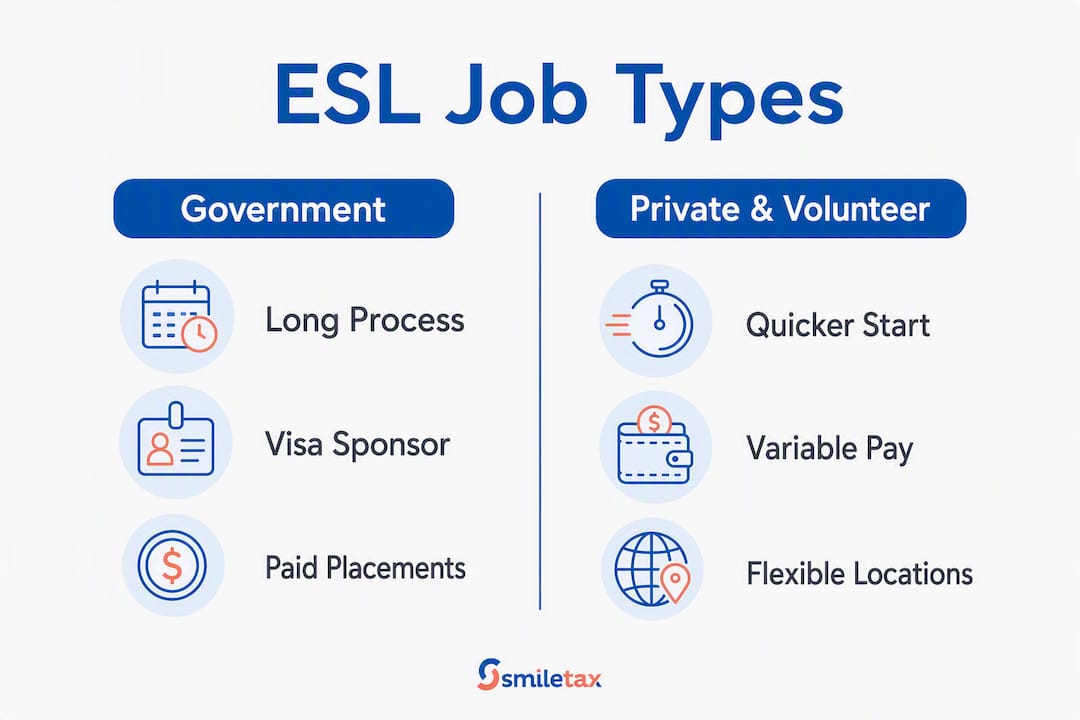
Government-sponsored placements typically take several months from application to departure. Private and volunteer programs can vary in duration but are generally shorter. Build in extra time regardless.

Where can you find ESL jobs and what employer types exist?
The hiring channel you choose shapes everything: your contract terms, visa support, and how much risk you carry.
- Government-sponsored programs (such as JET in Japan or EPIK in South Korea) offer structured sponsorship, clear contracts, and in-country orientation. Competitive and slow to process, but low-risk.
- Private language schools are the most common entry point. They hire year-round, especially in Asia and Latin America, and handle visa sponsorship directly. Quality varies widely.
- International schools require stronger qualifications (see Section 9) but offer higher pay, formal HR processes, and better benefits.
- Recruiters are common in Asia and the Middle East. Reputable recruiters do not charge candidates — the employer pays the commission. If a recruiter asks you for a placement fee, stop the process immediately.
- Program providers like International TEFL Academy, Teach Away, and GoAbroad connect applicants with vetted schools and sometimes include pre-departure support.
- Volunteering vs. paid work: volunteer placements (NGOs, community programs) rarely provide visa sponsorship or a living wage. Clarify payment terms before committing.
Primary job-search resources: Dave’s ESL Cafe, Teach Away, GoAbroad, International TEFL Academy, and International School Services (ISS) are the platforms most American ESL teachers use to find and vet positions.
Do you need a degree or certification to teach English overseas?
The short answer: it depends on where you want to go. Some countries require a bachelor’s degree for visa eligibility — South Korea, Japan, and the UAE are clear examples. Parts of Latin America, Cambodia, and Thailand may hire without one, though a degree still strengthens your application.
For certification, the 120-hour TEFL is the industry baseline. CELTA (Cambridge) and Trinity CertTESOL carry more weight in competitive markets because both include observed teaching practice. Accredited programs with live practicum components measurably improve hireability and classroom readiness compared with purely online courses.
| Region | Typical Pay / Benefits | Min. Qualifications | Visa Sponsorship | Hiring Season | Common Job Types |
|---|---|---|---|---|---|
| East Asia | Higher; housing or stipend common | Degree + TEFL usually required | Employer-sponsored; structured | Year-round, peaks Jan & Aug | Language schools, public schools, academies |
| Middle East | High, often tax-free; flight + housing | Degree + TEFL or CELTA | Employer-sponsored; competitive | Aug–Oct, Jan–Feb | Private schools, language centers |
| Europe | Moderate; lifestyle benefits | CELTA preferred; degree helpful | Varies; EU rules complicate non-EU applicants | Sep–Oct, Jan | Language schools, cultural institutes |
| Latin America | Lower pay; low cost of living | TEFL often sufficient; degree a plus | Less structured; varies by country | Feb–Mar, Jul–Aug | Language schools, private tutoring, NGOs |
How do visas usually work and what must your employer provide?
The employer-sponsored visa model is standard across most teaching destinations. Your school files the initial paperwork with the relevant government authority, then provides you with a sponsorship letter or invitation letter that you take to the consulate in your home country to complete the application. Visa processing typically takes four to twelve weeks, so do not delay once you have a signed contract.
Request these in writing before you travel:
- Signed employment contract (role, hours, salary, start date)
- Visa sponsorship letter or invitation letter from the school
- Housing details or housing allowance confirmation
- Flight reimbursement terms (if offered)
- Health coverage and sick leave terms
- Repatriation and end-of-contract clauses
Typical visa document checklist:
- Valid passport (6+ months remaining)
- Criminal background check (apostilled)
- Degree certificate (apostilled or notarized)
- TEFL/CELTA certificate
- Passport photos
- Medical forms (required in some countries)
- Employer’s sponsorship letter
What pay and benefits can you realistically expect by region?
Pay varies more by job type than most guides admit. An international school teacher in Seoul earns significantly more than a language-center teacher in the same city. East Asia and the Middle East consistently offer the highest ESL salaries, often with housing allowances and flight benefits included. Europe and Latin America pay less in absolute terms, but lower living costs and lifestyle factors attract a different kind of candidate.
| Region | Monthly Pay Range (approx.) | Common Benefits |
|---|---|---|
| East Asia | Competitive; varies by country and role | Housing, flight, health insurance, end-of-contract bonus |
| Middle East | High; often tax-free locally | Housing, flight, health insurance |
| Europe | Moderate | Varies; some include accommodation |
| Latin America | Lower | Varies; often fewer extras |
How job type shifts compensation:
- International schools: highest pay, full benefits packages, formal contracts
- Private language centers: mid-range pay, housing sometimes included
- Private tutoring: flexible but no benefits, no visa sponsorship
- Volunteer placements: stipend or accommodation only, rarely a living wage
How do you spot a bad employer before accepting an offer?
Red flags to watch for:
- Recruiter or employer asks you to pay a placement fee
- School asks you to enter on a tourist visa and “sort out the paperwork later”
- No signed contract or sponsorship letter offered before departure
- Vague or absent job description
- No references available from current or recent staff
- Pressure to decide immediately without time to review the contract
Questions to ask before signing:
- Who files the visa paperwork, and what is the timeline?
- What are the exact working hours and teaching duties?
- How and in what currency is salary paid?
- What happens if the school cancels the contract early?
- Is housing provided, and what are the terms?
Tip: Ask for contact details of two current staff members and reach out independently. Cross-check the school on expat Facebook groups and, where available, official inspection reports. If the employer resists, treat that as a red flag.
What should you expect in your first year of teaching?
The biggest mistake new ESL teachers make is over-lecturing. Effective teaching maximizes student talk time and keeps explanations to concise one-to-three-minute windows. Your job is to design tasks that get students speaking, writing, and problem-solving, not to demonstrate how much grammar you know.
Practical first-year tips:
- Build a repeatable 10-lesson starter pack using local materials that fit your class sizes and student goals — this saves enormous preparation time in the first term
- Ask “What will students be doing with English for most of this lesson?” before every plan
- Keep grammar explanations short and always follow them with a communicative task
- Learn the local administrative expectations early: parent communication norms, grading formats, and school reporting vary widely
- Expect cultural adjustment to take three to six months; homesickness and disorientation are normal, not signs you made the wrong choice
Tip: Collect authentic local materials (menus, signs, news headlines) from week one. They make lessons immediately relevant and cost nothing.
How do international school roles differ from TEFL positions?
Licensed international schools and private language centers operate in different hiring universes. Understanding the distinction helps you target the right applications.
- Qualifications: International schools typically require a home-country teaching license (K–12 certification) plus classroom experience. TEFL centers accept a TEFL or CELTA certificate and, for many roles, no prior teaching experience.
- Pay and benefits: International schools offer higher salaries, comprehensive benefits (housing, flights, health insurance, retirement contributions), and formal HR processes. TEFL roles are more accessible but generally pay less.
- Career trajectory: International school teaching is a recognized professional career path with structured advancement. TEFL roles offer flexibility and a lower barrier to entry, making them ideal for career changers or those testing the waters.
- Hiring process: International schools recruit through ISS, Teach Away, and similar formal channels, often six to twelve months ahead. Language centers hire faster and more informally.
What are your next steps and a realistic timeline?
30/60/90-day action plan:
- Month 1: Choose your target region, research visa and degree requirements, and enroll in a TEFL or CELTA course
- Month 2: Complete certification, begin collecting documents (background check, apostille), and start applying to positions via Dave’s ESL Cafe, Teach Away, GoAbroad, or ISS
- Month 3: Complete interviews, negotiate and sign a contract, and submit your visa application at the consulate
If you are already abroad:
- Do not attempt to convert a tourist visa into a work visa in-country — most countries require the process to start from your home country
- If you are between contracts, return to the U.S. to process the next visa application at the consulate
Budget reminders:
- TEFL certification, document fees, and initial housing deposit are the three biggest upfront costs
- Build a two-to-three-month financial buffer for the gap between arrival and first paycheck
Key Takeaways
Teaching English abroad as an American is straightforward when you secure the right certification, documents, and a signed contract before you leave the U.S.
| Point | Details |
|---|---|
| Secure a contract first | Never book a flight without a signed contract and employer sponsorship letter in hand. |
| 120-hour TEFL is the baseline | CELTA and Trinity CertTESOL carry more weight in competitive markets and include observed teaching practice. |
| Visa is employer-tied | Most work visas require employer sponsorship and must be processed at a U.S. consulate before departure. |
| Pay varies by region and role | East Asia and the Middle East offer the highest ESL pay; international schools pay more than language centers everywhere. |
| SmileTax supports teachers abroad | SmileTax helps American teachers living overseas with their U.S. filing obligations — see SmileTax teacher resources. |
The real trade-off most guides won’t tell you
The teach-abroad market is not one thing. It is three or four very different career paths wearing the same label, and conflating them leads to real disappointment.
Asia, particularly South Korea, Japan, and China, is where you go if saving money is the goal. The combination of competitive pay, low personal expenses, and housing benefits means a disciplined teacher can build genuine savings. The trade-off is a demanding schedule, large class sizes in some markets, and a work culture that can feel rigid to Americans.
Europe is a lifestyle choice, not a financial one. Pay in most European language centers is modest, and the cost of living in cities like Madrid or Prague is not as low as it once was. Go for the culture, the travel access, and the professional development, not the salary.
Latin America sits in the middle: low pay, low costs, and an unmatched depth of cultural immersion. It is the best region for someone who wants to learn Spanish while teaching, or who values community integration over career advancement.
The credential advice is simpler than it looks. A 120-hour online TEFL gets you in the door for most language-center roles. But if you want to work in competitive markets, move into international schools eventually, or simply feel prepared on day one, a CELTA or CertTESOL with a live practicum is worth the extra investment. The classroom confidence it builds in the first term alone justifies the cost.
One rule applies everywhere: demand a signed contract and a written sponsorship commitment before you spend a dollar on flights.
SmileTax helps American teachers living abroad
Teaching abroad is one of the most rewarding moves an American can make. The paperwork that follows you home is a different story. SmileTax works specifically with American teachers and school staff living overseas, helping them stay on top of their U.S. filing obligations without the stress or the guesswork of doing it alone. Whether you are at a language center in Seoul or an international school in Jordan, SmileTax offers straightforward, personal support from experienced U.S. tax professionals who understand expat realities. Visit smile.tax to learn more about how SmileTax supports teachers abroad.
Useful sources and next reading
- GoOverseas: Teach Abroad — program listings and regional pay data
- GoOverseas: How to Get Started — timeline and program-type overview