

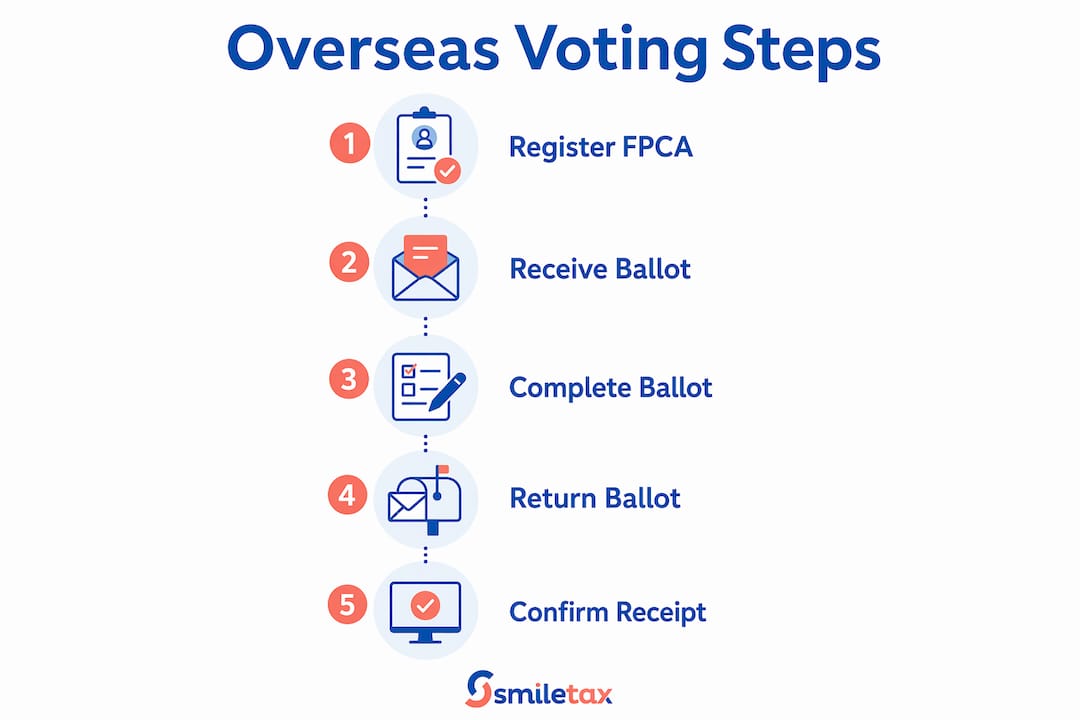
US citizens living abroad retain the full right to vote in federal elections, no matter how long they have been overseas. The process is called overseas absentee voting, and the Federal Post Card Application (FPCA) is the tool that makes it work. Knowing how to vote in US elections while living abroad comes down to three things: registering with your last US state of residence, requesting your absentee ballot, and returning it before your state’s deadline. This guide walks through every step, from the FPCA to backup options, so your vote counts from wherever you are in the world.
What is the Federal Post Card Application (FPCA) and how does it work?
The FPCA is the single form that handles both voter registration and absentee ballot requests for US citizens abroad. All US states and territories accept it, which means you do not need to track down state-specific forms. One form covers both steps simultaneously.
The FPCA does more than register you once. States no longer carry forward absentee voter status automatically, so you must submit a new FPCA every year. The right time to submit is in january, before election season begins. You should also resubmit whenever your address, email, or other voter information changes.
Here is what the FPCA covers in a single submission:
- Voter registration with your last US state of residence
- Absentee ballot request for all upcoming federal elections in that calendar year
- Electronic delivery preference, if you provide an email address or fax number
- Address update to ensure ballots reach you at your current overseas location
Providing your email address on the FPCA does two things. It lets election officials contact you if there is a problem with your registration, and it enables electronic ballot delivery in nearly all states. That combination makes email the single most useful field on the entire form.
Tip: Complete the FPCA online through the Federal Voting Assistance Program (FVAP) website at fvap.gov. The site walks you through each field and generates a ready-to-submit form tailored to your state.
How do you determine your voting residence and state?
Your voting residence is the last US address where you lived before moving abroad. That address determines which state you register in, which local election office handles your ballot, and which candidates appear on your ballot. You do not need to currently own property or pay taxes in that state. The connection is simply where you last lived.
Determining your voting residence is straightforward for most expats. If you moved abroad directly from a specific city and state, that is your voting residence. If you have moved between countries and never returned to the US, your voting residence is still the last US address you held before your first departure.
Use these criteria to confirm your voting residence:
- The last US state where you were physically present as a resident
- The address listed on your last US driver’s license or state ID
- The address you used for your last US tax return, if applicable
- The address where your family members still reside, if you shared that home
Some expats have never lived in the US as adults, particularly those born abroad to American parents. These individuals may be eligible to register in the state where their parent last resided. The FVAP website provides state-specific guidance for this situation.
Once you identify your state, contact that state’s local election office directly. Each state sets its own rules for ballot return methods, deadlines, and electronic delivery. Knowing your state early gives you time to understand those specific rules before an election approaches.
What are the key deadlines and mailing requirements for overseas absentee voting?
Deadlines are the most critical part of voting from abroad. Missing one means your ballot does not count, regardless of how carefully you completed it.
Federal law sets the baseline. States must send blank ballots to overseas voters at least 45 days before a federal general election. That 45-day window exists specifically to give international mail enough time to work in both directions. For primary, special, or runoff federal elections, the required lead time is 30 days.
The recommended submission timeline for your FPCA looks like this:
- Submit in january of each election year to cover all elections in that calendar cycle.
- Resubmit at least 45 days before any federal election if you have not already done so that year.
- Request your ballot early so you have maximum time to complete and return it.
- Return your completed ballot well before your state’s receipt deadline, not just the postmark deadline.
| Election type | Ballot sent to you by | Recommended FPCA submission |
|---|---|---|
| Federal general election | 45 days before election day | january of election year |
| Federal primary or special election | 30 days before election day | At least 45 days before election |
| State or local election | Varies by state | Contact local election office |
Returning your ballot requires attention to postage. Ballots mailed through embassies must include proper US domestic postage or prepaid envelopes to reach local election officials. Without correct postage, your ballot may not be delivered. Check with your local election office about whether they provide prepaid return envelopes for overseas voters.
US embassies and consulates are not polling places. They cannot process your vote or register you on the spot. Some embassies offer a diplomatic pouch service to forward sealed ballots, but this is a supplementary option, not a guaranteed service. Electronic return, where your state permits it, is faster and more reliable than any postal route.
Tip: If your state allows electronic ballot return by email or fax, use it. Electronic return eliminates international mail delays entirely and gives you a clear record that your ballot was submitted.
How to use the Federal Write-In Absentee Ballot (FWAB) as a backup option
The Federal Write-In Absentee Ballot (FWAB) is a backup ballot designed for one specific situation: your official absentee ballot has not arrived, and the deadline is approaching. The FWAB acts as an emergency write-in ballot that ensures your vote is counted even when international mail fails you.
The FWAB works like this:
- You complete the FWAB online using the FVAP assistant, print it, sign it, and mail it to your local election office.
- You can submit the FWAB and your official absentee ballot at the same time if the official ballot arrives late.
- Only one ballot is counted. If both arrive, election officials count the official absentee ballot and set the FWAB aside.
- The FWAB is valid for all federal offices, including President, Senate, and House of Representatives.
The FWAB is not a replacement for the FPCA registration process. You still need to be registered through the FPCA to use the FWAB. Think of it as an insurance policy you activate when your official ballot does not show up in time.
Submit the FWAB as early as possible once you realize your official ballot is delayed. Waiting until the last moment reduces the chance it arrives before your state’s deadline.
What tools and resources can US citizens abroad use to track their ballot status?
Staying informed after you submit your FPCA and ballot is just as important as submitting them correctly. Several tools exist specifically to help overseas voters confirm their registration and track their ballot.
The FVAP website is the primary resource. It offers:
- An online FPCA assistant that generates your completed form
- State-by-state voting guides covering deadlines, return methods, and electronic delivery rules
- Links to each state’s voter registration verification website
- Information on Voting Assistance Officers (VAOs) stationed at military installations worldwide
Most states provide online voter registration verification, so you can confirm your registration is active before an election. Check your state’s verification tool a few weeks after submitting your FPCA to confirm it was processed correctly.
Overseas voters should contact their local US election office directly rather than relying on embassies for ballot assistance. Embassy staff can answer general questions, but they do not have access to your state’s voter records. Your county or city election office is the authoritative source for your specific registration status.
Tip: Save the contact information for your local election office in your email. When a question arises about your ballot status, you can reach the right person immediately instead of searching for the contact during a time-sensitive situation.
Key Takeaways
Voting from abroad requires annual FPCA submission, attention to state-specific deadlines, and a clear understanding of electronic ballot delivery options.
| Point | Details |
|---|---|
| Submit the FPCA annually | Send a new FPCA every january and whenever your voter information changes. |
| Know your voting residence | Your last US address determines your state, your ballot, and your local election office. |
| Meet the 45-day window | States must send ballots 45 days before federal general elections; submit your FPCA well before that. |
| Use the FWAB as backup | If your official ballot does not arrive in time, submit the FWAB to protect your vote. |
| Verify your registration online | Check your state’s voter verification tool after submitting the FPCA to confirm it was processed. |
The vote that travels farther than you think
Many US federal elections at the House and Senate level have been decided by margins smaller than the total absentee ballots cast by overseas voters. That fact surprises most expats, who assume their vote disappears into a bureaucratic void somewhere between their mailbox and a county office in a state they left years ago. It does not.
The biggest practical mistake overseas voters make is not a paperwork error. The most common failure is simply not resubmitting the FPCA each year, assuming last year’s registration still applies. It does not. States reset absentee voter status annually, and that single oversight is enough to miss an entire election cycle.
Electronic ballot delivery changes the equation significantly. Expats who provide an email address on their FPCA receive their ballot faster, avoid international postal uncertainty, and have a clear submission record. The technology exists. Using it is a straightforward choice that removes the biggest logistical obstacle in overseas voting.
The civic connection to the US does not require a US address. It requires a current FPCA, a known deadline, and a ballot returned on time.
Staying connected to the US from abroad
Living abroad means managing more than just a new address. US citizens overseas carry ongoing connections to the American system, from voter registration to annual tax filing obligations. SmileTax works specifically with Americans abroad who need their US tax obligations handled accurately and without the complexity of large accounting firms. If you are keeping your voter registration current and your civic ties in order, it makes sense to keep your financial obligations just as organized. SmileTax offers clear, affordable service from experienced US tax professionals who understand exactly how expat life works.
FAQ
What is the FPCA and who needs to submit it?
The Federal Post Card Application (FPCA) is the official form US citizens abroad use to register to vote and request an absentee ballot. Every overseas voter must submit it annually to receive ballots for that year’s elections.
How early should I submit my FPCA before an election?
Submit your FPCA in january of each election year. If you miss that window, submit at least 45 days before any federal general election to meet the mandatory ballot transmission deadline.
Can I vote electronically from abroad?
Most states offer electronic ballot delivery by email, fax, or download when you provide contact details on your FPCA. Electronic return of completed ballots is also permitted in many states. Check your state’s specific rules through the FVAP website.
What happens if my absentee ballot does not arrive in time?
Submit the Federal Write-In Absentee Ballot (FWAB) as a backup. If both the FWAB and your official ballot arrive, only the official ballot is counted. The FWAB protects your vote when mail delays make the official ballot impossible to return on time.
Can I vote at a US embassy or consulate abroad?
No. US embassies and consulates are not polling places and cannot process votes. Some may forward sealed ballots via diplomatic pouch, but your primary contact for all voting matters is your local US election office back in your state of residence.