

Most American international school teachers earn a base salary typically in the mid-range, but total compensation including housing, flights, and tuition remission can significantly increase overall package value. The single factor that changes your real savings most is not the headline number. It is the benefits package and where you live on it.
- Base salary alone tells you very little. A contract with free housing and annual flights home can leave you saving more each month than a higher-paying contract where you pay your own rent.
- The benefits that move the needle most: school-provided housing or a housing allowance, tuition remission for your children, annual return flights, health insurance, and end-of-service gratuity.
- Always convert every benefit into a dollar value before comparing offers. School-provided housing can save thousands per month in rent alone in high-cost locations.
Tip: Before you compare two offers side by side, add up the monetized value of every benefit. A single free-housing clause or tuition remission for one child can add $15,000–$30,000 in annual value to a package that looks modest on paper.
Table of Contents
- What do international school teachers actually earn by region?
- How to convert a benefits package into a real dollar value
- Three teacher scenarios that show why base pay is not the whole story
- Questions to ask and levers to pull when negotiating an offer
- What to expect from contracts, timelines, and the hiring process
- How international teacher pay compares to US public school salaries
- Tax obligations Americans face when teaching abroad
- How currency fluctuations can affect your actual salary value
- How to research cost of living before you accept an offer
- Professional development and how it affects your earning trajectory
- Key Takeaways
- What 2026 trends mean for teachers negotiating right now
- SmileTax is here for American teachers abroad
- Useful sources
What do international school teachers actually earn by region?
Regional context is everything when evaluating international teaching jobs salary. The table below maps headline base salary ranges, common benefits, and realistic savings potential across the main hiring regions for 2026.

| Region / Example Country | Headline Base Salary (USD) | Common Benefits | Savings Potential |
|---|---|---|---|
| Middle East (UAE, Qatar, Saudi Arabia) | $39,000–$74,000 | Housing, flights, health insurance, often tax-free | High savings potential with included benefits ($1,000–$3,000/month realistic) |
| East Asia (China Tier 1, Singapore, Hong Kong) | $36,000–$72,000 (China Tier 1); Singapore/HK higher | Housing often included; Singapore/HK high cost | China: High (~46% savings potential); Singapore/HK: Moderate with structured packages |
| Western Europe (Switzerland, Germany, Belgium) | Switzerland: $57,000–$115,000; others lower | Varies; high cost-of-living offsets real savings | Moderate savings potential |
| Latin America (Colombia, Mexico, Brazil) | Generally lower ($15,000–$35,000) | Tuition and housing allowances common | Moderate savings potential due to low living costs |
| Africa (Kenya, South Africa, Egypt) | Competitive for region ($18,000–$32,000) | Housing often included; hardship allowances at some schools | Variable savings potential |
Middle East and Gulf: UAE and Qatar packages typically include housing, flights, and health insurance, and salaries are paid tax-free locally. Reported savings of $1,000–$3,000 per month are realistic for teachers who live modestly.
East Asia: China’s Tier 1 cities (Beijing, Shanghai) offer $36,000–$72,000 with housing frequently included, and China has been modeled at roughly 46% savings potential for well-structured packages. Singapore and Hong Kong carry high nominal pay but equally high rents, so purchasing-power parity matters here.
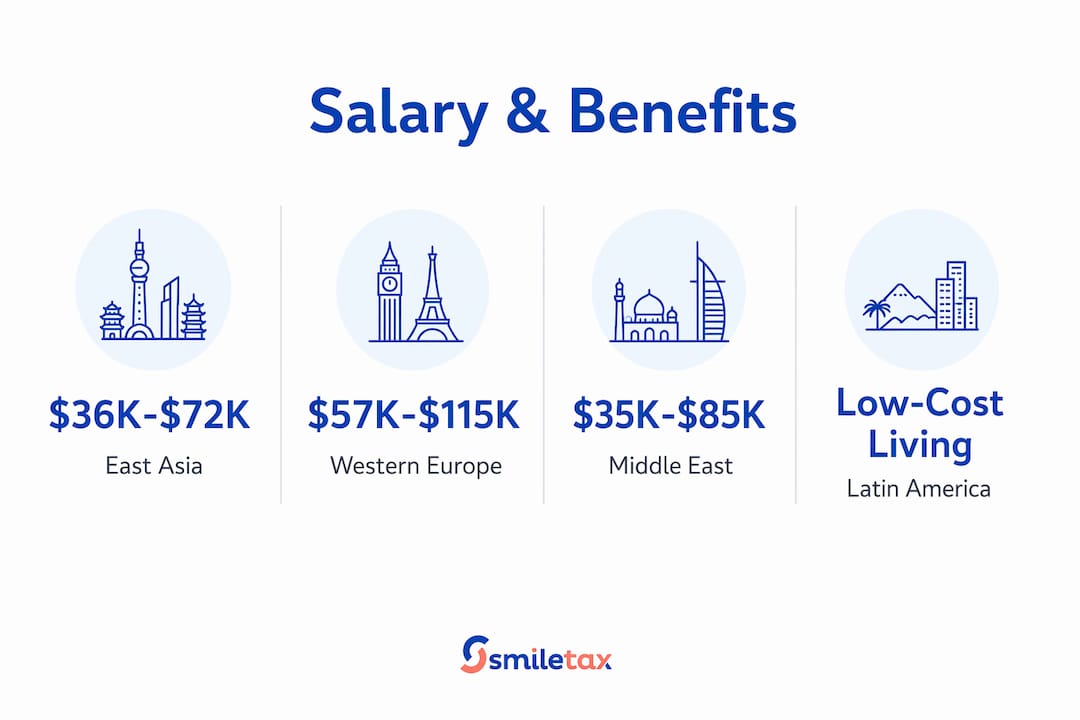
Western Europe: Switzerland sits at the top nominally ($57,000–$115,000), but cost-of-living adjustments significantly reduce real value.
Latin America: Colombia and Mexico offer lower headline pay, but housing allowances and low cost-of-living indices preserve reasonable savings.
How to convert a benefits package into a real dollar value
Monetizing school-provided benefits into a dollar value is the single most useful habit for comparing offers. Here is a simple method.
Step 1: Assign a rent equivalent to housing. Research the local rental market for a comparable furnished apartment. If the school provides housing, that monthly figure is your benefit value.
Step 2: Value annual flights. A round-trip economy ticket from your posting to the US costs $800–$2,500 depending on origin. If the school covers two tickets per year for a family of four, that is $6,400–$20,000 in annual value.
Step 3: Estimate tuition remission. International school tuition runs $10,000–$35,000 per child per year at many schools. Full remission for two children can add $20,000–$70,000 to your effective compensation.
Step 4: Add health insurance. A comprehensive expat health plan costs $3,000–$8,000 per year per adult. School-provided coverage is real money.
Benefits checklist — ask about every item before signing:
- Is housing furnished? Are utilities included?
- Does the flight allowance cover dependents?
- Is tuition remission full or partial, and which grades does it cover?
- What does health insurance cover (dental, vision, mental health, repatriation)?
- Is there a shipping or relocation allowance, and what is the cap?
- Is there an end-of-service gratuity or severance clause?
Tip: Request the actual contract language for housing and tuition clauses before you sign. Vague wording like “housing support provided” can mean anything from a furnished villa to a modest cash allowance. Specific numbers in writing protect you.
Questions to ask and levers to pull when negotiating an offer
Most schools have more flexibility on benefits than on base salary. Focus your negotiation there.
- Is housing school-provided or an allowance? School-provided housing removes market risk. An allowance that has not been updated in three years may not cover current rents.
- What is the tuition remission policy, and is it guaranteed in the contract? Verbal assurances are not enforceable.
- Does health insurance cover dependents, and what are the exclusions?
- What is the contract length and notice period? A 12-month contract with a 3-month notice clause limits your flexibility.
- Is there an end-of-service gratuity? Gulf schools commonly pay one month’s salary per year of service on departure.
- In what currency is salary paid, and is there a currency protection clause?
- What is the relocation and return-flight policy?
Common negotiation levers schools use:
- Offering a higher housing allowance instead of a base salary increase
- Providing a lump-sum relocation grant rather than ongoing benefits
- Extending tuition remission to cover more grade levels
Red flags to watch for: benefit descriptions that use words like “support,” “assistance,” or “where possible” without specific amounts; salary quoted in local currency with no exchange-rate floor; contract length left open-ended.
Tip: Ask for a sample pay schedule showing how salary is disbursed across the academic year. Some schools pay over 10 months, others over 12. That affects your monthly cash flow and how you plan for summer.
What to expect from contracts, timelines, and the hiring process
Most international schools run on academic contracts of 10–12 months, renewable annually or on a two-year fixed-term basis. Recruitment typically begins 6–9 months before the school year starts, so if the school year begins in September, expect the main application window from October through February.
International-hire vs. local-hire status matters more than most teachers realize. An international hire typically receives the full package: housing, flights, relocation, and tuition. A locally hired teacher, even at the same school, often receives a reduced package or none of those benefits. Always clarify your hiring status in writing before accepting an offer.
A typical relocation timeline:
- October–February: Apply, interview, receive and negotiate offer
- March–April: Sign contract, begin visa and work-permit process
- May–June: Arrange shipping (allow 6–10 weeks for sea freight), confirm housing
- July–August: Arrive, settle in, attend pre-school orientation
- September: School year begins
If you are a frequent flyer managing multiple trips home during the year, a Global Entry membership can make re-entry to the US noticeably smoother.
How international teacher pay compares to US public school salaries
The US national average for public school teachers sits in a range that overlaps with mid-level international teacher headline pay. On base salary alone, the comparison is close. The difference is what surrounds the paycheck.
A US public school teacher earning $55,000 in a mid-cost city pays rent, health insurance premiums, and any dependent tuition from that salary. An international teacher earning $48,000 in Abu Dhabi with housing, flights, and health insurance covered may have significantly more left over each month. The benefits package is where the financial case for teaching abroad is actually made, not in the headline number.
Tax obligations Americans face when teaching abroad
Americans teaching abroad remain subject to US tax filing requirements regardless of where they live or work. This article does not provide tax advice, and every teacher’s situation is different. For guidance specific to your circumstances, consult a qualified US tax professional who works with expats.
SmileTax works specifically with American international school teachers and can help you understand your filing obligations. Visit teachers.smile.tax for teacher-focused resources.
How currency fluctuations can affect your actual salary value
If your salary is paid in local currency, exchange-rate movements directly affect what you can send home or save in USD. A teacher paid in Thai baht or Colombian pesos who saw a 10–15% currency shift in a single year would feel that in real purchasing power.
Practical steps to manage currency risk:
- Request salary payment in USD where possible, especially in markets with volatile currencies.
- Ask whether the school has a currency protection clause or adjusts salaries for significant exchange-rate moves.
- Use a multi-currency account (Wise, for example) to hold and convert funds strategically rather than converting everything at once.
- Track the exchange rate for your posting currency against USD for at least three months before you arrive so you have a realistic baseline.
How to research cost of living before you accept an offer
Headline salary and benefits mean nothing without a city-level cost check. Two teachers earning the same package in Singapore and in Chiang Mai will have very different monthly surpluses.
Numbeo is the most widely used free tool for city-level cost-of-living comparisons. Expatistan and Mercer’s Cost of Living Survey (published annually) provide additional benchmarks, especially for housing. For a practical ground-level check, search Facebook groups and Reddit communities for teachers already living in your target city. They will tell you what a grocery run actually costs, what neighborhoods are realistic on your salary, and whether the school’s housing allowance is adequate for the current rental market.
Professional development and how it affects your earning trajectory
Experience and credentials drive salary growth in international schools just as they do at home, but the ceiling is higher and the path is different. Teachers with an International Baccalaureate (IB) authorization or a Cambridge International qualification consistently command higher starting salaries and faster progression at top-tier schools.
Department head and coordinator roles typically add $5,000–$15,000 to base salary and often come with enhanced benefits. Schools affiliated with the Council of International Schools (CIS) or accredited by the New England Association of Schools and Colleges (NEASC) tend to offer more structured professional development funding, including conference attendance and further study support.
Key Takeaways
Total compensation, not base salary, is the number that determines how well you live and save as an American international school teacher in 2026.
| Point | Details |
|---|---|
| Monetize every benefit | Convert housing, flights, tuition, and insurance into USD before comparing any two offers. |
| Gulf packages lead on savings | UAE and Qatar postings often yield $1,000–$3,000/month in savings thanks to tax-free pay and included housing. |
| China offers strong savings potential | China Tier 1 packages have been modeled at roughly 46% savings potential when housing is included. |
| Local-hire status changes everything | International hires receive full packages; local hires often do not. Confirm your status in writing. |
| SmileTax supports teachers abroad | SmileTax works with American international school teachers on US filing obligations at teachers.smile.tax. |
What 2026 trends mean for teachers negotiating right now
Demand for qualified international school teachers remains strong. The global network of international schools continues to grow, and recruitment pressure in key markets gives experienced teachers real negotiating leverage, particularly in the Gulf, China, and Singapore.
Several trends are shaping offers in 2026:
- Tuition remission is becoming more standard at top-tier IB and American-curriculum schools, particularly in Asia and the Middle East, as schools compete for experienced teachers with families.
- Gulf hiring remains active, with Saudi Arabia expanding its international school sector significantly alongside the established UAE and Qatar markets.
- Salary variance is widening between schools in high-demand cities and those in lower-profile markets, making city-level research more important than regional averages alone.
- Benefits standardization is happening at CIS-accredited schools, where package transparency is increasingly expected by candidates.
The teachers who negotiate best in this market are the ones who arrive at the table knowing exactly what their package is worth in total-comp terms, not just what the headline says.
SmileTax is here for American teachers abroad
Teaching abroad is one of the most financially and personally rewarding moves an American educator can make. The practical side of staying current with US obligations while you are living and working overseas is a separate matter, and one that SmileTax handles every day for teachers just like you.
SmileTax works exclusively with Americans abroad, including international school teachers at schools around the world. Every client works directly with an experienced US tax professional. No software handoffs, no generic advice. If you want to understand your US filing situation and get it handled properly, visit teachers.smile.tax to learn more and get started.
Useful sources
- Teacher Horizons: 12 Popular Destinations for Teaching in International Schools (2026) — Regional salary context, package norms, and hiring demand data used throughout this guide.
- Suraasa: International School Teacher Salary 2026 — Primary source for global base salary bands ($36,000–$56,000) and total compensation ranges ($46,000–$82,000).
- WhereNext: Teacher Salaries Abroad by Net Income and Cost of Living (2026) — Country-level savings potential modeling, including China’s ~46% figure and PPP-adjusted comparisons.
- Premier TEFL: The TEFL Salary Report (2026) — Benefits package norms across 30 countries, including housing, flights, and health insurance inclusion rates.
- SmileTax: Teaching Abroad Resources for American Teachers — Practical guides on international-hire terms, logistics, and US filing context for American teachers abroad.
- Global Entry Priority: How Does Global Entry Work? (2026) — Practical travel logistics for teachers making frequent trips between their posting and the US.