

If you are a US teacher considering a move abroad, the phrase “international school” probably sounds straightforward. It is not. International schools explained as a beginner’s guide for US teachers reveals a genuinely diverse world where schools differ by curriculum, ownership model, student body, and teaching philosophy. Some follow the International Baccalaureate. Others run British A-Levels or American AP programs. A few blend all three. Understanding what you are walking into before you apply makes the difference between a great career move and a frustrating mismatch. This guide covers school types, curricula, hiring timelines, cultural adaptation, and what your contract should actually include.
Table of Contents
- Key takeaways
- What are international schools?
- Understanding international school curricula
- Qualifications and the hiring process
- Cultural adaptation in international classrooms
- Practical considerations: contracts and benefits
- A perspective on what actually makes international teachers succeed
- Planning your move abroad: how SmileTax can help
- FAQ
Key takeaways
| Point | Details |
|---|---|
| No single model exists | International schools vary widely in curriculum, ownership, and mission, so research each school individually. |
| Hiring season is defined | Most international schools recruit from October through March for positions starting in August or September. |
| Benefits matter as much as salary | Housing allowances, flights, and tuition support can significantly change the real value of an offer. |
| Cultural adaptation takes time | Plan to redesign your first four to six weeks of teaching to fit the school’s curriculum map and rhythm. |
| Credentials must be ready in advance | Compiling your license, degree, references, and background check before applying accelerates your hiring timeline. |
What are international schools?
There is no uniform definition for an international school, but most share a recognizable set of traits: a multinational student and staff body, English as the primary language of instruction, and an internationally recognized curriculum. Beyond that, the differences are significant.
Ownership structure matters more than most US teachers realize. Some international schools are private non-profits governed by parent boards. Others are for-profit enterprises backed by global education companies. A third category includes mission-driven schools affiliated with religious organizations or diplomatic communities. School values and mission affect the teaching environment just as much as the curriculum does, so understanding what drives a school’s existence tells you a lot about what daily life there will feel like.
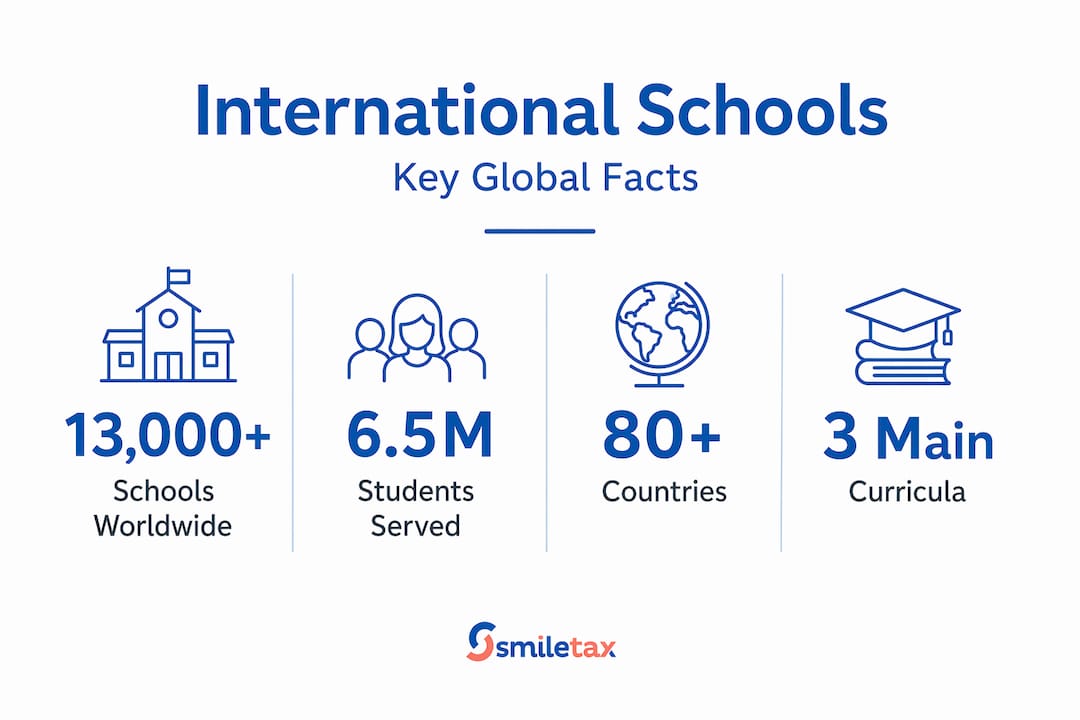
The scale of this sector surprises most newcomers. Over 13,000 international schools operate worldwide and serve more than 6 million students. The majority use English as the medium of instruction and deliver curricula that transfer across borders.
Here is a quick comparison of the three most common curricula you will encounter:
| Curriculum | Origin | Key Features | Assessment Style |
|---|---|---|---|
| International Baccalaureate (IB) | Switzerland | Inquiry-based, global focus, three programs (PYP, MYP, DP) | Portfolio, essays, exams |
| British (IGCSE / A-Levels) | United Kingdom | Subject-specialist, structured, linear progression | Standardized external exams |
| American (AP / US framework) | United States | Familiar structure, college-prep focus, AP exams | Coursework and standardized tests |
Key things to know before you apply:
- IB schools emphasize critical thinking and global citizenship above content delivery
- British curriculum schools tend to be more subject-specialist and exam-focused
- American curriculum schools feel familiar but may still differ in calendar and expectations
- Some schools blend curricula, particularly at the primary level
Understanding international school curricula
The curriculum a school uses changes how you plan, assess, and interact with students. This is one area where US teachers sometimes underestimate the learning curve.

The IB framework is the most globally widespread. IB programs operate in over 8,700 schools and reach nearly 2 million students. The Primary Years Programme (PYP) covers ages 3 to 12. The Middle Years Programme (MYP) spans ages 11 to 16. The Diploma Programme (DP) prepares students aged 16 to 19 for university admission worldwide. All three emphasize inquiry, interdisciplinary thinking, and reflection over rote learning. If you are used to standards-based instruction in a US public school, the IB approach requires a genuine shift in how you frame lessons and measure success.
British curriculum schools structure learning around discrete subject areas with clear linear progression. IGCSE courses (ages 14 to 16) and A-Levels (ages 16 to 18) are assessed primarily through external examinations set by Cambridge Assessment or Pearson Edexcel. The grading scales differ from what US teachers know, and the exam preparation cycle is more compressed and intense.
American curriculum schools feel familiar on the surface but still carry expectations that differ from a US public school. Many serve the children of US diplomats, corporate employees, or expat families who want their children to re-enter the American school system smoothly. AP courses function similarly to what you know, but the school calendar, parent communication culture, and staffing norms can still surprise you.
** Tip:** Before your interview, download the curriculum guide for the framework the school uses. Read one unit of work at the grade level you would teach. Walking into an interview with specific observations about that curriculum signals genuine preparation and separates you from candidates who only know the framework by name.
Curriculum impacts assessment design, grading philosophy, and even how you write reports. Planning to adapt, not just translate, your US teaching experience is the right mindset from day one.
Qualifications and the hiring process
International schools have consistent minimum expectations. Most require a recognized bachelor’s degree, a valid state teaching license, and at least two years of classroom experience. Some roles, particularly at IB World Schools or Cambridge-affiliated institutions, prefer candidates with additional specialist training in the relevant framework. Police clearance certificates and professional references are standard requirements across nearly all schools.
The skills schools look for go beyond credentials. Research from the International Schools Services network confirms that adaptability, cultural awareness, and communication are the top qualities hiring panels assess. Schools are looking for teachers who can shift quickly, collaborate across cultures, and continue learning professionally.
Here is how to prepare your application effectively:
- Compile a credential packet with your teaching license, degree transcript, two recent professional references, and a background check clearance. Candidates who have these ready reduce delays and improve offer conversion rates significantly.
- Write a personal statement that focuses on flexibility and cross-cultural experience. Generic statements focused on subject expertise alone rarely stand out.
- Apply between October and February. Hiring season runs from October to March for roles starting in August or September, with the most competitive positions filled before March.
- Research the school’s accreditation before your interview. Accreditation standards vary widely, and understanding how a school’s credentials are recognized for university admission tells you how seriously it takes academic quality.
- Ask directly about visa sponsorship during the interview. Unclear visa and licensure expectations are a leading reason international hires fall through, and getting clarity in writing before you commit protects you significantly.
** Tip:** Do not wait for a job listing to appear before contacting a school. Many international schools welcome direct inquiries from strong candidates, especially at the elementary level. A brief, professional email with your CV attached can open conversations before official positions are posted.
Cultural adaptation in international classrooms
Teaching in an international school means working with students from dozens of countries in a single classroom. A typical class at a large international school in Singapore, Brussels, or São Paulo might include students from eight to fifteen different nationalities. Some students are fluent in English. Others are working in their third language. A few just arrived from a school system where passive instruction was the norm.
Cultural adaptation extends beyond nationality. It involves adjusting your communication style, your classroom management approach, and your assumptions about what students already know. US teachers who rely heavily on cultural references, sports analogies, or American idioms often find that humor and informal language land differently or not at all.
Practical strategies that work in diverse international classrooms:
- Use visual learning tools and multilingual vocabulary support consistently, not just for struggling students
- Build relationships with students individually before assuming cultural norms about participation, eye contact, or questioning
- Adjust your pacing. Students working across language barriers process content at a different speed than native English speakers
- Invite student perspectives on content when appropriate. A classroom with fifteen nationalities has genuine diversity of lived experience that enriches discussion
The advantages of cross-cultural teaching are real. US teachers who embrace this environment consistently describe it as the most professionally rewarding experience of their careers. The challenge is front-loaded. Most of the discomfort concentrates in the first semester.
** Tip:** Connect with other international teachers at your school before your first day. Many schools have informal networks or welcome-week events for new staff. The practical knowledge those teachers carry about local culture, parent expectations, and school norms will save you weeks of guesswork.
Practical considerations: contracts and benefits
Salary comparisons between international schools and US domestic positions can be misleading if you look at the base figure alone. The total compensation package is what matters.
Relocation and benefits packages at international schools typically include some combination of the following:
- Housing allowance or provided accommodation: Often the largest component of real value in an offer
- Annual flights: Usually one round trip per year to your home country
- Medical insurance: Coverage quality varies; confirm what is and is not included
- Dependent tuition: Schools frequently offer free or reduced tuition for teachers’ children, which is a major benefit for families
- Contract renewal terms: Understand the notice period required on both sides and whether renewal is automatic or performance-dependent
Before signing, ask about visa sponsorship status, local pension or retirement contributions, and what happens to benefits if the school terminates your contract early. Transparent job postings include all of this clearly. If a school is evasive about any of these points during the offer stage, treat that as a meaningful signal.
| Benefit Type | What to Ask |
|---|---|
| Housing | Is accommodation provided or is it an allowance? What is the monthly value? |
| Flights | How many flights per year? Does it cover dependents? |
| Medical insurance | Is it local or international coverage? What are the exclusions? |
| Tuition support | Which school levels are covered? Is it full or partial? |
| Contract renewal | What is the notice period? Is renewal guaranteed after year one? |
Career development is another practical consideration. Strong international school networks, including IB World Schools and Cambridge partner schools, offer professional development pathways, leadership training, and internal promotion opportunities that can build your resume significantly over three to five years.
A perspective on what actually makes international teachers succeed
Many US teachers approach international school applications as a curriculum question. They study the IB framework or review IGCSE syllabi, and they treat that preparation as the main task. The curriculum knowledge matters. But in practice, what separates teachers who thrive in international schools from those who struggle is something harder to quantify.
Adaptability is the skill that determines almost everything. Schools shift curricula. Calendars change. Administrators turn over. The teacher who can absorb those changes without losing their effectiveness in the classroom is worth more to a school than any credential. Building that capacity consciously before you arrive, not waiting to develop it under pressure, puts you ahead.
The other factor that rarely appears in hiring guides is mission alignment. International schools range from genuinely values-driven institutions to high-revenue private enterprises. Both can offer excellent teaching environments, but they feel very different from the inside. Knowing which type of environment motivates you, and asking direct questions about school culture during your interview, saves you from a mismatch that no salary package can fix.
Approaching international teaching as both a professional and a personal growth opportunity is the most honest framing. The discomfort is part of the value. The teachers who grow most in these roles are the ones who stop trying to replicate what worked at home and start building something new in a different context.
Planning your move abroad: how SmileTax can help
Moving into international teaching involves a lot of moving parts beyond the school itself. US citizens teaching abroad continue to have US filing obligations regardless of where they live or who employs them. SmileTax works specifically with US teachers abroad and understands the realities of international school employment, including contract structures, foreign income, and the questions that come up in the first year overseas.
SmileTax serves teachers at schools across the globe. If you are preparing to make the move and want your US obligations handled by someone who understands your situation, a conversation with SmileTax is a practical first step.
FAQ
What are international schools?
International schools are private institutions that typically serve multinational student populations using English as the primary language of instruction and internationally recognized curricula such as IB, Cambridge IGCSE/A-Levels, or American AP programs.
What qualifications do US teachers need for international schools?
Most international schools require a recognized bachelor’s degree, a valid state teaching license, and a minimum of two years of classroom experience, along with professional references and a police clearance certificate.
When should US teachers apply for international school jobs?
The main hiring season runs from October to March for positions starting in August or September. Applying early in this window gives you access to the most competitive roles before schools finalize their hiring.
How does the IB curriculum differ from US teaching practice?
The IB framework emphasizes inquiry-based learning, critical thinking, and global awareness across three programs (PYP, MYP, and Diploma), which requires a different approach to lesson planning and assessment than most US standards-based instruction.
What benefits should US teachers look for in an international school contract?
Beyond base salary, strong offers typically include housing support, annual flights, medical insurance, dependent tuition for children, and clear visa sponsorship terms. These benefits can significantly increase the real value of an offer compared to a domestic position.