

Yes, Americans can live in Costa Rica legally and comfortably — and thousands already do. The right residency route depends on your income source, and your monthly budget depends almost entirely on where you choose to live. According to Tico Times’ 2026 analysis, a careful single expat living inland can manage on roughly $1,600–$2,200/month, most expats settle into a comfortable mid-range budget, and coastal beach towns typically start at higher costs and climb from there.
Quick budget snapshot:
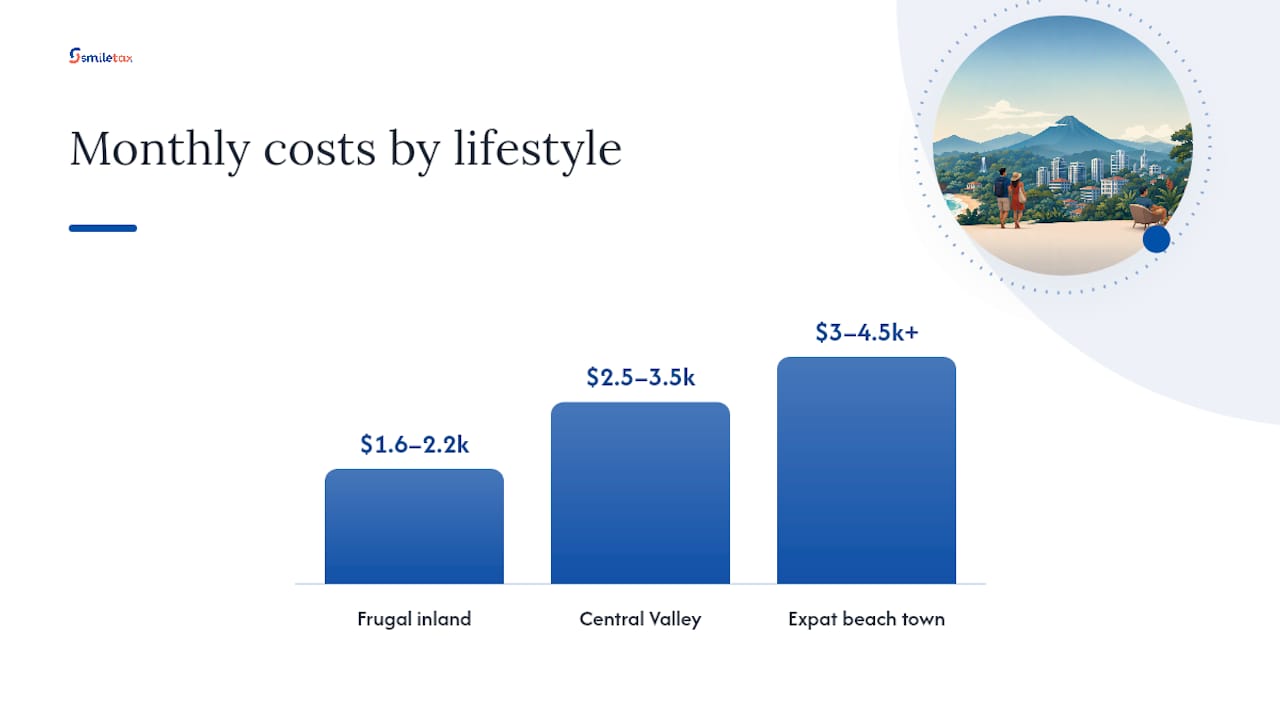
- Frugal inland: $1,600–$2,200/month (Central Valley, local shopping, public transport)
- Comfortable mid-range: $2,500–$3,500/month (Central Valley or secondary beach town, private car, some dining out)
- Beach lifestyle: $3,000–$4,500+/month (Guanacaste or Pacific coast, AC-heavy, expat amenities)
Healthcare access: Legal residents can enroll in the Caja Costarricense de Seguro Social (CCSS), Costa Rica’s public health system. Most expats pair Caja coverage with a private clinic for faster service and English-speaking doctors.
Your three immediate next steps:
- Identify which residency category fits your income (Pensionado, Rentista, Inversionista, or Digital Nomad)
- Book a 4–8 week scouting visit to your target region before committing to a lease or application
- Begin collecting the documents your chosen visa requires (apostilled records, police checks, proof of income)
Key Takeaways
Living in Costa Rica as an American is genuinely achievable on a range of budgets, but the right visa, the right region, and a realistic setup plan are what separate a smooth transition from a frustrating one.
| Point | Details |
|---|---|
| Pick the visa that fits your income | Pensionado suits retirees with modest pension income; Rentista fits passive income earners; Digital Nomad works for remote workers on foreign contracts. |
| Budget by location, not by country | Inland Central Valley living runs $1,600–$3,500/month; Pacific beach towns start around $3,000 and climb quickly with AC and rent. |
| Plan a scouting trip before committing | Four to eight weeks living and working in your target area reveals real costs, connectivity, and neighborhood fit that no guide can replicate. |
| Enroll in the Caja after residency | Legal residents must join CCSS once they receive their DIMEX; pair it with private coverage for faster specialist access. |
| Invest in community from day one | Language classes, local markets, and expat networks are the fastest path to feeling at home — and the most consistent predictor of long-term satisfaction. |
Table of Contents
- Which residency route is right for you?
- How the visa application process actually works
- What does it actually cost to live in Costa Rica?
- How healthcare works for American expats in Costa Rica
- Finding the right neighborhood and housing
- Banking, moving money, and staying connected
- Daily life, pura vida, and building your community
- Your pre-departure and arrival checklist
- What experienced expats know that most guides skip
- Sources
Which residency route is right for you?
Four main pathways cover the vast majority of Americans relocating to Costa Rica. Each has a different financial threshold, timeline, and long-term outcome. The U.S. Embassy in Costa Rica publishes practical guidance on navigating local residency requirements and is worth bookmarking before you start.
| Visa | Best for | Minimum financial proof | Duration and path to permanent residency | Timeline and complexity | Typical monthly cost profile | Healthcare access |
|---|---|---|---|---|---|---|
| Pensionado | Retirees with guaranteed pension income | $1,000/month in pension income | Temporary (renewable); eligible for permanent residency after 3 years | 6–12 months; moderate complexity | $1,600–$3,000+ depending on region | Caja enrollment required after approval |
| Rentista | Those with passive or investment income (not a pension) | $2,500/month in provable passive income | Temporary (renewable); eligible for permanent residency after 3 years | 6–12 months; moderate complexity | $2,500–$3,500+ | Caja enrollment required after approval |
| Inversionista | Investors with capital to deploy in Costa Rica | Minimum investment of $150,000 in approved sectors | Temporary; eligible for permanent residency after 3 years | 6–12 months; higher complexity | Varies widely by lifestyle | Caja enrollment required after approval |
| Digital Nomad | Remote workers employed by or contracting with companies outside Costa Rica | Proof of $2,500/month income (or higher for families) | Up to 2 years; does NOT lead directly to permanent residency | 1–3 months; relatively straightforward | $2,500–$3,500+ | Private insurance required; Caja not available under this visa |
Who each visa suits:
- Pensionado: The most popular route for American retirees. Social Security income qualifies, and the $1,000/month threshold is achievable for most retirees. After three years, you can apply for permanent residency.
- Rentista: Suited to early retirees or those with rental income, dividends, or annuities that don’t qualify as a pension. The $2,500/month bar is higher, but the path to permanence is the same.
- Inversionista: A fit for entrepreneurs or those buying property or a business. The $150,000 investment threshold is firm, and the process involves more legal coordination.
- Digital Nomad: Designed for remote workers on foreign payrolls or contracts. It’s faster to obtain and simpler to document, but it’s a two-year permit, not a residency pathway. Many digital nomads use it as a trial before switching to a longer-term route.
💡 Tip: Choose the visa that matches the most stable, provable income stream you can document. If you have a pension, the Pensionado route is almost always the clearest path. If you’re a remote worker testing the waters, the Digital Nomad visa lets you live legally for up to two years while you decide whether to commit to permanent residency.
How the visa application process actually works
The overall timeline for most residency applications runs from six months to just over a year, depending on document readiness and which route you’re pursuing. The Digital Nomad visa moves faster, often processing in one to three months. The most common bottleneck isn’t the immigration office — it’s getting apostilled documents from the U.S. in the right format.
For a full breakdown of legal and financial steps Americans need before and during the application, the moving to Costa Rica from the USA guide covers the practical groundwork in detail.
Step-by-step application process:
- Choose your residency category and confirm you meet the financial thresholds before collecting any documents.
- Gather U.S. documents: valid passport (with at least six months remaining), birth certificate, marriage certificate if applicable, and FBI criminal background check. All must be apostilled by the U.S. Secretary of State.
- Get certified translations: all documents in English must be translated into Spanish by a certified Costa Rican translator (traductor oficial). This is a legal requirement, not optional.
- Obtain proof of income or investment: pension award letters, bank statements, investment account statements, or employment contracts — depending on your visa category.
- Arrange medical documentation: some visa categories require a medical certificate from a Costa Rican-licensed physician and proof of health insurance.
- Notarize and authenticate: a Costa Rican notary (notario público) must authenticate your documents for submission to the Dirección General de Migración y Extranjería.
- Submit your application at the immigration office in San José or through your attorney. Pay the applicable government fees at the time of submission.
- Wait for approval: processing times vary. During this period, you can remain in the country legally on your tourist entry stamp, which the U.S. Department of State notes allows stays of up to 180 days.
- Receive your DIMEX card: this is your official residency ID and the document you’ll need for everything from opening a bank account to enrolling in the Caja.
- Enroll in the Caja (CCSS): once you have your DIMEX, you’re required to register with Costa Rica’s public health system. Contributions are income-based.
Document checklist:
- Valid passport (original and certified copies)
- Birth certificate (apostilled)
- Marriage certificate if applicable (apostilled)
- FBI criminal background check (apostilled, issued within the last six months)
- Proof of income (pension letters, bank statements, contracts)
- Certified Spanish translations of all English-language documents
- Medical certificate from a Costa Rican physician (for some visa types)
- Proof of health insurance or private coverage
- Passport-size photos
- Application fees (paid at submission)
On hiring an attorney: Most expats find it worth hiring a bilingual Costa Rican immigration attorney, particularly for the Pensionado, Rentista, and Inversionista routes. Attorney fees typically range from $1,000 to $2,500 depending on complexity. For the Digital Nomad visa, the process is simpler and some applicants handle it independently, though an attorney still reduces the risk of rejection due to document errors.
What does it actually cost to live in Costa Rica?
Location is the single biggest lever in your budget. A 2026 cost guide confirms that the gap between Central Valley living and a Pacific beach town can easily run $1,000–$1,500/month for the same lifestyle, driven primarily by rent and electricity.
Sample monthly budgets (single person):
| Expense | Frugal inland | Comfortable (Central Valley) | Expat-premium (beach town) |
|---|---|---|---|
| Rent (1-bed) | $800 | $900–$1,200 | $1,500–$2,500 |
| Groceries | $200–$300 | $350–$400 | $450–$600 |
| Utilities (electric, water) | $50–$80 | $80–$150 | $150–$350 |
| Internet | $30–$50 | $50–$80 | $50–$80 |
| Transport | $50–$100 | $150–$300 | $200–$400 |
| Healthcare (Caja + private top-up) | $100–$150 | $150–$300 | $200–$400 |
| Dining out and leisure | $100–$200 | $300–$350 | $400–$700 |
| Monthly total | $1,600–$2,200 | $2,500–$3,500 | $3,000–$4,500+ |
These figures align with the Tico Times’ 2026 regional ranges and the Moveabroadtoolkit, which both emphasize that the first year often runs higher due to setup costs.
Regional comparison:
| Region | Typical 1-bed rent | Climate and utilities | Healthcare access | Expat infrastructure |
|---|---|---|---|---|
| Central Valley (Escazú, Santa Ana, Atenas) | $700–$1,200/month | Spring-like, low AC use, lower electric bills | Excellent — private hospitals, CCSS clinics | Strong — English services, international schools, supermarkets |
| Pacific coast (Tamarindo, Nosara, Jacó) | $1,200–$2,500/month | Hot, heavy AC use, higher electric bills | Moderate — private clinics, some CCSS access | Good in tourist hubs; thinner in smaller towns |
| Caribbean coast (Puerto Viejo, Cahuita) | $800–$1,200/month | Humid, rain-heavy, moderate AC | Limited — fewer private options, longer travel to major hospitals | Smaller expat community, more local-focused |
| Inland secondary towns (Grecia, Sarchí, San Ramón) | $500–$800/month | Temperate, minimal AC | Moderate — CCSS clinics, some private options | Growing expat presence, quieter pace |
Common budget surprises:
- Imported goods (U.S. brands, specialty foods) carry high import tariffs and can cost two to three times what you’d pay at home
- Air conditioning in beach towns can push monthly electricity bills to $200–$350 or more, compared with $50–$80 in the Central Valley
- Vehicle ownership adds fuel, insurance, and maintenance costs — roads outside major cities can be rough on cars
- Short-term furnished rentals during your first one to three months cost more per month than a long-term lease, but they’re worth the flexibility
💡 Tip: The “city base, beach weekends” approach works well for budget-conscious expats. Living in the Central Valley keeps rent and utilities low while Guanacaste or the Pacific coast is a two-to-four hour drive for weekend trips. Many long-term expats live this way for years before deciding whether to move to the coast permanently.
How healthcare works for American expats in Costa Rica
Costa Rica’s public health system, the Caja Costarricense de Seguro Social (CCSS), covers legal residents and provides access to hospitals, clinics, specialists, and prescription medications. For a broader look at how Costa Rica compares with other expat destinations, the countries with the best healthcare for American expats guide offers useful context.
Most expats use a dual approach: Caja for routine care and major procedures, private clinics for faster appointments and English-speaking doctors. Private visits typically run $50–$100 for a general practitioner and $80–$200 for a specialist, which is manageable for occasional use.
Caja vs. private care — key differences:
- Caja (CCSS): Available to all legal residents after DIMEX issuance. Contributions are income-based (typically 5–13% of declared income). Covers hospitalizations, surgeries, specialist referrals, and medications. Wait times for non-emergency specialist appointments can run weeks to months.
- Private clinics: No enrollment required. Pay per visit. English-speaking doctors are common in San José, Escazú, and major tourist areas. Faster access for diagnostics and elective procedures. Costs are low by U.S. standards but not negligible over time.
- Private health insurance: International health plans (available through insurers operating in Costa Rica) can cover private care costs and are required under the Digital Nomad visa. Many Pensionado and Rentista holders also carry a supplemental private plan for peace of mind.
How to enroll in the Caja after residency:
- Obtain your DIMEX card from the immigration office.
- Visit your nearest CCSS office (Ebáis or regional clinic) with your DIMEX, passport, and proof of address.
- Declare your income level — this determines your monthly contribution.
- Receive your Caja membership number and begin accessing services.
During the residency application period (before your DIMEX arrives), you won’t yet qualify for Caja enrollment. Plan for private coverage or an international health insurance policy to bridge that gap. For a detailed comparison of international health insurance options, the health insurance abroad guide for American expats is a practical starting point.
Finding the right neighborhood and housing
Where you live shapes everything: your commute, your social life, your grocery bill, and your electricity costs. The Central Valley towns of Escazú, Santa Ana, and Atenas are the most popular expat zones for good reason — temperate climate, proximity to San José’s private hospitals, international schools, and a well-established English-speaking community. Guanacaste and the Pacific coast offer beach life with a clear price premium. The Caribbean side is quieter, more affordable, and less developed for expat services.
What each region offers:
- Escazú and Santa Ana (Central Valley): Urban convenience, the best private hospital access in the country, international supermarkets, and a large American expat community. Rents are higher than other inland areas but lower than the coast.
- Atenas and Grecia (Central Valley, west): Slower pace, cooler climate, lower rents, and a growing retiree community. Less English infrastructure but very livable once you’re settled.
- Tamarindo and Nosara (Guanacaste/Pacific): Strong expat and digital nomad communities, beach access, but noticeably higher rents and electricity bills. Seasonal availability affects rental prices.
- Puerto Viejo (Caribbean): Affordable, culturally distinct, and beautiful — but healthcare access is limited and infrastructure is thinner. Better suited to younger expats or those comfortable with a more remote lifestyle.
Rental checklist:
- Deposits in Costa Rica typically run one to two months’ rent, paid upfront
- Standard lease lengths are one year, though shorter furnished rentals are common and useful for newcomers
- Leases are often written in Spanish — have a bilingual attorney or trusted local review any contract before signing
- Rental listings are frequently informal (Facebook groups, local word of mouth) rather than through formal agencies; this is normal but requires more due diligence
- Seasonal demand in beach towns drives prices up from December through April — plan your search accordingly
- Utilities may or may not be included; always confirm what’s covered before signing
For Americans thinking about eventually buying property, the guide to where Americans can buy property overseas covers the legal framework and practical considerations.
💡 Tip: Spend at least four to six weeks living and working in your target area before signing a long-term lease or making any purchase. Rent a furnished place month-to-month, shop at the local feria, test your internet connection during peak hours, and drive the roads you’d use daily. What looks ideal on a two-week vacation often feels different after a full month of real life.
Banking, moving money, and staying connected
You can manage most of your financial life in Costa Rica with a combination of a U.S. bank account and local payment methods. Many expats keep their U.S. checking account active for international transfers and use a local account for rent, utilities, and daily expenses.
Opening a local bank account:
- State banks (Banco Nacional, Banco de Costa Rica) are accessible but require a DIMEX for full account access — meaning you’ll need residency first.
- During the pre-residency period, some private banks (BAC Credomatic, Scotiabank) offer accounts with a passport and proof of address, though requirements vary by branch.
- Bring your DIMEX, passport, proof of address (a utility bill or lease), and proof of income to your appointment.
- Expect the process to take one to three visits — Costa Rican banking moves at its own pace.
Moving money from the U.S.:
- International wire transfer services (Wise, Remitly, and similar platforms) offer competitive exchange rates and lower fees than traditional bank wires
- ATMs are widely available in cities and tourist areas; Visa and Mastercard are broadly accepted
- The local currency is the Costa Rican Colón (CRC), though USD is accepted in many tourist areas, hotels, and some supermarkets
- Avoid exchanging cash at airports; rates at local banks or ATMs are consistently better
Phone and internet:
- Home fiber internet is available in most urban and suburban areas, with speeds of 50–200 Mbps for $30–$60/month
- Mobile data from providers like Kolbi, Claro, and Movistar covers most populated areas; a local SIM with a data plan costs $10–$30/month
- Rural and coastal areas can have inconsistent connectivity — test speeds during your scouting trip, especially if remote work depends on video calls
- For backup, a mobile hotspot with a local SIM is a reliable failsafe for digital nomads
Daily life, pura vida, and building your community
The expats who thrive in Costa Rica are the ones who embrace “pura vida” as a genuine operating principle, not just a phrase on a souvenir. It means a slower pace, patience with bureaucracy, and investing in relationships rather than chasing U.S.-level convenience. Those who arrive expecting everything to work the way it does back home tend to find the adjustment harder than it needs to be.
Honest pros and cons:
- Pros: Year-round warm climate (with regional variation), extraordinary natural beauty, relatively affordable healthcare, a large and welcoming expat community, political stability, and genuine warmth from locals
- Cons: Bureaucracy moves slowly, road quality outside cities can be poor, imported goods are expensive, petty theft is a real concern in tourist areas, and some services (plumbing, internet repairs) can take longer than expected
- For retirees: The combination of affordable healthcare, natural beauty, and a well-established expat network makes Costa Rica one of the most consistently recommended retirement destinations in Latin America
- For remote workers: Infrastructure in the Central Valley and major beach hubs is solid, but connectivity in rural areas requires testing before committing
The Global Peace Index 2025 places Costa Rica among the most stable and peaceful countries in the region — a meaningful data point for retirees and families evaluating safety.
Building community:
- Enroll in Spanish classes early — even basic conversational Spanish opens doors and earns respect from locals
- Join local Facebook groups and expat forums specific to your target region (they’re active and genuinely helpful)
- Attend community events, farmers’ markets (ferias), and local festivals
- Volunteer with local organizations — conservation, education, and community development groups are active throughout the country
- Seek out community centers and sports clubs; many towns have active pickleball, tennis, and hiking groups with mixed local-expat membership
Safety habits worth building:
- Use ride-hailing apps (Uber operates widely) rather than unmarked taxis in unfamiliar areas
- Avoid displaying expensive electronics, jewelry, or large amounts of cash in tourist zones
- Lock vehicles and never leave valuables visible inside — car break-ins are the most common property crime
- Register with the U.S. Embassy in San José through the Smart Traveler Enrollment Program (STEP) so you receive safety alerts and can be reached in an emergency
- Check the State Department’s Costa Rica travel advisory periodically for updated safety guidance
- If you plan to live in a remote area, consider medical evacuation insurance — it’s relatively inexpensive and worth having
Your pre-departure and arrival checklist
The first three to six months in Costa Rica involve more logistics than most people anticipate. Planning the sequence matters — some steps can’t happen until others are complete.
Before you leave the U.S.:
- Order your FBI background check early (processing can take 8–12 weeks through the standard channel; FBI-approved channelers are faster)
- Apostille your birth certificate, marriage certificate, and any other required documents through your state’s Secretary of State office
- Arrange a 90-to-180-day supply of any prescription medications — some U.S. prescriptions aren’t available in Costa Rica or require a local doctor’s prescription
- Notify your U.S. bank of your move and confirm your cards will work internationally without excessive fees
- Set up mail forwarding or a virtual mailbox service for U.S. correspondence
- Research and shortlist immigration attorneys in your target region before you arrive
On arrival — first week:
- Secure temporary furnished housing (booked in advance for at least the first month)
- Get a local SIM card for a phone number and data connectivity
- Open a P.O. box or confirm your address for official correspondence
- Begin meeting with immigration attorneys to review your document package
First month:
- Finalize your immigration attorney and submit your residency application (or begin the Digital Nomad visa process)
- Open a local bank account if your residency status allows
- Register with the U.S. Embassy through STEP
First three to six months:
- Receive your DIMEX card upon residency approval
- Enroll in the Caja (CCSS) with your DIMEX
- Establish relationships with a local private clinic and a general practitioner
- Settle into a longer-term rental once you’ve confirmed the neighborhood suits your daily life
Initial setup cost estimates:
- Furnished short-term rental (first 1–3 months): $1,200–$2,500/month depending on region
- Immigration attorney fees: $1,000–$2,500
- Document apostilles and certified translations: $300–$700
- Vehicle purchase or long-term rental (if needed): $8,000–$20,000 for a used 4WD, or $400–$800/month for a rental
- Emergency fund runway: plan for at least three months of living expenses in accessible savings before you arrive
What experienced expats know that most guides skip
The Central Valley’s cost advantage over the coast isn’t just about rent. Electricity bills in beach towns can run two to three times higher than in Escazú or Atenas because of constant AC use — a detail that rarely appears in headline budget figures but shows up clearly in monthly bank statements. Expats who move inland and visit the coast on weekends consistently report lower overall costs and less lifestyle friction.
A practical 4–8 week scouting trip plan:
- Week 1–2: Stay in the Central Valley (Escazú or Atenas). Test internet speeds from a co-working space or rental, visit private clinics, and explore grocery options (local ferias vs. supermarkets).
- Week 3–4: Move to your top coastal or secondary region. Rent a furnished place, test connectivity, and note the real electricity and transport costs.
- Week 5–8 (if time allows): Settle into your preferred area, attend a local expat meetup, and begin preliminary conversations with an immigration attorney.
Provider onboarding — who to hire and how to vet them:
- Immigration attorney: Ask for referrals from established expat Facebook groups specific to your region. Verify they are registered with the Costa Rican Bar Association (Colegio de Abogados). Avoid anyone who guarantees timelines — no attorney can control immigration processing speeds.
- Real estate agent or rental contact: Use agents who specialize in expat clients and can provide references. For rentals, always view the property in person before paying any deposit.
- Local contractor or handyman: Get at least two quotes for any work. Ask your expat community for vetted recommendations — word of mouth is the most reliable filter here.
Red flags to avoid:
- Any service provider who asks for large cash payments upfront with no written contract
- Rental listings with no verifiable address or landlord contact information
- Immigration “consultants” who are not licensed attorneys — document errors can delay your application by months
💡 Tip: Run your scouting trip as a working trip. Keep your normal remote work schedule, cook at home most days, and use local transport rather than taxis. The goal is to stress-test your real daily life, not to vacation. You’ll learn more in four weeks of living like a resident than in six months of weekend visits.
Sources
Before you submit a single document or sign a lease, verify the current rules directly from official and authoritative sources. Requirements and fees do change, and the sources below reflect the most reliable starting points.
- Travel
- What It Really Costs to Live in Costa Rica as an Expat in 2026
- Getwherenext
- Moveabroadtoolkit
- Visionofhumanity
This article is for general informational purposes only and does not constitute legal, immigration, or financial advice. Visa requirements, fees, and procedures can change. Confirm current rules with the Costa Rica Dirección General de Migración y Extranjería, the U.S. Embassy in San José, or a licensed Costa Rican immigration attorney before beginning your application.
Living in Costa Rica as an American means your U.S. tax filing obligations don’t stop at the border. SmileTax keeps U.S. filing straightforward for Americans in Costa Rica — working directly with experienced tax professionals who understand expat realities, with no generic software and no handoffs to unknown preparers. If you want your U.S. taxes handled with confidence and simplicity, SmileTax was built for exactly this.
This article is general information, not a substitute for advice from a qualified lawyer. Consult a qualified legal professional about your own circumstances before acting on anything here.