

Dubai is defined by a striking paradox for American expats: zero local income tax and world-class infrastructure sit alongside strict legal codes, punishing summer heat, and a residency structure that offers no permanent home. Living in Dubai as an American expat means weighing real financial advantages against equally real lifestyle trade-offs. The UAE hosts roughly 85% non-Emirati residents, making it one of the most internationally diverse cities on earth. That statistic tells you something important: Dubai was built for expats, but it was not built to keep them forever.
What are the main advantages of living in Dubai for American expats?
Dubai’s appeal to American professionals is grounded in concrete financial and lifestyle benefits that few cities can match simultaneously.
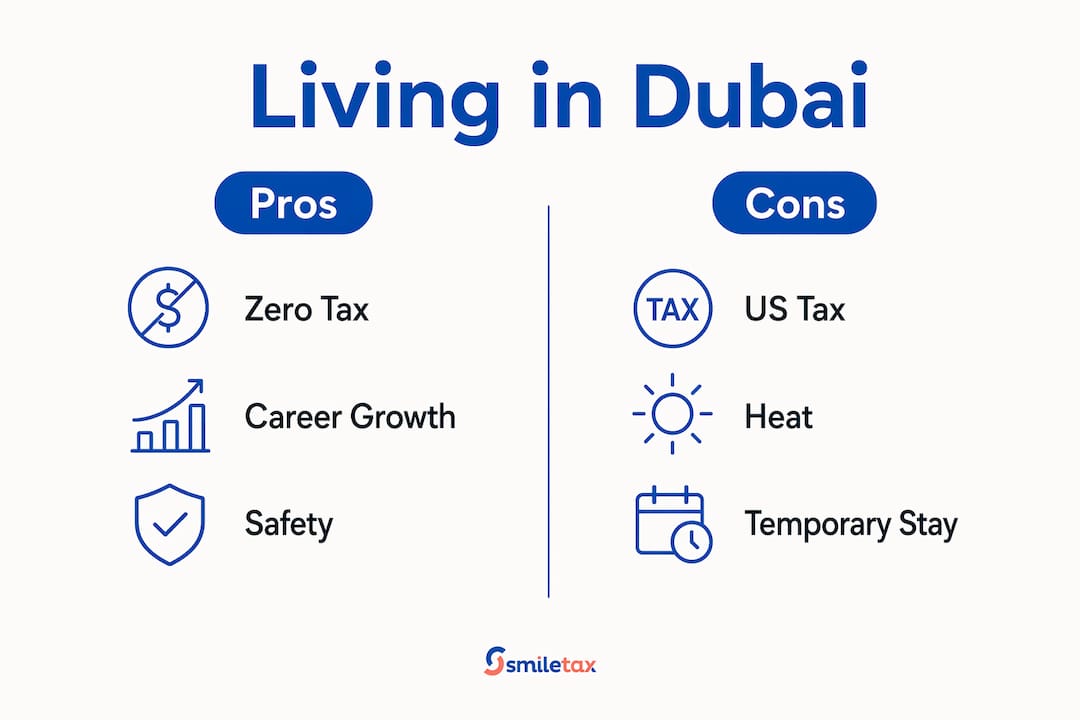
Zero local income tax is the headline benefit. The UAE levies no personal income tax on salaries, which means your gross compensation and your take-home pay are the same number. For Americans earning strong salaries in finance, technology, energy, or education, this translates directly into faster savings and a noticeably higher standard of living. Many employers in Dubai also offer housing allowances, school fee contributions, and annual flight allowances as part of standard packages, which amplifies the financial advantage further.

Career opportunities are concentrated in multinational firms, regional headquarters, and fast-growing tech and logistics sectors. Dubai functions as the commercial hub for the broader Middle East, North Africa, and South Asia region, which means companies like Amazon, Microsoft, HSBC, and PricewaterhouseCoopers all maintain significant regional operations there. For mid-career professionals, a Dubai posting often accelerates both compensation and international experience simultaneously.
The city’s infrastructure and urban services are genuinely world-class. The Dubai Metro covers major corridors efficiently, roads are well maintained, and utilities rarely fail. Healthcare access is strong, with facilities like Cleveland Clinic Abu Dhabi and Mediclinic operating across the emirate. International schools, including American curriculum schools such as American School of Dubai and GEMS American Academy, provide families with familiar educational frameworks.
Personal safety in Dubai is consistently high. Violent crime rates are low, and public spaces feel secure at all hours. For American families relocating from major U.S. cities, the contrast in day-to-day safety is often one of the most immediately noticed quality-of-life improvements.
- Zero UAE personal income tax increases take-home pay significantly
- Multinational employers offer competitive packages with housing and school allowances
- World-class healthcare at facilities like Cleveland Clinic Abu Dhabi
- American curriculum schools including American School of Dubai and GEMS American Academy
- Low violent crime rates and high personal safety in public spaces
- Direct flight connections to the U.S. via Emirates and United Airlines
Tip: Before accepting a Dubai job offer, calculate your total compensation package including housing allowance, school fees, and flights. The base salary alone rarely tells the full story of what life will actually cost.
What cons and challenges should American expats consider before moving to Dubai?
A clear-eyed look at expat life in Dubai requires confronting several challenges that do not appear in recruitment brochures.
U.S. tax obligations do not disappear. American citizens must file U.S. returns on worldwide income regardless of where they live. Zero UAE tax does not mean zero U.S. tax complexity. You still file annually with the IRS, report foreign financial accounts, and navigate forms that most Americans have never encountered before. This administrative layer adds cost and time every year.
UAE laws are strict and enforced. The U.S. State Department advises Americans to be fully aware of UAE laws covering social behavior, drug possession, and financial disputes. Actions that carry minor consequences in the U.S., including public intoxication, certain social media posts, or bounced checks, can result in arrest or detention in Dubai.
Summer heat is genuinely extreme. Temperatures between May and September regularly exceed 104°F (40°C) with high humidity. Outdoor life shuts down for roughly five months each year. Families with children who expect outdoor recreation will find this period genuinely limiting, and the psychological effect of being confined to air-conditioned spaces for months is underestimated by most new arrivals.
The expat community is transient. With 85% of Dubai residents being foreigners and many staying only around two years, the social environment has a revolving-door quality. Friendships form quickly but dissolve just as fast when contracts end. Building a stable social network requires consistent effort and a realistic acceptance that goodbyes are frequent.
Residency is tied to employment. There is no general pathway to permanent residency or citizenship for most expats. Your right to remain in Dubai is directly linked to your employer’s sponsorship. If you lose your job, you have a limited window to find new sponsorship or leave the country.
Housing and schooling costs are high. Annual school fees at American curriculum schools typically run from $15,000 to $30,000 per child. Housing deposits and upfront payments are substantial, with many landlords requiring one or two post-dated checks covering the full year’s rent at signing.
Reality check: Dubai’s financial advantages are real, but they require careful budgeting. A family with two school-age children can spend $60,000 or more annually on school fees alone, which significantly offsets the tax savings that initially attract many Americans.
How does the U.S. tax layer affect Americans living in Dubai?
The zero UAE income tax benefit is real locally, but incomplete as a full picture for Americans. The U.S. taxes its citizens on worldwide income regardless of where they live, which means moving to Dubai does not remove your IRS filing obligation.
The Foreign Earned Income Exclusion (FEIE), claimed via IRS Form 2555, allows qualifying Americans to exclude a portion of foreign-earned income from U.S. taxable income. Qualifying requires meeting either the Physical Presence Test (330 full days outside the U.S. in a 12-month period) or the Bona Fide Residence Test. Mid-year moves and frequent trips back to the U.S. can disrupt eligibility, so tracking your travel days carefully matters from day one.
Americans with foreign bank accounts also face Foreign Bank Account Report (FBAR) obligations if account balances exceed certain thresholds. Opening a local UAE bank account, which is a practical necessity for daily life in Dubai, creates a reporting requirement back in the U.S.
| U.S. Filing Consideration | What It Means for Dubai Expats |
|---|---|
| Annual U.S. tax return | Required regardless of UAE zero-tax status |
| Foreign Earned Income Exclusion (Form 2555) | Can reduce U.S. taxable income if Physical Presence or Bona Fide Residence tests are met |
| FBAR (FinCEN Form 114) | Required if UAE bank accounts exceed reporting thresholds |
| Extended filing deadlines | Americans abroad receive an automatic filing extension to June 15 each year |
Tip: Track every day you spend in the U.S. from the moment you move to Dubai. The Physical Presence Test counts exact days, and even a few extra trips home can affect your FEIE eligibility for that tax year.
What practical steps should new American expats take when setting up life in Dubai?
The first 90 days in Dubai are dominated by administrative tasks that must be completed in a specific sequence. Getting this sequence wrong creates delays that cascade across every other area of your life.
The Emirates ID is the foundational document. Without it, you cannot open a bank account, sign a lease, set up utilities, or register a vehicle. Your employer typically initiates the residency visa process, which then unlocks the Emirates ID application. Expect this to take two to four weeks after arrival.
- Emirates ID: Apply through your employer’s PRO (Public Relations Officer) or directly via the IDA portal. This is your gateway to all other services.
- Bank account: Emirates NBD, Abu Dhabi Commercial Bank (ADCB), and Mashreq Bank are common choices for expats. Most require your Emirates ID, visa, and salary certificate.
- Housing: Expect to pay one or two post-dated checks for the full year’s rent. Neighborhoods like Jumeirah, Arabian Ranches, and Dubai Hills Estate are popular with American families.
- School enrollment: American curriculum schools fill quickly. Contact American School of Dubai or GEMS American Academy before you arrive, not after.
- Driving license: U.S. license holders from certain states can convert directly without a driving test. Check the Roads and Transport Authority (RTA) website for your state’s eligibility.
- Community building: Groups like InterNations Dubai and Facebook expat communities provide immediate social connection while you build longer-term friendships.
Transportation in Dubai is heavily car-dependent outside of the metro corridors. Most families own at least one vehicle. The Dubai Metro is reliable for central routes but does not reach many residential neighborhoods. Budget for a car purchase or long-term rental as part of your initial setup costs.
How does the social and legal environment affect Americans in Dubai?
Dubai’s social environment is genuinely international but structurally temporary. Residency tied to employment means that most expats are always one contract away from departure, which shapes how people invest in relationships and community. Americans who thrive in Dubai tend to approach it as a medium-term career posting rather than a permanent home.
The legal environment requires active awareness. Civil travel bans can be imposed on individuals involved in financial or contract disputes, sometimes preventing departure from the UAE until the matter is resolved. This is not a theoretical risk. Americans have faced extended detention due to unresolved business disputes or unpaid debts. Careful contract management and understanding your legal obligations before signing anything are non-negotiable practices.
| Factor | Positive | Challenge |
|---|---|---|
| Personal safety | Low violent crime, secure public spaces | Strict enforcement of social behavior laws |
| Community | Large, diverse international expat network | High turnover; friendships frequently disrupted |
| Legal standing | Clear rules and predictable enforcement | Civil travel bans possible in financial disputes |
| Residency | Employer-sponsored visa is straightforward | No permanent residency or citizenship pathway |
Tip: Before signing any business contract or lease in Dubai, have it reviewed by a UAE-qualified legal professional. The legal framework differs significantly from U.S. contract law, and misunderstandings can have serious consequences.
Key takeaways
Dubai offers Americans genuine financial and lifestyle advantages, but the absence of UAE income tax does not remove U.S. filing obligations, and the city’s strict legal environment and transient residency structure require careful, informed planning before committing to a move.
| Point | Details |
|---|---|
| Zero UAE tax, ongoing U.S. filing | Americans still file U.S. returns on worldwide income regardless of local tax rates. |
| High cost of family life | School fees and housing deposits can reach $60,000 or more annually for families. |
| Transient social environment | 85% of Dubai residents are foreigners, with many staying only around two years. |
| Legal compliance is non-negotiable | Civil travel bans and strict social laws create real risks for non-compliant expats. |
| First 90 days are document-driven | Emirates ID unlocks banking, housing, and utilities; delays in this step cascade widely. |
What the numbers don’t tell you about Dubai expat life
Dubai’s reputation as a tax-free paradise is accurate in the narrowest sense. The UAE takes nothing from your paycheck. But the full picture of American expat life in Dubai is more layered than that headline suggests.
The city rewards people who arrive prepared. Those who research the legal environment, understand their U.S. filing obligations, budget honestly for housing and schooling, and approach the social scene with realistic expectations tend to have genuinely positive experiences. Those who arrive expecting a permanent, low-friction life often find the transient nature of the community and the administrative demands of the first year more disorienting than anticipated.
The climate deserves more weight in the decision than most people give it. Five months of extreme heat is not a minor inconvenience. It reshapes your entire social calendar, your children’s outdoor activities, and your relationship with the city itself. Families who love outdoor life should factor this in seriously.
Dubai suits a specific type of expat: someone with a clear professional goal, a medium-term time horizon, and the flexibility to adapt to a very different legal and cultural framework. For that person, it can be an exceptional base. For someone seeking permanence, community roots, or a relaxed relationship with rules, the fit is less obvious.
The financial upside is real. So are the trade-offs. Going in with both sets of facts gives you the best chance of making the right call for your situation.
Managing your U.S. tax obligations while living in Dubai
Living in Dubai does not pause your U.S. tax filing requirements. Americans abroad still file annually with the IRS, report foreign accounts, and navigate forms like the Foreign Earned Income Exclusion that most people have never dealt with before. That complexity is manageable with the right support.
SmileTax works specifically with Americans living and working abroad, including those based in Dubai and across the UAE. Every client works directly with an experienced U.S. tax professional, with no handoffs and no generic software. If you want your U.S. expat taxes handled accurately and without the stress of figuring it out alone, SmileTax was built for exactly that situation. Clear pricing, real accountability, and a team that understands how expat life actually works.
FAQ
Does Dubai have income tax for American expats?
The UAE levies no personal income tax on salaries, so Americans working in Dubai pay nothing locally on their earnings. However, U.S. citizens must still file U.S. tax returns on worldwide income and report foreign financial accounts to the IRS each year.
Can Americans get permanent residency in Dubai?
Standard employment-based residency in Dubai is tied to your employer’s sponsorship and does not lead to permanent residency or citizenship. The UAE does offer long-term Golden Visas for qualifying investors, entrepreneurs, and specialized professionals, but these require meeting specific criteria.
How hot does Dubai get in summer?
Temperatures between May and September regularly exceed 104°F (40°C) with high humidity, effectively shutting down outdoor life for five months. Most residents plan vacations or extended trips abroad during peak summer to escape the heat.
Is Dubai safe for American expats?
Dubai has very low violent crime rates and public spaces are considered safe at all hours. The primary safety consideration for Americans is legal compliance, as strict UAE laws on social behavior, financial disputes, and drug possession carry serious consequences including detention and civil travel bans.
What are the biggest costs for American families in Dubai?
Housing and international school fees are the largest expenses. Annual fees at American curriculum schools typically range from $15,000 to $30,000 per child, and most landlords require one or two post-dated checks covering the full year’s rent at signing.