

Ecuador is one of the most practical and affordable destinations for Americans living abroad, particularly retirees on modest pensions and remote workers paid in USD. The country uses the US dollar as its official currency, which removes exchange-rate risk entirely for Americans relying on Social Security or U.S.-sourced income. Entry is visa-free for up to 90 days as a tourist, and several clear residency paths exist for those who want to stay longer.
Monthly cost bands at a glance:
- Lean/frugal: budget-friendly monthly costs in smaller cities or towns, with local shopping and basic housing
- Comfortable: moderate monthly costs covering furnished apartments, private health insurance, and occasional dining out
- Upscale: higher monthly costs reflecting larger cities, premium housing, and increased dining and travel
Top cities for American expats include Cuenca (large expat community, walkable, spring-like highland climate), Quito (capital city amenities, direct U.S. flights, runs 15–20% higher in cost), Guayaquil (coastal business hub, warmer and more humid), and Manta (relaxed Pacific coast lifestyle). Highland cities sit above 8,000 feet, so altitude sensitivity is worth testing before committing. Coastal cities are hotter and typically require air conditioning, which adds to monthly utility costs.
Main residency routes for Americans include the Pensionado (pensioner) visa, the Investor (Inversionista) visa, and the Rentista visa. The Pensionado visa is especially popular with retirees because its income threshold is low compared to most Latin American countries. The U.S. Embassy in Quito is the primary U.S. government resource for Americans in Ecuador.

Tip: Use your initial 90-day tourist entry as a scouting trip. Walk the neighborhoods you’d actually rent in, visit a private clinic, and attend a local expat meetup. Bring small USD denominations ($20s and below) since many vendors and taxis struggle to make change for $50 or $100 bills. Start your FBI background check and apostille process 2–3 months before you plan to apply for residency, as document errors are the most common cause of delays.
Key residency steps (simplified):
- Enter on a 90-day tourist stamp and scout your preferred city.
- Gather required U.S. documents (FBI background check, proof of income or investment), apostilled and translated into Spanish.
- Submit your residency application at Ecuador’s Cancillería (immigration authority) in-country.
- Once approved, a temporary residency visa is valid for two years; after 21 months of residence, permanent residency becomes available.
Ecuador is significantly cheaper than the U.S. on many measures than the U.S. on many measures. Private healthcare is a standout benefit: a GP visit at a quality private clinic typically costs modestly less than in the U.S., with MRI scans similarly affordable, compared to multiples of that in the U.S. Specialist access is best in Quito and Guayaquil; smaller towns and coastal areas have fewer options. Private health insurance for expats generally costs substantially less than comparable U.S. plans. For a broader comparison of healthcare options abroad, Ecuador consistently ranks well for affordability.
Housing in Cuenca starts from affordable ranges for basic one-bedroom apartments to moderately priced two-bedroom units with views. Quito’s upscale districts generally cost 10–20% more than Cuenca for equivalent space. Most expats skip car ownership entirely, relying on walking, buses are inexpensive, costing less than a dollar per ride, and rideshare apps like Uber and InDriver. Bringing a vehicle from the U.S. is generally not worth it given complex import rules and high taxes.
Spanish is not required to get started, especially in Cuenca’s established expat community, but even basic conversational Spanish opens doors to better prices, warmer interactions, and a richer daily experience; for practical tips on living abroad and managing local logistics, see this expat advice blog. Private Spanish lessons are available at modest hourly rates. If you want to compare Ecuador’s value against other affordable destinations, the cheapest countries for Americans abroad guide offers useful context.
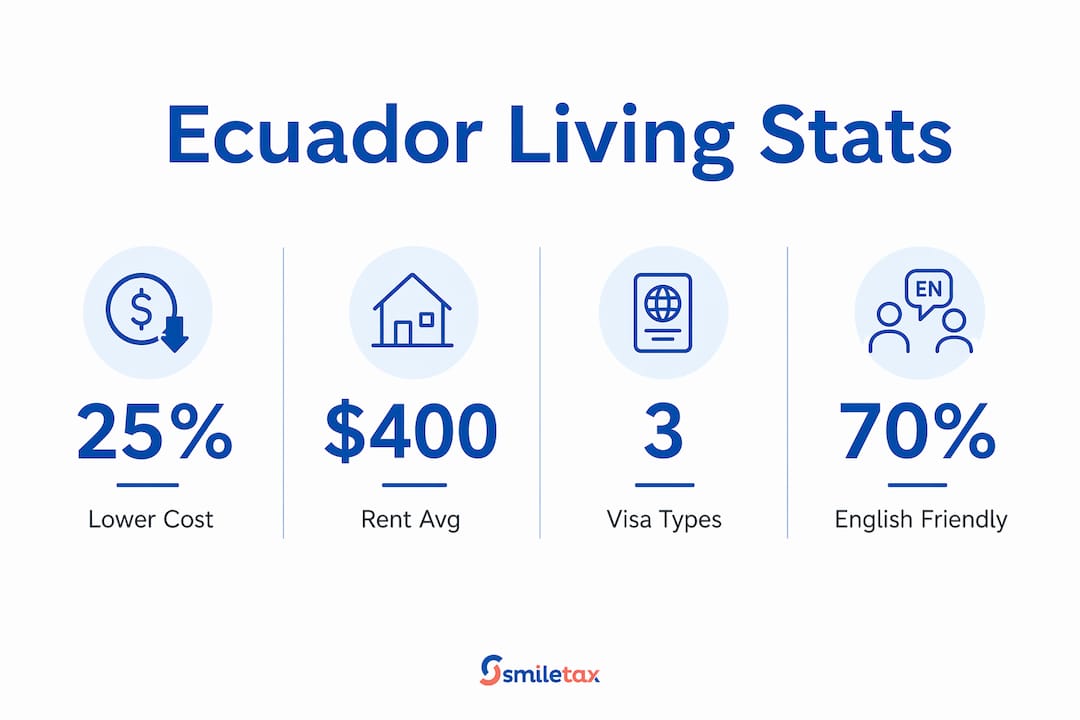
Table of Contents
Your US Filing Stays Simple with SmileTax
Moving to Ecuador is the exciting part. Keeping your U.S. filing current while you’re there doesn’t have to be complicated. SmileTax works specifically with Americans living abroad, including retirees, remote workers, and long-term expats, handling U.S. returns accurately and without the drama of large impersonal firms. Every client works directly with an experienced U.S. tax professional, remotely and securely, no matter where in Ecuador you’re based. Visit smile.tax to learn more.
Key Takeaways
Ecuador is an affordable, practical choice for Americans abroad, especially retirees and remote workers who benefit from dollarization and low living costs.
| Point | Details |
|---|---|
| Dollarization advantage | Ecuador uses the USD, eliminating exchange-rate risk for Americans on pensions or U.S.-sourced income. |
| Realistic monthly costs | Lean budgets for a solo person in Cuenca can be under $1,000/month, while comfortable two-person budgets commonly range $1,800–$2,500/month. |
| Main visa routes | Pensionado, Investor (Inversionista), and Rentista visas are the primary long-term options for Americans. |
| Healthcare affordability | Private GP visits cost $30–$60; private health insurance typically runs $70–$150/month. |
| SmileTax for expats | SmileTax handles U.S. filing for Americans in Ecuador, working one-on-one with each client remotely. |
This article is general information for Americans considering life in Ecuador. Confirm current visa requirements and fees with Ecuador’s official immigration authority or a qualified immigration professional before applying.