

France has captured the American imagination for generations. Cobblestone streets, world-class wine, and a culture that seems to take beauty seriously. But living in France as an American, the good the bad and the surprising realities of daily life, tells a more layered story than any Instagram feed suggests. The gap between a two-week vacation and a life actually lived there is enormous. This guide cuts through the romance to give American expats an honest, practical look at what France really delivers, and what it demands in return.
Table of Contents
- Key takeaways
- Living in France as an American: what the experience actually looks like
- Visas, residence permits, and the paperwork reality
- Cultural contrasts and the social integration puzzle
- Housing, healthcare, and the real cost of living
- Practical surprises that catch Americans off guard
- Weighing the pros, cons, and surprises
- An honest perspective on making France work for you
- Your next step as a US expat in France
- FAQ
Key takeaways
| Point | Details |
|---|---|
| Visa validation is non-negotiable | VLS-TS holders must validate online within 3 months of arrival or lose legal status in France. |
| Administrative costs have risen | Residence permit fees increased significantly in 2026, so budget carefully before you move. |
| Social integration takes years | Meaningful friendships in France develop slowly through school, work, or long-term community involvement. |
| Healthcare has a waiting period | Non-working expats wait three months before qualifying for public healthcare coverage. |
| Paperwork preparation pays off | Gathering key documents before arrival dramatically reduces stress during your first weeks in France. |
Living in France as an American: what the experience actually looks like
The phrase “living abroad as an American” carries a certain aspirational weight. France, in particular, tends to attract Americans drawn to its food culture, architecture, and pace of life. What surprises most people once they arrive is not the culture itself. It is the bureaucratic infrastructure wrapped around it.
France operates on a compliance-first model. Every administrative interaction, from opening a bank account to enrolling a child in school, requires documentation. Not once. Repeatedly. The justificatif de domicile, or proof of address, is one of the most requested documents in French administrative life. Expats describe being asked for it constantly, across entirely separate institutions and processes.
Understanding this reality upfront changes everything. Americans who arrive expecting French efficiency to match French elegance are often caught off guard. Those who treat the administrative process as part of the experience tend to settle in far more successfully.
Visas, residence permits, and the paperwork reality
The most important step for any American planning to stay in France beyond 90 days is choosing the right visa. The most common option for non-working American expats is the long-stay visitor visa, known as the VLS-TS. It is valid for 4 to 12 months and allows you to live in France without working locally.
Here is where many expats get tripped up. Arriving in France with this visa does not complete the process. You must validate it online via the ANEF portal within three months of arrival. This step also requires paying a validation tax. Miss this deadline and you lose your legal residency status. There are no warnings and no extensions.
Beyond the visa itself, Americans planning longer stays will eventually need a residence permit (titre de séjour). The fees for these increased significantly in 2026. Current costs are:
- First issuance: €350 (up from €225)
- Renewal: €250 (up from €225)
- Minors: €150 reduced rate
These fee increases in 2026 are a good example of why budget planning for life in France needs to stay flexible. Administrative costs shift without much notice.
Tip: Before you arrive, gather multiple certified copies of every key document: your birth certificate, marriage certificate if applicable, proof of financial means, and accommodation confirmation. French administrative offices often request originals or certified copies, and getting them re-issued from the US while abroad takes time you may not have.
A solid pre-departure moving abroad checklist specifically built for Americans heading to Europe can help you stay ahead of these requirements.
Cultural contrasts and the social integration puzzle
The challenges of living in France go well beyond paperwork. The cultural adjustment for Americans is real, and it tends to hit hardest in social situations.
French social culture is built on earned trust. Friendships do not form quickly or casually. Meaningful connections in France typically develop through sustained proximity, shared institutions like schools or workplaces, or long-term neighborhood engagement. An American who expects the easy warmth of a first conversation to deepen naturally into friendship may feel confused when it simply does not.
This is not coldness. It is a different set of social rules. French people tend to be quite formal with acquaintances and intensely loyal to close friends. The challenge is that the bridge between the two requires time and context that most new expats have not yet built.
“The French aren’t unfriendly. They’re just not in a hurry to let you in. Once you earn that trust, it lasts.” This observation captures something many American expats in France eventually come to understand.
Customer service is another adjustment. The American model of enthusiastic, customer-first service does not translate. French service culture prioritizes stability over speed, and staff are not expected to perform friendliness. A neutral, businesslike interaction is the norm, not a sign of dissatisfaction with you.
Practical strategies that help with social integration include:
- Enrolling in a local language class, even if your French is already decent
- Joining volunteer groups or neighborhood associations (associations de quartier)
- If you have children, getting involved in school parent networks
- Attending recurring events like weekly markets where familiar faces accumulate over time
Building early social anchors matters more than any single grand social gesture.
Housing, healthcare, and the real cost of living
The financial picture for American expats in France contains both genuine advantages and some rude awakenings.

Housing
Paris is expensive by any measure, and popular regions like Provence and the Côte d’Azur are not far behind. If you are drawn to the lifestyle of the French Riviera, understanding the full financial picture of that region before committing is worth the time. Smaller cities and rural areas offer considerably better value, but come with trade-offs in English-speaking services and international connections.
Healthcare
France’s healthcare system is widely praised, and for good reason. The public system covers a substantial portion of medical costs for residents. Most expats supplement it with a mutuelle, a private top-up insurance that fills the gaps. The result is genuinely good coverage at reasonable cost. For Americans accustomed to the US healthcare system, this can feel like a revelation.
The catch for non-working expats is a three-month wait period before qualifying for public coverage. You will need private international health insurance during those first months. Factor that cost into your arrival budget.
| Aspect | US experience | France experience |
|---|---|---|
| Healthcare access | Insurance-dependent, high premiums | Universal public system with mutuelle top-up |
| Customer service | Enthusiastic, customer-first culture | Neutral, process-oriented |
| Work culture | Fast-paced, output-focused | Regulated hours, strong worker protections |
| Administrative speed | Generally fast, digital-first | Slower, document-heavy, in-person often required |
| Social pace | Casual friendships form quickly | Deep friendships form slowly through trust |
Work and remote employment
Americans who work remotely for US companies can live in France on a visitor visa without working locally. This is a popular setup, but it requires careful attention to your visa conditions. Americans who want to work for French employers or run a business face a more complex path, with labor regulations and entrepreneurial structures that differ significantly from the US model.
Tip: If you are a retiree or planning a long-term stay in France, the SmileTax guide for US citizens in France covers important cross-border considerations worth reviewing before you commit to a timeline.
Practical surprises that catch Americans off guard
Beyond the headline challenges, French life delivers a set of smaller frictions that accumulate into genuine stress if you are unprepared.
Proof of address is relentless. Americans often underestimate how frequently this single document is requested. Recurring proof-of-address demands appear when setting up utilities, opening bank accounts, registering children for school, dealing with insurance, and handling almost every administrative task. Keeping multiple up-to-date copies readily available is not optional. It is a survival strategy.
Language fluency matters more than you think. Tourist-level French gets you through a restaurant order. It does not get you through a dispute with your landlord, a medical appointment with a specialist, or a phone call with a government office. Investing in real language ability before and after arrival is one of the highest-return moves you can make.
French postal mail is serious business. Administrative correspondence arrives by post, often as registered letters requiring a signature. Missing these can delay visa renewals, healthcare registrations, or legal notifications. Setting up a reliable mail management system from day one is not bureaucratic paranoia. It is practical necessity.
Additional practical realities worth noting:
- Shops and services often close for lunch (typically noon to 2 p.m.), and many close entirely on Sundays
- Banking hours are shorter than Americans expect, and in-person visits are sometimes required
- Pharmacies are the first stop for minor health issues, and French pharmacists are highly knowledgeable
- French administrative culture is document-driven rather than hostile. Bring more paperwork than you think you need, every time
Tip: Treat your first 30 to 90 days in France as a dedicated administrative sprint. Prioritize locking down your housing proof, bank account, healthcare registration, and visa validation before you focus on anything else. Getting these foundations in place removes enormous pressure from the months that follow.
Weighing the pros, cons, and surprises
Balancing the pros and cons of French life requires honesty about what you are trading and what you are gaining.
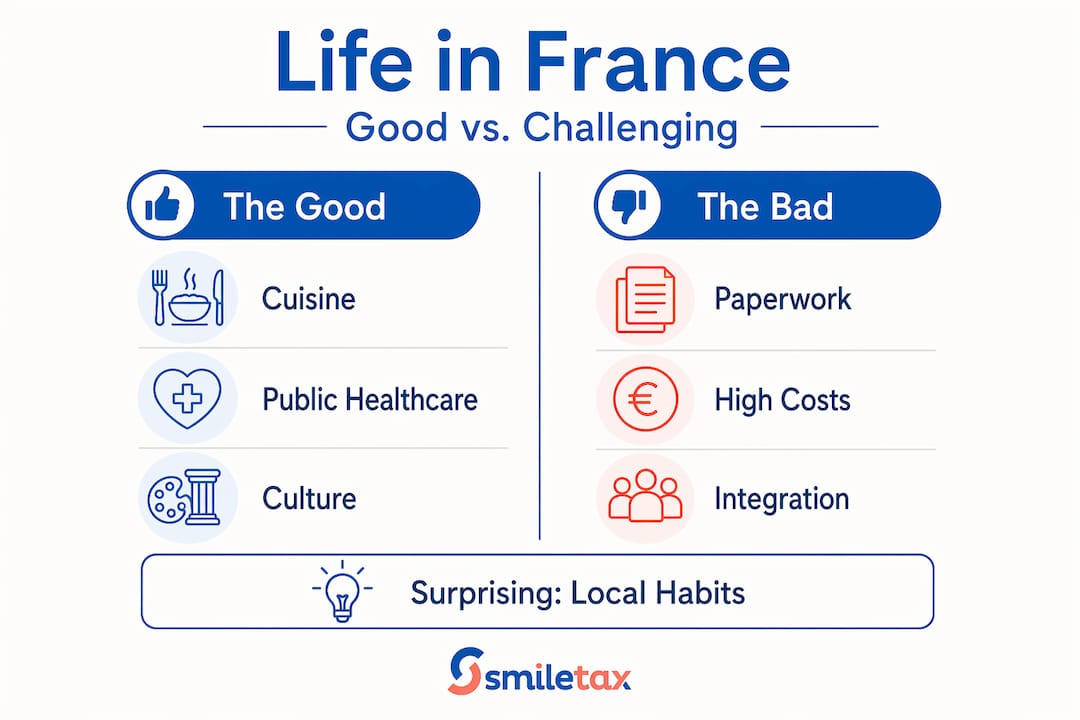
| The good | The bad | The surprising |
|---|---|---|
| World-class food, wine, and cultural life | High administrative friction and slow bureaucracy | Proof of address required for almost everything |
| Strong public healthcare system | Three-month healthcare wait for non-workers | Deep friendships take years, not weeks |
| Safe, stable society with strong worker protections | Social integration is slow and requires real investment | Fiscal stamp fees rose sharply in 2026 |
| Slower pace and genuine quality of life | Housing costs high in popular regions | French customer service neutrality reads as rudeness to many Americans |
| Central location for European travel | Language barrier significant outside tourist zones | Administrative culture is not hostile, just document-heavy |
For families, the education system is strong and international school options exist in major cities. The best schools for US expat families in Paris are worth researching early, as waitlists can be long.
The expats who thrive in France tend to share a few traits. They are patient with systems. They invest in the language. They do not need instant social gratification. And they recognize that French life rewards those who adapt to it rather than those who wait for it to adapt to them.
An honest perspective on making France work for you
The tension at the heart of French expat life is real. France offers beauty, stability, and a quality of life that is genuinely hard to replicate elsewhere. It also wraps that life in an administrative system that requires patience and preparation most Americans have not had to develop before.
The expats who struggle most are those who arrive expecting France to function like a more scenic version of the United States. The ones who succeed are those who approach the cultural and administrative differences with curiosity rather than frustration. That is not a small shift. But it is the shift that makes the difference.
France rewards preparation, language investment, and genuine cultural engagement. If you bring those things, it gives back considerably more than it takes.
Your next step as a US expat in France
Living in France as an American brings complexity that extends well beyond finding an apartment and learning to order coffee properly. From visa timelines to healthcare registration to understanding your ongoing obligations as a US citizen abroad, the details matter.
SmileTax supports Americans living overseas who want their US obligations handled professionally and without unnecessary stress. Whether you are a retiree settling in the south of France, a teacher at an international school in Paris, or a remote worker figuring out your long-term status, SmileTax provides clear, personal support from real professionals who understand expat life. If cross-border financial questions are creating tax-related anxiety, SmileTax was built specifically to help Americans in exactly your situation.
FAQ
What visa do Americans need to live in France long-term?
Most Americans use the long-stay VLS-TS visitor visa, valid for 4 to 12 months. You must validate it online via the ANEF portal within three months of arrival to maintain legal residency status.
How much does a French residence permit cost in 2026?
As of May 2026, first-time issuance costs €350 and renewals cost €250. These fees increased from the previous rate of €225 for both categories.
How long before Americans qualify for French public healthcare?
Non-working expats face a three-month waiting period before qualifying for public healthcare. Private international health insurance is necessary to cover that gap.
Is French social life really that different for Americans?
Yes. Meaningful friendships in France typically develop through long-term shared contexts like schools or workplaces, not casual social encounters. Expect the process to take considerably longer than it would in the US.
Do Americans need to speak French to live comfortably in France?
Functional French is strongly recommended for anything beyond tourist interactions. Medical appointments, administrative processes, and landlord or neighbor disputes all require real language ability, not just basic phrases.