

Living in Ireland as an American means stepping into a country that feels familiar on the surface but operates by entirely different rules underneath. The Irish Central Statistics Office (CSO) recorded 9,600 Americans immigrating to Ireland in the twelve months leading to April 2025, a 96% increase from the previous year. That surge reflects genuine enthusiasm, but many of those arrivals admitted they went in underprepared. The gap between American expectations of moving to Ireland and the day-to-day reality covers housing, cultural integration, bureaucracy, and cost of living. Understanding that gap before you board the plane makes all the difference.
Living in Ireland as an American: what the reality actually looks like
The romantic image most Americans carry of Ireland comes from films, ancestry, and St. Patrick’s Day mythology. The reality of expat life in Ireland is warmer and more grounded than that image, but also more demanding in practical terms. Ireland is a modern, fast-moving European economy with a housing shortage, a complex immigration system, and a social culture that rewards patience over urgency. Americans who arrive expecting a slower, simpler version of home tend to be surprised by Dublin’s pace, its prices, and the paperwork required just to get settled.
How does Ireland’s housing market differ from American expectations?
The Irish housing market is one of the biggest shocks for American expats, and it operates nothing like the US system. There is no Multiple Listing Service (MLS) equivalent. Agents exclusively represent sellers, not buyers, and listing prices are often strategic starting points rather than firm offers. A property marked “sale agreed” on daft.ie is essentially a verbal handshake. Actual contracts can take months to finalize, which catches Americans off guard after expecting the faster, more transparent US process.

Rental costs vary significantly by location. A one-bedroom apartment in Dublin city center typically costs €2,000 or more per month, while cities like Cork, Galway, and Limerick run 20 to 30% cheaper. That difference matters enormously for budgeting, especially in the first few months before a salary starts.
| City | Avg. monthly rent (1-bed) | Relative cost vs. Dublin |
|---|---|---|
| Dublin | €2,000+ | Baseline |
| Cork | €1,400–€1,600 | ~20–25% cheaper |
| Galway | €1,300–€1,500 | ~25–30% cheaper |
| Limerick | €1,100–€1,400 | ~25–30% cheaper |
Landlords in Ireland require proof of income equal to roughly 30 times the monthly rent annually, along with previous landlord references and a deposit of four weeks’ rent. Agency fees between €50 and €150 are standard but often catch Americans off guard. Without Irish references or a local employment contract in hand, securing a rental before arrival is extremely difficult.
The Irish housing market is also relationship-driven in ways the US market is not. Landlords and letting agents respond better to applicants who demonstrate local commitment, such as having an Irish phone number and a local bank account. Americans who treat the search like an online transaction tend to struggle.
Tip: Approach the housing search with curiosity rather than urgency. Americans who take time to understand local norms before making offers report less regret and fewer costly mistakes.
What cultural differences should Americans expect in Ireland?
Ireland’s reputation for friendliness is well-earned, but social integration takes longer than most Americans anticipate. Irish social culture is warm but not immediately open. Locals are welcoming in conversation, but building genuine friendships requires consistent presence over time, not just a few good pub nights.
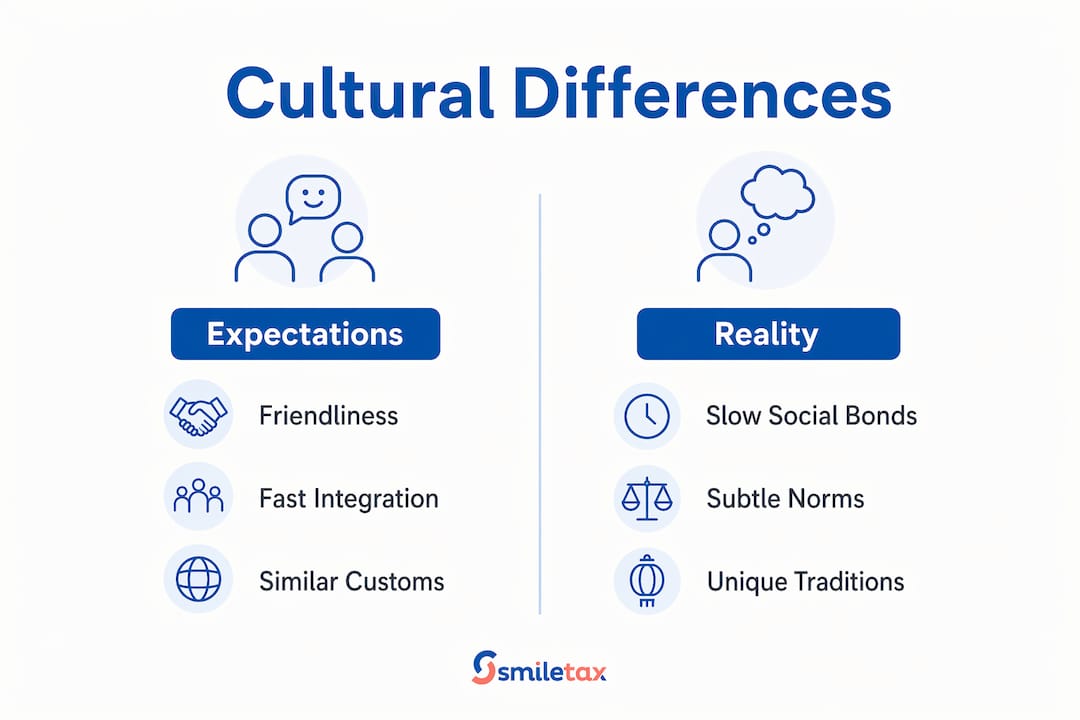
Communication style is another adjustment. Irish humor relies heavily on understatement, sarcasm, and self-deprecation. Americans who speak directly and enthusiastically can sometimes read as overly intense to Irish colleagues. The phrase “that’s grand” means everything from “perfect” to “acceptable but I have reservations.” Learning to read between the lines is a real skill.
Key cultural differences Americans commonly encounter:
- Social pace: Friendships develop slowly. Joining a local GAA club, sports team, or community group accelerates integration far more than workplace socializing alone.
- Local credibility: Getting an Irish mobile number immediately upon arrival signals commitment and increases trust with landlords, employers, and service providers.
- Expat community: Dublin, Cork, and Galway all have active international communities. Organizations like InterNations host regular events specifically for newcomers.
- Transport reality: Public transport in Dublin, Cork, and Galway is adequate for daily commuting. Rural living requires a car, often on narrow country roads that are not always accurately mapped on Google Maps.
- Weather expectations: Americans from the South or West Coast consistently underestimate how frequently it rains. Waterproof gear is not optional.
The social adjustment for most Americans takes three to six months. Those who engage with local communities rather than clustering exclusively with other expats tend to settle in faster and report higher satisfaction with the Ireland living experience overall.
How does the Irish cost of living compare to US expectations?
The average monthly cost for a single expat living in Dublin ranges from $2,500 to $3,500, covering rent, food, transport, and utilities. That figure places Dublin firmly among Europe’s more expensive cities, comparable to Amsterdam or Stockholm. Americans moving from high-cost cities like San Francisco or New York may find it manageable. Those relocating from mid-size US cities often find it a significant increase.
Beyond rent, several costs surprise Americans consistently:
- Utilities: Electricity and heating costs in Ireland are higher than US averages, partly due to older housing stock and energy pricing structures.
- Groceries: Supermarkets like Tesco, Lidl, and Dunnes Stores offer affordable staples, but American-specific products such as certain cereals, peanut butter brands, or specific condiments are either unavailable or priced as specialty imports.
- Healthcare: Ireland operates a two-tier system. Public healthcare through the HSE (Health Service Executive) is available but can involve long wait times. Private health insurance through providers like VHI Healthcare or Laya Healthcare costs roughly €100 to €200 per month for an individual and is strongly recommended for new arrivals.
- Dining out: A casual dinner for two in Dublin averages €60 to €80 including drinks. This is noticeably higher than equivalent meals in most US cities outside Manhattan.
Tip: Budget for three months of full expenses before your first Irish paycheck arrives. Between deposits, agency fees, and setup costs, the first months abroad consistently cost more than planned.
What are the key immigration and bureaucratic realities Americans should prepare for?
Americans often assume that because Ireland is English-speaking and culturally familiar, the administrative process of moving there will be straightforward. It is not. Here is the sequence most Americans need to work through after arrival:
- Understand your visa status. US citizens can enter Ireland visa-free for up to 90 days. That window is not a residency permit. Using it to “figure things out” without a work permit or visa in place creates legal complications.
- Secure a work permit if employed. The Critical Skills Employment Permit is the primary route for skilled workers. It requires a job offer from an Irish employer and a minimum salary threshold. Other routes include the General Employment Permit and the Intra-Company Transfer Permit.
- Apply for a PPS number. The Personal Public Service (PPS) number is Ireland’s equivalent of a Social Security number. You need it for employment, banking, and accessing public services. Applications are made in person at a local Intreo office.
- Open a bank account. Irish banks including AIB, Bank of Ireland, and Permanent TSB require proof of address and a PPS number. Until those are in place, fintech solutions like Revolut can bridge banking gaps temporarily.
- Register with your local Garda station if staying longer than 90 days on a visa. This step is mandatory and often overlooked.
The immigration permit process requires overlapping tasks that must be completed in a specific sequence. Proper sequencing can save weeks of frustration. Many Americans underestimate how long each step takes and how dependent each step is on the previous one being completed first.
How does family life in Ireland compare with American expectations?
Families relocating to Ireland face a specific set of challenges that single expats do not. The Irish school system is largely denominational, with the majority of primary schools operated by the Catholic Church. Educate Together schools offer a non-denominational alternative, but places are limited and demand is high, particularly in Dublin and Wicklow.
School catchment areas govern enrollment, and capacity in desirable areas fills quickly. Families who secure housing without first confirming school availability often find themselves commuting across districts or splitting siblings between schools. The practical advice from families already settled in Ireland is consistent: identify your preferred school first, then search for housing within that catchment area.
Key considerations for families moving to Ireland:
- Irish language classes (Gaeilge) are compulsory in most state schools. Children adapt quickly, but parents should expect this as a standard part of the curriculum.
- Extracurricular activities center heavily on GAA sports (Gaelic football, hurling, camogie). These are deeply community-rooted and offer excellent social integration for children.
- Parental involvement in Irish school communities is expected and genuinely welcomed. School fundraisers, parent associations, and community events are active across the country.
- Commute and quality of life: Families who prioritize school access sometimes end up in suburbs with longer commutes. Balancing school zone, commute time, and housing cost is the central planning challenge for most relocating families.
The family-focused expat experience in Ireland is genuinely positive for most who plan carefully. Children tend to integrate faster than adults, and the Irish school community often becomes the primary social network for the whole family within the first year.
Key takeaways
Living in Ireland as an American rewards preparation, patience, and a willingness to learn local systems rather than replicate US habits.
| Point | Details |
|---|---|
| Housing market is relationship-driven | No MLS equivalent exists; agents represent sellers, and local credibility matters as much as finances. |
| Dublin is expensive, but alternatives exist | Cork, Galway, and Limerick cost 20 to 30% less than Dublin for comparable housing. |
| Immigration sequencing is critical | PPS number, work permit, and bank account must be completed in order to avoid weeks of delays. |
| School zones determine housing choices | Families should confirm school availability before signing a lease or purchasing property. |
| Social integration takes time | Joining local clubs and getting an Irish mobile number early accelerates trust-building significantly. |
What most Americans get wrong about moving to Ireland
The biggest misconception Americans carry into the Ireland living experience is that cultural similarity equals practical similarity. Ireland and the US share a language and a lot of history, but the systems, pace, and social expectations are genuinely different. Americans who arrive expecting to replicate their US life in a greener setting tend to struggle. Those who arrive curious about how Ireland actually works tend to thrive.
The housing market frustrates Americans most consistently, not because it is worse than the US market, but because it is different in ways that are not obvious until you are in the middle of a search. Understanding that agents work for sellers, that “sale agreed” is not a contract, and that relationships matter more than speed changes the entire approach.
The social adjustment is real but manageable. Irish people are not cold. They are simply measured. Earning a place in a local community takes consistent presence, genuine interest, and a willingness to show up repeatedly before being fully welcomed in. Americans who expect instant warmth sometimes misread measured friendliness as indifference.
The practical advice that comes up most often from Americans already settled in Ireland: organize your documents before you leave the US, get an Irish SIM card on day one, and give yourself at least six months before judging whether the move was right. Almost universally, those who stayed past the six-month mark say they are glad they did.
Planning your move to Ireland with confidence
Moving abroad involves more than packing boxes and booking flights. Americans living in Ireland still carry US tax filing obligations, and staying compliant while managing a new life overseas adds a layer of complexity that catches many expats off guard. SmileTax specializes in US tax filing for Americans living and working abroad, including those employed locally in Ireland. The team works directly with each client, with no handoffs and no generic software. If you want your US obligations handled accurately while you focus on settling into Irish life, SmileTax consultations are a practical starting point. You can also explore the full range of expat resources available to Americans living overseas.
FAQ
How many Americans are currently living in Ireland?
The Irish CSO recorded 9,600 Americans immigrating to Ireland in the twelve months leading to April 2025, the highest figure ever recorded. The total American-born population resident in Ireland is significantly larger when long-term residents are included.
Do Americans need a visa to move to Ireland?
US citizens can enter Ireland visa-free for up to 90 days, but long-term residency and employment require a valid work permit such as the Critical Skills Employment Permit. Using the 90-day window to resolve long-term immigration issues is not legally valid.
Is Dublin too expensive for most American expats?
Dublin is one of Europe’s more expensive cities, with monthly costs for a single expat ranging from $2,500 to $3,500. Cities like Cork, Galway, and Limerick offer comparable quality of life at 20 to 30% lower cost.
How long does it take to feel settled in Ireland?
Most American expats report that genuine social integration takes three to six months. Those who join local clubs, get an Irish mobile number early, and engage with community activities consistently report settling in faster.
What is the biggest practical challenge for families moving to Ireland?
School catchment areas are the primary planning challenge for families. Dublin and Wicklow in particular have limited school capacity, and securing housing within the right zone before arrival is strongly recommended to avoid commuting or split enrollment situations.