

Malaysia is one of the most affordable and livable countries in Southeast Asia for American expats, offering a cost of living 60–72% lower than the United States, widespread English, and a visa program designed for long-term foreign residents. Whether you are a retiree stretching a fixed income, an international teacher, or a remote worker looking for a base in Asia, Malaysia delivers a rare combination of modern infrastructure, rich multicultural culture, and accessible healthcare at a fraction of what you would pay back home. Living in Malaysia as an American requires understanding the costs, visa options, and cultural adjustments before you commit. This guide covers all three.
What is the cost of living like for Americans in Malaysia?
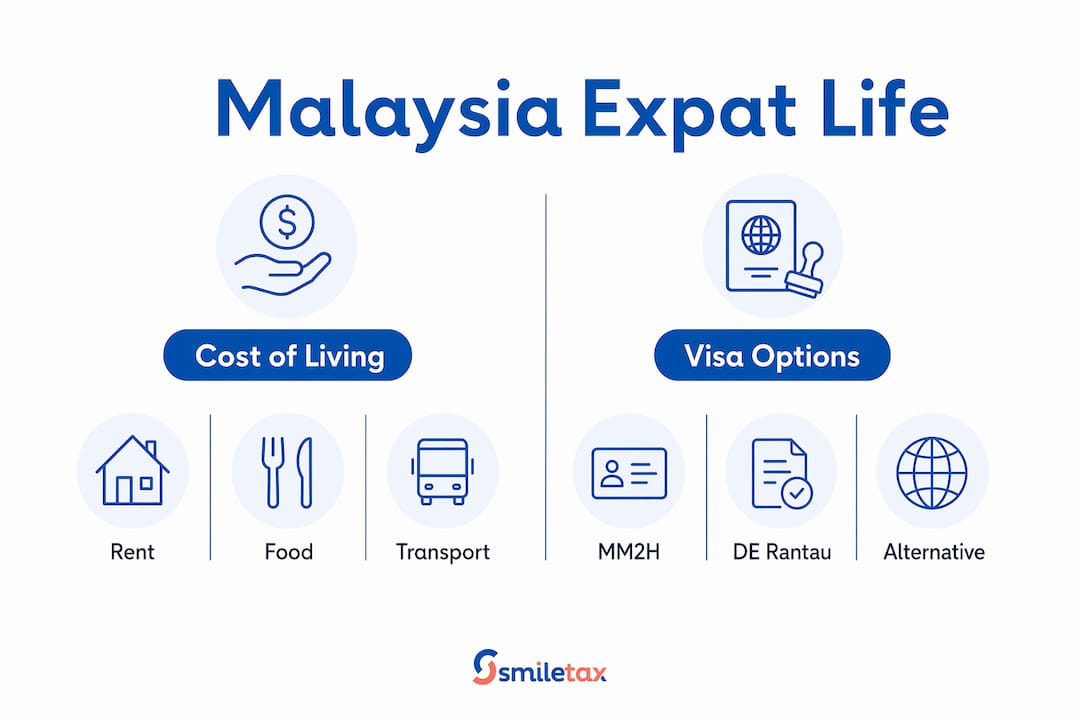
Monthly living costs in Malaysia are significantly lower than in any major American city. A single person can live comfortably on $1,200 to $1,800 per month including rent. A couple can manage well on $2,000 to $2,800 depending on lifestyle choices and city.

Housing costs
Rent is the biggest variable in your budget. In Kuala Lumpur’s city center, a furnished one-bedroom apartment runs $400 to $500 per month. A two-bedroom in a good neighborhood costs $600 to $900. Outside the city center, those numbers drop by 20–30%. Penang offers similar quality at slightly lower prices, especially away from the tourist zones of Georgetown.
Food and daily expenses
Street food and hawker centers are where Malaysia truly shines for budget-conscious expats. A full meal at a hawker stall costs $1 to $3. A sit-down restaurant meal for two runs $15 to $25. Groceries from local wet markets cost a fraction of American supermarket prices, though imported Western products carry a premium.
Other typical monthly expenses include:
- Utilities (electricity, water, internet): $80 to $150, with air conditioning pushing costs higher in the tropical heat
- Transportation: Grab (the regional ride-hailing app) is cheap for city trips; car ownership adds $300 to $500 monthly in loan payments, insurance, and fuel
- Domestic help: A part-time cleaner costs $50 to $100 per month, and live-in helpers are common among families
- Entertainment and dining out: $200 to $400 covers a comfortable social life
Tip: Living expenses excluding rent can be as low as $540 per month if you eat locally and use public transit. That number rises fast if you default to Western restaurants and imported goods.
One important financial reality: low monthly costs do not tell the whole story. The Malaysia My Second Home (MM2H) visa requires a large fixed deposit and property investment, meaning total asset requirements for a financially secure move often reach $700,000 to $800,000. Monthly living is affordable. Getting there legally and securely is a different calculation.
How do Malaysian visa options work for Americans?
The Malaysia My Second Home program, known as MM2H, is the primary long-term residence visa for American retirees and non-working expats. It was redesigned in 2021 and tightened further since then, making it considerably harder to qualify than it was a decade ago.
MM2H requirements in 2026
The current MM2H program demands:
- Offshore income: A minimum of RM40,000 per month (approximately $8,500) from sources outside Malaysia
- Fixed deposit: RM1 million (approximately $213,000) placed in a Malaysian bank account
- Property purchase: A qualifying property worth at least $150,000, with foreigners restricted from buying landed property below RM1 million
- Health insurance: Valid coverage for the duration of your stay
- Security bond: A government-required bond paid at application
These requirements effectively exclude many middle-income retirees who were the program’s original target audience. The financial bar is now set for high-net-worth individuals, not average American retirees living on Social Security and a modest pension.
Alternative visa options
Americans who do not qualify for MM2H have several other paths:
- Employment Pass: For Americans hired by a Malaysian company or an international organization operating in Malaysia
- Professional Visit Pass: Short-term option for contractors and consultants
- DE Rantau visa: Malaysia’s digital nomad visa, requiring a minimum monthly income of $2,000 USD. It is time-limited and income-dependent but far simpler to access than MM2H.
- Student visa: Valid for those enrolled in accredited Malaysian institutions
Tip: The DE Rantau visa is the fastest entry point for remote workers. It does not require a large fixed deposit and can be renewed, making it a practical starting point while you assess whether Malaysia suits your long-term plans.
Visa rules in Malaysia change with some regularity. Working with a licensed immigration agent in Kuala Lumpur or Penang saves time and reduces the risk of application errors. The locked capital in the MM2H fixed deposit is a real constraint. That money earns modest interest but is not freely accessible, so factor it into your total financial picture before committing.
What cultural experiences should American expats expect in Malaysia?
Malaysia’s multicultural society is one of its most defining features. The population includes Malay, Chinese, Indian, and indigenous communities, each maintaining distinct traditions, languages, and festivals. For Americans, this creates a daily environment that is genuinely different from anything in the United States, and genuinely rewarding once you settle in.
Language and communication
English is widely used in business, healthcare, banking, and everyday conversation, making Malaysia one of the easiest Southeast Asian countries for English-speaking expats to adapt to. You will not need Bahasa Malaysia to open a bank account, see a doctor, or navigate a grocery store. That said, learning basic Malay phrases earns immediate goodwill from locals and signals respect.
Communication style in Malaysia tends toward indirectness. Malaysians often avoid saying “no” outright, preferring softer alternatives. Americans accustomed to direct feedback may initially misread this as agreement when it is actually polite deflection. Patience and reading context matter more than pushing for a straight answer.
Social customs and daily life
A few cultural norms shape daily life for American expats:
- Religion: Islam is the official religion. Mosques broadcast the call to prayer five times daily. During Ramadan, eating and drinking in public during daylight hours is considered disrespectful in Muslim-majority areas.
- Dress codes: Modest dress is expected at government offices, mosques, and rural areas. Urban Kuala Lumpur is more relaxed, but covering shoulders and knees in religious spaces is non-negotiable.
- Shoes: Remove them before entering homes and many traditional businesses.
- Food culture: Sharing food is central to Malaysian social life. Hawker centers are communal spaces where different ethnicities eat side by side. Pork is absent from halal stalls; beef is avoided at some Indian Hindu establishments. Navigating this is easier than it sounds.
Malaysia’s food culture is arguably the best argument for moving there. Penang is widely considered one of the world’s great street food cities, with dishes like char kway teow, laksa, and nasi kandar drawing food travelers from across the globe. Eating well in Malaysia costs almost nothing, and it never gets boring.
Bureaucracy and administration
Malaysian bureaucracy combines digital efficiency in banking and immigration portals with traditional, paperwork-heavy government processes. Rules sometimes vary by office or officer. Bring physical copies of every document, expect multiple department approvals for anything official, and budget extra time for government transactions. Hiring a local agent for visa renewals and property transactions is common practice among long-term expats, not a sign of weakness.
How is healthcare for American expats in Malaysia?
Malaysia’s private healthcare system is genuinely excellent and significantly cheaper than equivalent care in the United States. Routine doctor visits cost $15 to $40. Specialist consultations run $30 to $100. Compare that to $200 to $500 for the same visits in the U.S., and the savings are immediate and substantial.
Kuala Lumpur and Penang are the two main healthcare hubs. Hospitals like Gleneagles, Pantai, and Prince Court in KL attract medical tourists from across the region. English-speaking doctors are standard in private facilities. Dental and optical care are also priced well below American rates.
Key considerations for expat healthcare planning:
- Private insurance is not optional: Public hospitals are under-resourced and not designed for foreign residents. Private health insurance is the standard for expats.
- Cost of coverage: Annual premiums for private health insurance average $8,000 to $12,000 per year for older adults. That figure significantly affects retirement budget calculations.
- Age and renewability: Securing lifetime-renewable international insurance before age 70 is critical. Policies become harder to obtain and more expensive after that threshold.
- Specialist access: Penang has strong specialist care. Smaller cities and rural areas have limited options, making location choice directly relevant to healthcare access.
Tip: Review your international health insurance options before you leave the U.S. Locking in a policy while you are younger and healthier gives you far better terms than applying after you arrive.
Kuala Lumpur vs. Penang: which city suits you?
The two cities most Americans choose between are Kuala Lumpur and Penang. They offer very different experiences, and the right choice depends on your lifestyle priorities.
| Feature | Kuala Lumpur | Penang |
|---|---|---|
| Cost of living | Moderate to high for Malaysia | Lower overall |
| Public transit | Extensive MRT and LRT network | Limited; car often needed |
| Expat community | Large and diverse | Strong, especially among retirees |
| Food scene | World-class variety | Widely considered Malaysia’s best street food |
| Healthcare | Top-tier private hospitals | Strong specialist options |
| Lifestyle pace | Fast, urban | Relaxed, island-oriented |
| Beach access | Requires travel | Close to beaches and islands |
Kuala Lumpur suits expats who want urban density, a wide range of international restaurants, and easy regional flight connections. The city’s MRT and LRT network covers most central areas well. Outside those transit corridors, car ownership is nearly essential, and traffic congestion is a daily reality.
Penang appeals to retirees and remote workers who prefer a slower pace, lower costs, and a tight-knit expat community centered around Georgetown. The island’s UNESCO World Heritage status means a preserved historic core alongside modern amenities. Langkawi, further north, offers duty-free shopping and a beach lifestyle, but healthcare options are limited compared to KL or Penang.
Key Takeaways
Malaysia offers Americans a genuinely affordable and culturally rich expat lifestyle, but the MM2H visa’s high financial thresholds mean serious asset planning is required before committing to a long-term move.
| Point | Details |
|---|---|
| Cost of living | A single person lives comfortably on $1,200–$1,800 per month including rent in Kuala Lumpur. |
| MM2H visa bar | Current MM2H requirements include a RM1 million fixed deposit and $8,500 monthly offshore income. |
| English accessibility | English is widely used in business, healthcare, and banking, easing daily life for American expats. |
| Healthcare planning | Private insurance costs $8,000–$12,000 annually for older adults; secure coverage before age 70. |
| City choice | Kuala Lumpur offers urban convenience; Penang offers lower costs and a strong retiree expat community. |
What I’ve learned about Malaysia that most guides won’t tell you
Most articles about Malaysia for expats focus on the numbers: the cheap rent, the hawker food prices, the visa thresholds. Those numbers are real and they matter. But the thing that actually determines whether someone thrives in Malaysia is how they approach the culture, not the cost.
Americans who arrive expecting to recreate a Western lifestyle in a cheaper location tend to struggle. They seek out imported groceries, avoid hawker centers, and spend their weekends in air-conditioned malls watching American streaming content. They are technically in Malaysia but not really experiencing it. Their costs creep up, and their satisfaction does not match the promise.
The expats who genuinely love Malaysia are the ones who eat where locals eat, learn a few words of Malay, and show up to the neighborhood festivals. They find that the multicultural fabric of the country, Malay, Chinese, Indian, and indigenous traditions all coexisting, is not just interesting to observe. It becomes part of daily life in a way that genuinely enriches you.
On the practical side: do not underestimate the MM2H capital commitment. The monthly costs are low, but locking $200,000-plus into a fixed deposit changes your financial picture significantly. Run the full numbers, not just the monthly budget. And on healthcare, secure your international insurance policy before you leave the U.S. The savings on medical care in Malaysia are real, but only if you have solid coverage in place from day one.
Malaysia rewards patience and genuine curiosity. It is not a plug-and-play retirement destination. It is a country with its own rhythms, its own bureaucratic quirks, and its own extraordinary rewards for those willing to meet it on its own terms.
Your U.S. taxes still follow you to Malaysia
Moving to Malaysia simplifies a lot of things. Your U.S. tax obligations are not one of them. Americans abroad must still file a U.S. federal tax return every year, regardless of where they live or where their income originates. SmileTax works specifically with Americans living overseas, including retirees, teachers, and remote workers based in Malaysia. Every client works directly with an experienced U.S. tax professional. There is no generic software, no handoffs to unknown preparers. If you want your U.S. filing handled properly while you focus on building your life in Malaysia, SmileTax was built for exactly that situation. Review service fees and options to find the right fit.
FAQ
How much does it cost to live in Malaysia as an American?
A single American can live comfortably in Malaysia on $1,200 to $1,800 per month including rent. Living expenses excluding rent can be as low as $540 monthly if you eat locally and use public transportation.
What visa do Americans need for long-term residence in Malaysia?
The Malaysia My Second Home (MM2H) program is the main long-term residence visa, but it now requires a RM1 million fixed deposit and RM40,000 monthly offshore income. Remote workers can apply for the DE Rantau digital nomad visa with a minimum monthly income of $2,000 USD.
Is English widely spoken in Malaysia?
English is widely used in business, healthcare, banking, and daily interaction throughout Malaysia, making it one of the most accessible Southeast Asian countries for American expats linguistically.
How good is healthcare in Malaysia for expats?
Private healthcare in Malaysia is high quality and significantly cheaper than in the U.S., with specialist visits costing $30 to $100. Private health insurance is strongly recommended, with annual premiums averaging $8,000 to $12,000 for older adults.
Is Kuala Lumpur or Penang better for American expats?
Kuala Lumpur suits expats who want urban amenities, diverse dining, and strong public transit. Penang offers lower costs, a relaxed island lifestyle, and a well-established retiree expat community, making it the preferred choice for many Americans seeking a quieter pace.