

Poland is one of the most practical relocation choices in Europe for Americans right now. Cost of living indexes show Poland running significantly cheaper than the United States, you enter visa-free for up to 90 days on a US biometric passport, and three clear legal anchors (work, study, family) open the door to long-term residence. A single person can live comfortably in Kraków on a modest budget. A couple in Wrocław typically manages on moderate expenses. A family in Warsaw, including international school fees, budgets vary widely depending on lifestyle.
Before you book a flight, three things belong on your immediate list. First, confirm which residence route fits your situation (work permit, student visa, or family reunification). Second, gather your core documents now: passport valid for at least 18 months, proof of income or employment, and a clean criminal background check. Third, plan your first 30 days around four priorities: temporary lodging, a local SIM card, a bridge banking solution, and the start of your address registration. The relocation checklist for Americans moving to Europe covers these steps in detail if you want a printable reference.
Table of Contents
- What are the visa and residence options for Americans in Poland?
- How much does it really cost to live in Poland each month?
- Where do Americans find work in Poland?
- How does renting an apartment in Poland actually work?
- How do you access healthcare in Poland as an American?
- How do you manage money as an American in Poland?
- What administrative steps do you need to complete after arriving?
- What should Americans expect from Polish culture and daily life?
- Your first 30 days in Poland: a practical arrival checklist
- Key Takeaways
- Why Poland keeps attracting American expats
- SmileTax keeps your US filing simple while you live in Poland
What are the visa and residence options for Americans in Poland?
US citizens can enter Poland visa-free for up to 90 days in any 180-day Schengen period. That window is enough for a scouting trip or a short contract, but anyone planning to stay longer must apply for a temporary residence permit before Day 90 expires.
The main residence routes
Work-based residence is the most common path. Your Polish employer applies for a work permit (or a single combined permit), and you submit your residence application to the relevant Voivodeship Office. Processing typically takes 3–6 months, so apply early.
Study-based residence works similarly: admission to a Polish university or language school triggers eligibility for a student residence permit, usually valid for the duration of your program.
Business formation (registering a Polish company or operating as a sole trader) can anchor a residence application, though it requires proof of genuine economic activity and sufficient funds.
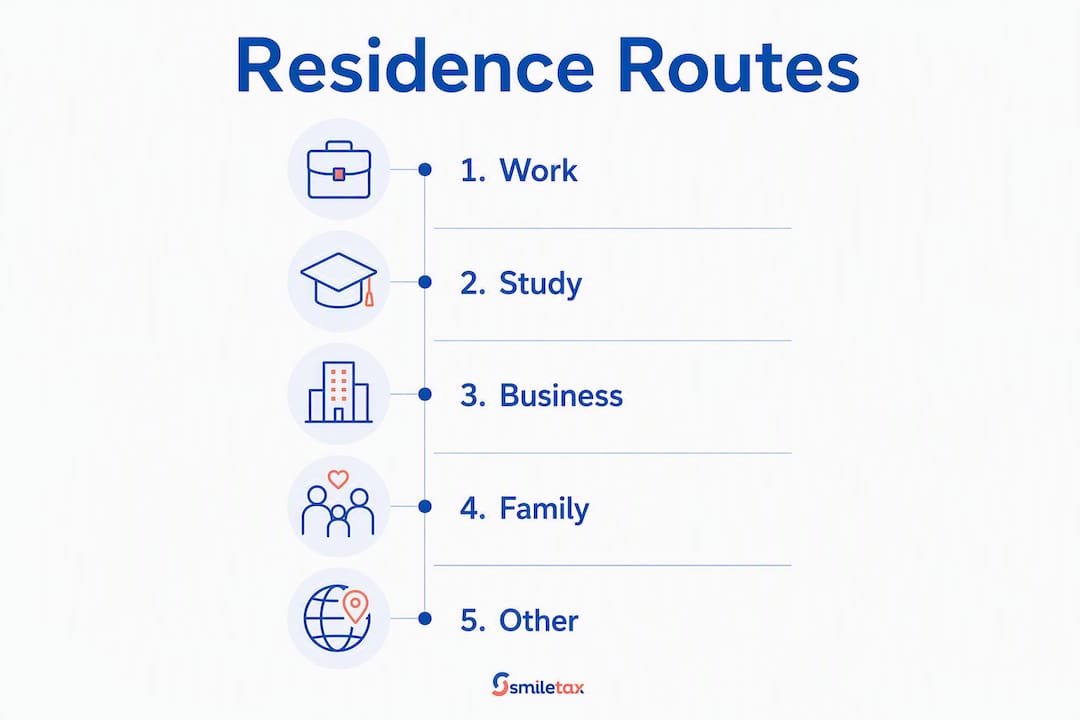
Family reunification applies if you have a Polish spouse or a family member who already holds Polish residence. This route often moves faster than work-based applications.
Karta Polaka (Polish Heritage Card) is worth knowing if you have Polish ancestry. It does not grant residence automatically, but it simplifies several administrative steps and can support a descent-based residence application.
Step-by-step: work residence application
- Secure a written job offer from a Polish employer.
- Employer submits a work permit application (or a statement of intent to employ) to the Voivodeship Office.
- Once the work permit is issued (or a statement is registered), you apply for a temporary residence and work permit at the Voivodeship Office in your city of residence.
- Submit the full document package: passport, photos, proof of address (lease), employer letter, work permit, proof of health insurance, and financial evidence.
- Attend any required in-person appointments; collect your residence card when notified.
- Register your address (zameldowanie) within 30 days of moving in.
Immigration processing in Poland is often slow and document-sensitive. A single missing or incorrectly formatted document commonly causes delays or rejections. Bring originals and certified copies of everything, and keep a digital backup.
Residence permit overview
| Route | Typical duration | Key financial requirement | Approx. processing time |
|---|---|---|---|
| Work (combined permit) | 1–3 years, renewable | Proof of employment income | 3–6 months |
| Study | Duration of program | Proof of tuition payment + funds | 2–4 months |
| Business/self-employment | 1–3 years, renewable | Proof of business activity + funds | 3–6 months |
| Family reunification | 1–3 years, renewable | Sponsor’s income evidence | 2–4 months |
| Permanent residence | Indefinite (after 5 years) | Stable income, language basics | 3–6 months |
Official guidance benchmarks financial requirements at 1,010 PLN per month for the principal applicant and 823 PLN per dependent. These are minimums for visa purposes; in practice, demonstrating higher income strengthens your application. For current official visa forms and D-type national visa details, the Polish government visa portal and the e-konsulat appointment system are the authoritative starting points.
How much does it really cost to live in Poland each month?
Warsaw is the priciest of the three major cities, while Kraków and Wrocław tend to have noticeably lower costs for rent and day-to-day expenses. That gap matters when you are budgeting a full year.
Monthly cost comparisons vary by city and lifestyle.
| Expense | Warsaw | Kraków | Wrocław |
|---|---|---|---|
| 1-bed apartment, central locations vary significantly in price, generally highest in Warsaw and lower in Kraków and Wrocław. | |||
| 1-bed apartment in outer city areas typically costs less than central locations, with similar city-based variance. | |||
| Utility costs vary seasonally and by apartment type, generally higher in Warsaw than in Kraków or Wrocław. | |||
| Groceries costs for a single person vary moderately between cities, influenced by shopping choices. | |||
| Public transport passes cost vary by city, with Warsaw generally more than Kraków or Wrocław. | |||
| Internet (fiber) | 50 PLN | 50 PLN | 50 PLN |
| Dining out and entertainment expenses differ by city, with Warsaw higher on average. |
All figures in Polish złoty (PLN). Exchange rates fluctuate; check current USD/PLN rates before budgeting.
Sample monthly budgets
Single person in Warsaw: Central one-bedroom, groceries, transport, dining out, and entertainment runs roughly 6,000–8,000 PLN ($1,500–$2,000 at typical exchange rates). Moving to an outer neighborhood drops that by 1,000–1,500 PLN.
Couple in Kraków: A two-bedroom apartment plus shared expenses lands around 8,000–11,000 PLN ($2,000–$2,750). Kraków’s compact center means lower transport costs and more walkable daily life.
Family of four in Wrocław: Add international school fees (typically 30,000–60,000 PLN per child per year) and the monthly budget rises substantially. Without school fees, a comfortable family lifestyle runs 12,000–16,000 PLN per month.
Winter heating is the main seasonal wildcard. Polish winters are cold, and older apartment buildings with district heating can push utility bills noticeably higher from November through March. Budget an extra 300–500 PLN per month in winter for a centrally heated apartment, more for older stock with individual gas boilers.
Tip: Spend your first month in a furnished short-term rental before signing a 12-month lease. Testing two or three neighborhoods tells you far more than any online forum, and it protects you from locking into an area that does not fit your daily routine. Use public transit for the first 60 days before deciding whether a car makes sense.
For a fuller picture of costs Americans often miss, the hidden costs of moving abroad article covers deposits, agency fees, and seasonal surprises worth building into your first-year budget.
Where do Americans find work in Poland?
Poland’s job market has shifted considerably over the past decade. Warsaw, Kraków, and Wrocław now host large clusters of tech companies, global business services centers, and shared service operations for multinationals. That concentration creates real opportunities for English-speaking Americans.
Sectors with the most openings for Americans
Tech and IT is the strongest sector. Software engineers, product managers, data analysts, and cybersecurity professionals are in demand across Polish offices of global firms and fast-growing local companies. English is the working language in most of these environments.
Business process outsourcing and shared services employ tens of thousands in Kraków and Wrocław. Finance, HR, legal, and customer operations roles often require English fluency and sometimes a second European language.
International schools and teaching is a consistent route for Americans with teaching credentials. Warsaw, Kraków, and Wrocław each have several international schools following American, British, or IB curricula. Salaries are lower than US equivalents in raw dollar terms, but purchasing power in Poland makes them livable.
Remote and contract work is increasingly viable. Americans working for US employers remotely while based in Poland benefit from the cost differential most directly. Polish internet infrastructure is reliable, and co-working spaces are well-established in all three cities.
Salary expectations
Local Polish salaries in tech typically range from 8,000–18,000 PLN gross per month depending on seniority, which translates to roughly $2,000–$4,500. That sounds modest against US benchmarks, but purchasing power in Poland stretches those figures considerably given the lower cost of housing, food, and transport. International school teaching positions often include housing allowances or subsidized accommodation, which changes the effective compensation picture.
Work permit requirements apply to most locally employed Americans. Your employer handles the permit application, but you should confirm the timeline before resigning from a US position. Remote workers employed by US companies operate under different rules and should confirm their employment structure with their employer’s legal team.
How does renting an apartment in Poland actually work?
Finding a good apartment in Poland is straightforward once you understand the local conventions. The two main search portals are Otodom.pl and OLX.pl. Most listings are in Polish, but Google Translate handles them well enough for initial filtering. Agency-listed properties carry a fee (typically one month’s rent), while direct landlord listings do not.
Understanding najem okazjonalny
Most reputable private landlords in Poland insist on a najem okazjonalny (occasional tenancy) contract. This form requires a notarized declaration from the tenant naming an alternative address where they could be housed if evicted. Landlords prefer it because it simplifies the legal eviction process if a tenant fails to vacate. As a tenant, it is a standard and legitimate contract type, not a red flag. Budget for the notary fee (typically 200–400 PLN) when signing.
What to check before signing
- Verify the landlord’s identity: Ask for their ID and confirm they own the property (a land registry extract, wypis z księgi wieczystej, confirms ownership).
- Inspect the inventory list: A reputable landlord provides a written inventory of all furnishings and appliances. Photograph everything on move-in day.
- Confirm heating type: District heating (ciepłownia) is predictable; individual gas boilers require more active management and can be costlier.
- Check internet speed: Fiber is widely available in cities, but older buildings sometimes have only cable or DSL.
- Understand deposit terms: Deposits are typically one to two months’ rent, held by the landlord and returned after move-out inspection.
Red flags to avoid
- No written contract or insistence on a handshake deal.
- Cash-only rent payments with no receipt.
- Landlord unwilling to provide their ID or proof of ownership.
- Vague language about deposit return conditions.
Upfront costs at signing typically include: first month’s rent, a deposit of one to two months’ rent, and an agency fee if applicable. Budget 3–4 months’ rent as your total upfront cash requirement.
How do you access healthcare in Poland as an American?
Poland’s public healthcare system is administered by the Narodowy Fundusz Zdrowia (NFZ). Access for foreigners typically activates once you hold a valid residence permit and are either employed (with social contributions paid by your employer) or self-registered as a contributor. Until that coverage kicks in, private insurance is the practical solution.
Immediate steps on arrival
Short-term travel insurance covers your first weeks. Policies from US insurers with international coverage or European providers work for this gap period. Once your residence and employment are established, your employer’s social contributions enroll you in NFZ automatically.
Private clinics are widely available in Warsaw, Kraków, and Wrocław, and many have English-speaking doctors. A GP visit at a private clinic typically costs 150–250 PLN. Specialist consultations run 200–400 PLN. Private health insurance plans covering outpatient and specialist care cost roughly 150–400 PLN per month depending on age and coverage level, making them affordable as a bridge or supplement.
For families, pediatric care is well-developed in all three cities. Private pediatric clinics are common and accessible without long waits. Vaccinations follow a Polish schedule; bring your children’s US vaccination records and have them translated.
Emergency services use the European standard number 112. At any clinic or hospital, bring your passport, residence card (once issued), and your insurance documentation.
How do you manage money as an American in Poland?
Opening a bank account
Polish banks typically require a passport, proof of address (your lease), and sometimes a PESEL number (Poland’s national ID number). Getting a PESEL first simplifies the account-opening process considerably. Major retail banks include PKO Bank Polski, mBank, and Santander Bank Polska.
For the first weeks before you have a PESEL or a local address confirmed, Wise and Revolut work well as bridge solutions. Both support PLN accounts, offer competitive exchange rates, and are accepted for most online payments. The guide to opening a bank account abroad as an American walks through the documentation and options in detail.
Payment culture
Cards are the norm in Polish cities. Contactless and mobile payments (Google Pay, Apple Pay) are widely accepted, including on public transit in Warsaw and Kraków. Small neighborhood shops, market stalls, and some rural businesses still prefer cash, so keep 200–300 PLN on hand for those situations.
Transferring money from the US
- Use Wise or a comparable specialist transfer service rather than a traditional US bank wire. The exchange rate difference on a $2,000 monthly transfer adds up to hundreds of dollars over a year.
- Set up a recurring transfer schedule once your Polish account is open to avoid manual transfers each month.
- Tipping is appreciated but not obligatory in Poland. Rounding up the bill or leaving 10% at sit-down restaurants is the local norm.
What administrative steps do you need to complete after arriving?
Polish bureaucracy rewards preparation. The steps below are sequential for a reason: each one unlocks the next.
- Open a local bank account — using your PESEL and proof of address.
Processing at Voivodeship Offices is in-person and often slow. Book appointments online in advance where the system allows. Expect multiple visits: one to submit, one or more for follow-up queries, and a final visit to collect your residence card. Bring a Polish-speaking friend or a relocation agent if your Polish is limited.
The Polish government’s diplomacy portal and the Polish Investment and Trade Agency both maintain useful English-language guidance on administrative requirements.
What should Americans expect from Polish culture and daily life?
The cultural adjustment for Americans in Poland is real but manageable. Polish communication tends to be more direct than the American style: Poles say what they mean without the social cushioning Americans often use. A Polish colleague who skips pleasantries and gets straight to the point is not being rude. Equally, the warm, effusive friendliness that Americans project in new social situations can read as insincere to Poles who reserve warmth for people they know well.
Public spaces tend to be quieter and more reserved than American equivalents. Strangers do not typically chat in lines or on public transit. Once you move past that initial reserve, though, Polish friendships tend to be loyal and genuine.
Most Americans follow a predictable emotional arc after relocating: excitement in the first days, a period of frustration and loneliness around weeks two through four, then gradual adaptation. Full familiarity typically arrives by months three to four. Knowing this arc in advance takes much of the anxiety out of the difficult middle period.
Language
Polish is the local language, and it is genuinely difficult for English speakers. That said, English is widely spoken among younger Poles and in professional and tech environments. Learning even basic Polish (greetings, numbers, shopping phrases) signals respect and opens doors that English alone cannot. Apps like Duolingo and Pimsleur cover the basics; a local tutor accelerates progress faster than either.
Building a social life
Joining hobby clubs, language exchanges, or interest groups converts surface-level encounters into real friendships. Passive socializing (showing up at expat bars) rarely builds the connections that make a place feel like home. Volunteering, joining a sports club, or attending a regular class puts you in repeated contact with the same people, which is how Polish friendships form.
Tip: Become a regular somewhere specific: a neighborhood café, a climbing gym, a Sunday market. Poles warm to consistency. Showing up repeatedly in the same place signals that you are not just passing through, and that changes how people engage with you.
Your first 30 days in Poland: a practical arrival checklist
The first month sets the tone for everything that follows. Keeping priorities clear reduces the overwhelm of a new country.
Before you travel
- Renew your passport if it expires within 18 months.
- Obtain a certified copy of your birth certificate and a criminal background check (FBI Identity History Summary for most Americans).
- Arrange travel insurance covering medical evacuation.
- Set up Wise or Revolut with a PLN balance before departure.
- Download digital copies of all key documents to a secure cloud folder.
First week
- Secure temporary lodging (serviced apartment or short-term rental) for at least 30 days.
- Buy a local SIM card from Play, Orange, or T-Mobile Poland at the airport or any phone shop. Monthly plans with data start around 30–50 PLN.
- Confirm your bridge banking solution is working for PLN transactions.
- Do a neighborhood grocery run to orient yourself and check local prices.
First month
- Register your address (zameldowanie) at the municipal office.
- Apply for PESEL.
- Open a local bank account once PESEL is in hand.
- If staying beyond 90 days, begin gathering documents for your residence permit application.
- Arrange short-term private health insurance if not yet covered by an employer.
What to buy locally vs. ship
Buy locally: appliances, linens, basic furniture, and winter clothing. Polish retail chains like IKEA (present in all major cities), Castorama, and Leroy Merlin cover household needs at reasonable prices. Ship from the US: personal items, irreplaceable documents, specialty medications, and anything with strong sentimental value. Shipping costs and customs processing make it impractical for anything you can replace affordably in Poland.
Emergency contacts: US Embassy Warsaw: +48 22 504 2000. European emergency services: 112. US Embassy consular services: gov.pl diplomacy portal.
Key Takeaways
Living in Poland as an American is genuinely practical: the visa-free entry window, lower living costs, and clear residence routes make it one of the more accessible European relocations available to US citizens today.
| Point | Details |
|---|---|
| Cost advantage | Poland runs significantly cheaper than the US; a single person can live comfortably in Kraków on a modest budget. |
| Residence routes | Work, study, family, and business formation are the main legal anchors; apply before Day 90 of your Schengen stay. |
| Document diligence | One missing or incorrectly formatted document commonly causes delays; compile and verify everything before submitting. |
| First-month priorities | Register address (zameldowanie), get PESEL, open a bank account, and arrange health insurance in that order. |
| SmileTax | Americans living in Poland still file US returns annually; SmileTax handles that obligation simply and professionally. |
Why Poland keeps attracting American expats
The numbers make the case plainly. Poland’s economy has modernized faster than most of its Central European neighbors, yet prices have not caught up with Western Europe. That gap is the core appeal for Americans: EU-standard infrastructure, reliable internet, low-cost travel across the continent, and a monthly cost of living that makes a US remote salary feel genuinely comfortable.
Warsaw’s tech sector has grown into one of the more active startup and corporate tech hubs in the region. Kraków draws business services operations from global firms. Wrocław has built a reputation for engineering talent. Americans with backgrounds in tech, finance, or education find that their skills carry real weight in these markets, particularly when combined with native English fluency.
The bureaucracy is the honest caveat. Expats consistently cite administrative complexity as the top frustration, but equally consistent is the finding that it becomes manageable once you understand the system. The architecture, food, and quality of life more than compensate for the paperwork.
If you are seriously considering the move, the practical next steps are: pick a city based on your job sector or remote work situation, research a specific employer or study program, and plan a two-week scouting trip before committing to a lease. Poland rewards Americans who arrive with a plan rather than a vague intention to figure it out on arrival.
SmileTax keeps your US filing simple while you live in Poland
Moving to Poland does not end your US filing obligations. Americans abroad file US returns regardless of where they live, and that requirement follows you to Warsaw, Kraków, or Wrocław just as it would anywhere else.
SmileTax is built specifically for Americans living abroad, including those working locally in Poland, teaching at international schools, or running remote contracts. Every client works directly with an experienced US tax professional, not software, not a handoff to an unknown preparer. The service is straightforward, the pricing is transparent, and the process is designed around how expats actually live and work. If you are planning a long-term stay in Poland, check what SmileTax offers for Americans working abroad and get your US filing sorted before the first deadline arrives.