

Living in Switzerland as an American means accepting one of the world’s highest price tags in exchange for world-class infrastructure, safety, and quality of life. The Swiss franc is strong, the bureaucracy is real, and the visa process for non-EU citizens is genuinely restrictive. Americans who relocate successfully tend to arrive with a job offer already in hand, a healthy cash reserve, and realistic expectations about social integration. This guide covers the core realities: what visas are available, what things actually cost, how banking works for US citizens, and what daily life feels like on the ground.
What visa options do Americans have to live and work in Switzerland?
Americans are classified as third-country nationals in Switzerland. That distinction matters enormously because it places US citizens outside the preferential EU/EFTA free movement framework, making the path to legal residence more structured and more competitive.
Four main pathways exist for Americans seeking Swiss residence: employer-sponsored work permits, retirement or private means permits, family reunification, and student visas. For most working-age Americans, the employer-sponsored route is the only realistic option.

Work permits and the quota system
Switzerland operates a strict annual quota for non-EU work permits. An employer must demonstrate that no qualified Swiss or EU candidate was available before sponsoring an American hire. This is not a formality. Cantonal labor authorities review applications carefully, and approvals are not guaranteed even for senior roles. Industries like pharma, finance, and international tech tend to have more success because they can credibly argue for specialized talent.
The two most common residence permits are the B permit (temporary, typically one year, renewable) and the C permit (permanent residence). Americans become eligible for a C permit after 10 consecutive years of legal residence. That timeline is longer than for EU nationals, who qualify after five years.
- B permit: Tied to your employer initially; renewable annually; allows family reunification
- C permit: Permanent residence after 10 years; not tied to employer; broader rights
- Student permit: Valid for the duration of studies; does not lead directly to work authorization
- Retirement/private means permit: Requires proof of substantial financial independence and cantonal approval
Tip: Start the work permit process at least 3–6 months before your planned move date. Swiss cantonal authorities set their own processing timelines, and delays are common, especially in high-demand cantons like Zurich and Geneva.
How does the cost of living in Switzerland compare for Americans?
Switzerland is consistently ranked among the most expensive countries in the world to live in. The good news is that average net salaries range from CHF 5,500 to CHF 8,000 per month, and six-figure CHF packages are standard in tech, pharma, finance, and medicine. High costs are real, but they are generally matched by high compensation in professional sectors.
Monthly budget benchmarks
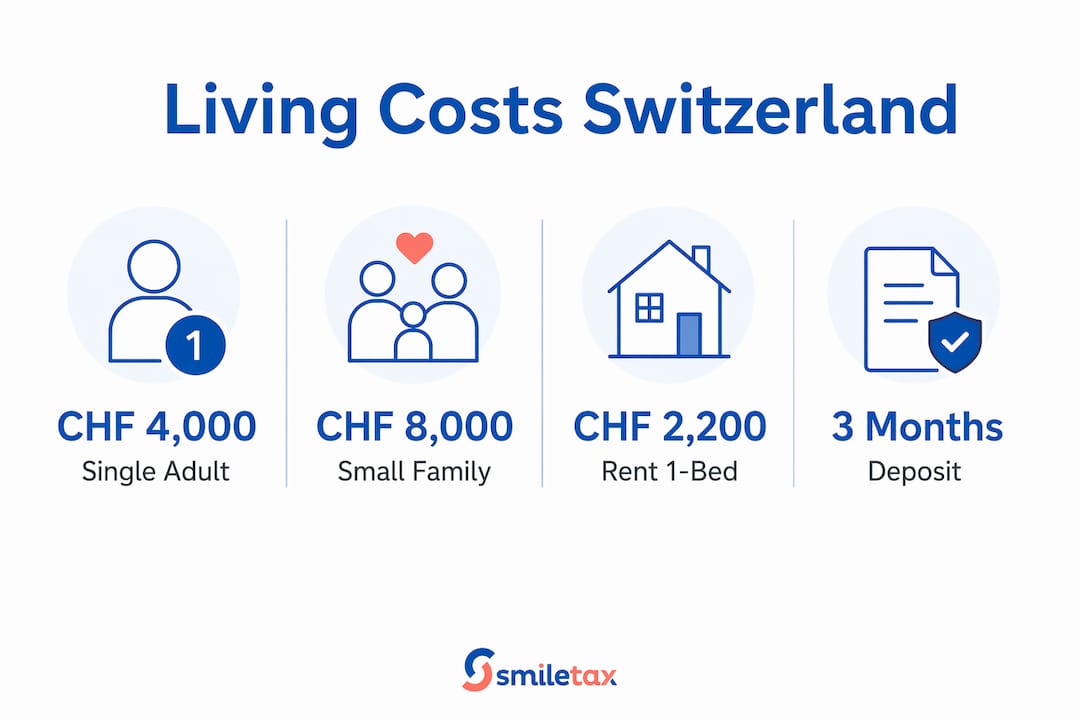
A comfortable single-person budget starts at CHF 4,000–5,000 per month. Families should budget CHF 8,000–14,000 before tax, depending on location and number of children. These figures do not include savings or discretionary spending.
| Expense | Single adult (CHF/month) | Family of four (CHF/month) |
|---|---|---|
| Rent (1-bed Zurich/Geneva) | CHF 2,200–3,800 | CHF 3,500–6,000+ |
| Health insurance | CHF 350–500 | CHF 1,200–2,000 |
| Childcare (per child) | N/A | CHF 1,500–3,500 |
| Groceries | CHF 400–600 | CHF 900–1,400 |
| Transport (public) | CHF 80–120 | CHF 200–350 |
Key cost drivers to understand before you move
Health insurance in Switzerland is mandatory and entirely private. Every resident must enroll within three months of arrival. Premiums vary by canton, age, and chosen deductible. There is no employer-provided group plan equivalent to what most Americans are used to. You pay your premium directly to an insurer like CSS, Helsana, or Swica, and you choose your own deductible level.
Housing deserves special attention. Swiss landlords require up to three months’ rent as a security deposit, and the rental application process is competitive. Applicants must submit a full dossier including proof of salary, a debt register extract, and residence permit documentation. Americans arriving without a local credit history or Swiss bank account face real friction at this stage.
Zug stands out as a lower-tax canton that attracts finance and crypto professionals. Geneva and Zurich offer the largest expat communities but carry the highest rents. Cantonal income tax rates vary significantly across Switzerland’s 26 cantons, which affects your net take-home pay without changing the gross salary your employer offers.
The recommended arrival buffer is CHF 25,000–50,000 in liquid savings. That figure covers your deposit, first months of health insurance, permit fees, and living costs before your first paycheck clears. Many Americans underestimate this requirement and arrive financially stressed before they have even started work.
What banking challenges do American expats face in Switzerland?
Banking is one of the most underestimated practical hurdles for Americans in Switzerland. Many Swiss banks refuse US clients outright due to the compliance burden created by FATCA, the US law that requires foreign financial institutions to report American account holders to the IRS. Major Swiss institutions including UBS and Credit Suisse have historically been cautious or restrictive with US persons.
The consequences are concrete. Opening a salary account, securing a mortgage, and building a local financial profile all become harder. Some Americans arrive with a job offer and cannot open a basic checking account for weeks.
Practical options that work for American expats include:
- Neon and Yuh: Swiss fintech apps that are generally more accessible to US persons than traditional banks
- Postfinance: The postal bank, which has historically been more open to US clients than private banks
- Interactive Brokers: Used by some expats for investment accounts when Swiss brokerages decline
- US-based accounts: Maintaining a US bank account like Charles Schwab’s international checking account provides a reliable fallback for international transfers
Tip: Before you relocate, confirm in writing that your chosen Swiss bank will open an account for a US person. Do not assume approval. Some expats have had job start dates delayed because they could not receive their salary.
What is the lifestyle reality for American expats in Switzerland?
Switzerland delivers on its reputation for safety, cleanliness, and reliability. Trains run on time. Healthcare is excellent. The outdoor access, from the Alps to Lake Geneva to the Rhine, is genuinely extraordinary. For families, the combination of low crime, strong schools, and clean cities is hard to match anywhere in the world.
The social culture, however, surprises most Americans. Swiss social reserve is real and consistent. Neighbors do not introduce themselves spontaneously. Friendships form slowly and through structured contexts like sports clubs, language classes, or workplace relationships. Americans accustomed to easy, informal socializing often find the first year isolating.
The expat community in Zurich, Geneva, Basel, and Zug is large and active. International schools like the Zurich International School and the International School of Geneva serve families well and create natural social networks for parents. English is widely spoken in professional settings, which reduces the urgency of learning German, French, or Italian but also limits deeper integration.
Quality of life benefits that consistently matter to American expats include:
- Exceptional public transportation connecting cities, towns, and mountain regions
- Healthcare system ranked among the best in Europe for access and quality
- Low violent crime rates across all major cities
- Strong outdoor recreation culture including skiing, hiking, and cycling
- Central European location enabling easy travel to France, Italy, Germany, and Austria
The honest trade-off is this: Switzerland rewards people who value structure, reliability, and long-term stability. It is less comfortable for people who prioritize spontaneous social connection, affordable urban living, or a relaxed bureaucratic environment. The rise in US citizenship renunciations among Americans living in Switzerland reflects not just financial complexity but genuine frustration with the dual burden of Swiss and American administrative requirements.
Key takeaways
Living in Switzerland as an American is financially viable for high earners but demands careful preparation across visas, housing, banking, and social adjustment before arrival.
| Point | Details |
|---|---|
| Visa timeline matters | Start the employer-sponsored permit process 3–6 months before your move date. |
| Budget for arrival costs | Arrive with CHF 25,000–50,000 liquid to cover deposits, insurance, and fees. |
| Health insurance is mandatory | Every resident must enroll in private health insurance within three months of arrival. |
| Banking requires advance planning | Confirm Swiss bank access before relocating; many institutions restrict US clients. |
| Social integration takes effort | Swiss social culture is reserved; expat networks and clubs are the fastest path to connection. |
The Switzerland reality check most articles skip
Switzerland works brilliantly for Americans who arrive prepared and stay realistic. The problem is that most relocation content focuses on the upside: the Alps, the salaries, the trains. What gets glossed over is the compounding weight of the practical challenges in the first six months.
The banking situation alone can derail a smooth start. Arriving in Zurich with a signed employment contract and no functioning bank account is more common than people admit. The rental market adds another layer. Competing for a two-bedroom apartment in Zurich against Swiss and EU applicants with local credit histories and established bank accounts is genuinely difficult, especially when you are new to the country.
The social adjustment is the quietest challenge. Switzerland does not reject newcomers. It simply does not rush to include them either. Americans who build their social life through structured activities, international school communities, or professional networks tend to settle in well. Those who wait for organic connection the way it happens in American cities often find the first year lonely.
The cost-benefit calculation ultimately depends on your sector and your life stage. For a pharma professional or a finance executive, Swiss salaries more than compensate for the high cost of living. For a trailing spouse or a professional in a field without strong Swiss demand, the math is harder. Go in with your eyes open, your savings ready, and a realistic picture of what the first year actually looks like.
Your US tax obligations don’t pause when you move to Switzerland
Living in Switzerland does not end your US filing obligations. Americans abroad must continue filing US returns every year, regardless of where they live or work. SmileTax specializes in US tax compliance for Americans living overseas, including those based in Switzerland. The team works directly with expats who need accurate, professional filing support without the cost or impersonality of a large accounting firm. If you are relocating to Switzerland or already living there and want your US taxes handled properly, SmileTax was built for exactly that situation. Explore expat filing support and get your compliance sorted before it becomes a problem.
FAQ
What visa does an American need to live in Switzerland?
Americans need a residence permit, most commonly an employer-sponsored B permit. Work permits for non-EU nationals are subject to annual quotas and require employer sponsorship.
How much money do you need to move to Switzerland?
Arriving with CHF 25,000–50,000 in liquid savings is strongly recommended to cover deposits, health insurance enrollment, and living costs before your first salary payment.
Is Switzerland expensive for Americans?
Switzerland is one of the most expensive countries in the world, but average net salaries of CHF 5,500–8,000 per month in professional sectors generally offset the high cost of living for employed expats.
Can Americans open a bank account in Switzerland?
Many Swiss banks restrict or refuse US clients due to FATCA compliance requirements. Fintech options and postal banking services are more accessible, but confirming account access before relocating is critical.
How long does it take to get permanent residency in Switzerland as an American?
Americans become eligible for a C permit, which grants permanent residence, after 10 consecutive years of legal residence in Switzerland.