

Uruguay is one of the most stable, livable countries in South America, and for Americans who want a safe, predictable base outside the US, it delivers on most fronts. Expect to spend roughly a moderate to high range per month as a single person in Montevideo, a residency process that takes patience but is genuinely accessible, and a quality of life that trades American-speed convenience for something slower and often more satisfying.
Three things to know before you read further:
- Rent first. Spend 6–12 months in furnished temporary housing before signing a long-term lease or buying anything.
- Learn Spanish. English is not widely spoken outside expat circles, and functional Spanish within six months is realistic and worth the effort.
- Gather your documents early. Apostilled birth certificate, background check, and proof of address are the foundation of almost every official process here.
Key Takeaways
Uruguay is a practical, stable choice for Americans who budget realistically, rent before buying, and commit to learning Spanish.
| Point | Details |
|---|---|
| Monthly cost baseline | Singles budget $1,500–$2,200/month in Montevideo; families of four plan for $3,500–$6,000. |
| Rent first, always | Spend 6–12 months in furnished housing before signing a long-term lease or buying property. |
| Residency takes time | The process can take many months; apostille documents before leaving the US to avoid delays. |
| Healthcare is accessible | Private mutualista plans cost roughly $80–$120/person/month and cover most expat needs. |
| SmileTax for US filing | Americans in Uruguay still file US returns; SmileTax handles that simply and professionally. |
Table of Contents
- What does living in Uruguay as an American actually cost?
- What are the visa and residency options for Americans in Uruguay?
- How should you approach housing when you first arrive?
- Which Montevideo neighborhoods should you consider first?
- How does healthcare work, and what are the school options?
- How do you set up a bank account, phone, and utilities?
- What does a practical 0–12 month moving timeline look like?
- What mistakes do American expats most commonly make?
- How do you build a real life in Uruguay, not just a long vacation?
- Your US taxes don’t have to be complicated from Uruguay
- Sources
What does living in Uruguay as an American actually cost?
The INGAR Index provides indicative monthly budget ranges for Montevideo for single persons, couples, and families, assuming mid-tier neighborhoods and local private healthcare.
Punta del Este runs noticeably higher, especially in summer (December–March), when short-term rental demand spikes. Carrasco, Montevideo’s most upscale suburb, adds a 20–30% premium on rent compared to Pocitos. The interior towns of Colonia del Sacramento or Salto offer lower costs but fewer English-speaking services and fewer direct flights.
💡 Tip: Budget a 20–30% buffer on top of these figures if you plan to live in Carrasco, enroll children in international schools, or maintain a car. Those three choices together can push a family budget well past $6,000/month.
What are the visa and residency options for Americans in Uruguay?
Uruguay does not offer a dedicated digital nomad visa, but the path to legal residency is genuinely accessible. Americans can enter without a visa and stay up to 90 days as tourists, with the option to extend. Most people who plan to stay longer apply for temporary residency, which converts to permanent residency after two years of continuous presence.
Documents typically required:
- Valid US passport (6+ months remaining)
- FBI background check (apostilled)
- Birth certificate (apostilled)
- Proof of income or financial solvency
- Proof of address in Uruguay (a lease agreement works)
- Marriage certificate if applicable (apostilled)
- Uruguayan ID photos and biometric data
The full residency process can take many months, sometimes longer, depending on document processing times and appointment availability at the Dirección Nacional de Migración. Apostilling US documents before you leave saves weeks.
💡 Tip: Get certified Spanish translations of all apostilled documents done in Uruguay by a certified translator (traductor público). Bringing pre-translated copies from the US is rarely accepted.
How should you approach housing when you first arrive?
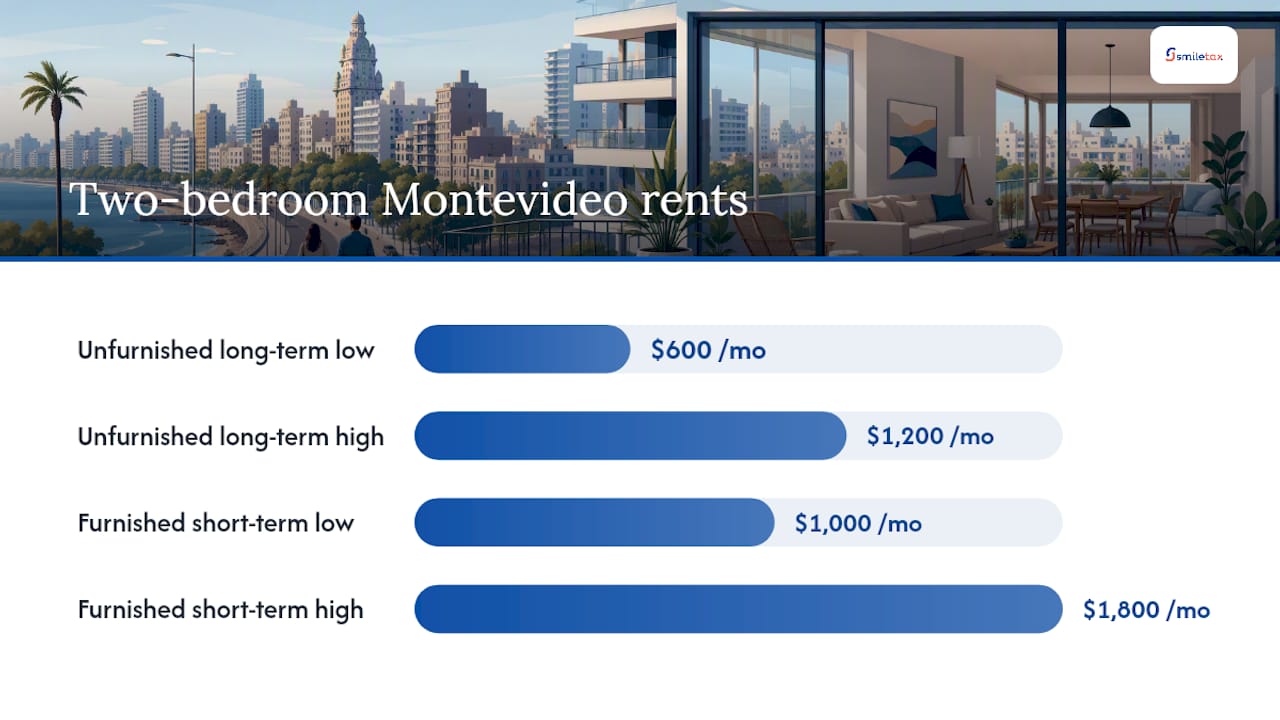
The single most practical move is to arrive with a short-term furnished rental already booked and spend your first months testing neighborhoods before committing to anything longer. INGAR recommends this 6–12 month approach explicitly, and furnished short-term units in Montevideo typically run $1,000–$1,800/month for a 2BR. Long-term unfurnished leases drop to $600–$1,200/month for comparable units.
| Housing type | Typical cost (2BR Montevideo) | Guarantee required? | Best for |
|---|---|---|---|
| Furnished short-term | $1,000–$1,800/month | Usually not | First 6–12 months |
| Unfurnished long-term | $600–$1,200/month | Yes (garantía or ANDA) | After neighborhood testing |
The guarantee system catches many foreigners off guard. Landlords typically require a garantía, which is a local property owner who co-signs the lease. Foreigners without local contacts can use ANDA (the national notary association’s guarantee service) or a private rental insurance product. Living-abroad that tenant protections are solid once you are in a lease, but getting through the guarantee requirement is the main friction point for new arrivals.
Before signing any long-term lease, check:
- Exact monthly gastos comunes (condo fees) in writing
- Whether utilities are included or separate
- Noise levels on the street at night (visit after 9 PM)
- Morning sunlight and ventilation in the unit
- Proximity to a bus line or the Rambla
💡 Tip: Ask the building’s portero (doorman) about the neighbors and the building’s maintenance history. They know everything and are usually happy to talk.
Which Montevideo neighborhoods should you consider first?
Pocitos is the default starting point for most American expats. It sits on the Rambla (the waterfront promenade), has good supermarkets, cafés, and bus connections, and offers furnished apartment rents around $600–$1,200. It suits digital nomads and couples equally well.
Punta Carretas sits just south of Pocitos and feels slightly quieter. The neighborhood centers on a converted prison that is now a shopping mall, surrounded by tree-lined streets and good restaurants. Families with young children often prefer it for the calmer pace.
Carrasco is Montevideo’s most upscale residential area, home to most of the city’s international schools and embassies. Rents are higher, the neighborhood is car-dependent, and it suits families prioritizing school access over walkability.
Ciudad Vieja (the old city) attracts younger expats and digital nomads who want character and proximity to cultural life. It is improving but still uneven in quality block by block. Visit at night before committing.
Punta del Este works well as a part-year base. Summers are lively, with beaches, restaurants, and a large seasonal expat community. Off-season (April–November), the town quiets dramatically, which suits some people and frustrates others. It is not a practical full-year base for families needing consistent school access or healthcare.
Ciudad de la Costa is a suburban coastal strip east of Montevideo. It offers lower rents and a quieter lifestyle but requires a car and a longer commute into the city.
How does healthcare work, and what are the school options?
Uruguay’s healthcare system runs on two tracks. The public system (ASSE, under the SNIS framework) is free but slow and under-resourced for non-emergency care. Most expats join a mutualista, a private cooperative health plan that covers GP visits, specialist referrals, emergency care, and most procedures. ExpatArrivals confirms that mutualista plans are the standard choice among the expat community, and costs run roughly $80–$120 per person per month.

Enrollment is straightforward: choose a mutualista (CASMU, Médica Uruguaya, and Hospital Británico are among the well-regarded options), present your residency documentation or passport, and pay the monthly fee. Coverage begins quickly.
For families, international schools cluster in Montevideo and Carrasco. Tuition at English-medium international schools typically runs $500–$1,200 per child per month, depending on the school and grade level. Local public schools are free and teach in Spanish, which works well for families committed to full integration. Private Uruguayan schools offer a middle path, with bilingual programs at lower tuition than full international schools.
💡 Tip: Visit any school during a regular school day, not an open house. Ask for a sample weekly schedule, the language support policy for non-Spanish speakers, and the full fee breakdown including registration, uniforms, and activity fees.
How do you set up a bank account, phone, and utilities?
Banking is the most friction-heavy setup task. Most banks require your cédula (Uruguayan ID card), which you will not have on arrival. In the interim, some banks accept a passport and proof of address for a basic account. Expect the process to take several visits. BROU (Banco de la República) is the state bank and the most accessible for new residents.
Mobile phones: Both Antel and Movistar operate nationwide networks. Antel is state-owned and generally offers better rural coverage; Movistar suits urban users. A prepaid SIM costs a few dollars and is available at any convenience store. Monthly postpaid plans with data start around $15–$25.
Utilities:
- UTE (electricity): Register in your name once you have a lease and cédula. Bills arrive monthly and average $60–$100 for a standard apartment.
- OSE (water): Similar registration process; costs are low and rarely a budget concern.
- Antel fiber internet: Available in most Montevideo buildings; fiber plans run $30–$50/month and speeds are reliable enough for remote work.
What does a practical 0–12 month moving timeline look like?
- Before departure: Apostille FBI background check and birth certificate; book 4–8 weeks of furnished temporary housing; unlock your US phone for a local SIM.
- Arrival week: Buy an Antel or Movistar SIM; confirm temporary housing; open a basic bank account with your passport.
- Month 1: Register with a mutualista; begin Spanish classes; explore 2–3 neighborhoods on foot and by bus at different times of day.
- Months 2–3: Initiate residency paperwork at the Dirección Nacional de Migración; visit schools if relevant; narrow your neighborhood shortlist.
- Months 3–6: Sign a long-term unfurnished lease once you have confirmed your preferred neighborhood; register UTE, OSE, and Antel in your name.
- Months 6–12: Receive your cédula (timing varies); open a full bank account; consider whether buying property makes sense only after living through all four seasons.
💡 Tip: Keep both a digital cloud backup and a physical folder of every apostilled document. Uruguayan offices sometimes request originals, and losing them mid-process causes significant delays.
What mistakes do American expats most commonly make?
- Buying property too early. Closing costs include notary fees and a property transfer tax (ITP) of roughly 2% of the property value, plus additional transaction fees. Buying before you know the neighborhood well is expensive to undo.
- Ignoring condo fees. Gastos comunes can add 5–15% to your monthly housing cost on top of rent. Always confirm the exact figure in writing before signing.
- Underestimating winter. Montevideo winters (June–August) are damp and cold, and most apartments lack central heating. Budget for electric heaters or a gas heater, and check that your apartment has adequate insulation.
- Misreading the guarantee requirement. Showing up without a local property owner to co-sign a lease leaves you dependent on ANDA or insurance products, which add cost and paperwork.
- Assuming English is enough. Outside Pocitos and Carrasco, daily life runs entirely in Spanish. Banking, healthcare appointments, and lease negotiations all require at least functional Spanish.
How do you build a real life in Uruguay, not just a long vacation?
Integration happens through repetition and proximity, not grand gestures. A few practical anchors:
- Spanish classes: Aim for functional conversational Spanish within six months. Group classes at a local language school are cheaper and more social than private tutoring.
- Ferias (street markets): Weekly neighborhood ferias are where locals shop for produce. They are also one of the easiest places to practice Spanish and meet neighbors.
- Sports clubs and social clubs: Uruguay has a strong club culture. Joining a local tennis club, fútbol club, or rowing club gives you a ready-made social structure.
- The Rambla: Montevideo’s 22-kilometer waterfront path is where the city exercises, socializes, and walks dogs. Showing up regularly makes you a familiar face faster than almost anything else.
Sundays move slowly here. Most shops close, and the rhythm shifts to family meals and outdoor time. RewireAbroad notes that Uruguay’s political stability and decent internet infrastructure make it a practical base for remote workers, but the pace of daily life is genuinely unhurried, which is an adjustment for most Americans.
💡 Tip: Invest your social energy in one or two consistent local hubs rather than attending every expat event. Depth of connection matters more than breadth, and locals respond well to people who show up regularly.
How this guide was put together
Cost ranges in this guide draw primarily from the INGAR Index, which tracks Montevideo rental data, and from expat guides published by Expat.com, ExpatArrivals, RewireAbroad, PropertyInUruguay, and Living-abroad.org. Figures reflect mid-2020s conditions and will vary by neighborhood, season, and family size. A 6–12 month rental period before buying reduces the risk that any single data point misleads your decision.
What actually determines whether the move succeeds
Uruguay rewards a specific kind of expat: someone who is self-sufficient, genuinely curious about a different pace of life, and willing to do the work of learning Spanish and building local ties without a formal support structure. The country does not hold your hand. Bureaucracy is slow, services are not always intuitive, and the expat community, while warm, is smaller than in Colombia or Panama.
The rent-first rule is not just financial advice. It is the single highest-leverage action you can take. Living in a neighborhood for six months before committing to buy tells you things no guide can: whether the noise bothers you at 2 AM, whether the commute is sustainable in winter rain, whether the neighbors are people you want to know. Americans who skip that step and buy quickly tend to regret it. Those who take the slower path tend to stay.
Your US taxes don’t have to be complicated from Uruguay
Moving abroad does not end your US filing obligations, but it does not have to be stressful either. SmileTax works specifically with Americans living overseas, including retirees, digital nomads, international teachers, and families who have made the move to places like Uruguay. Every client works directly with an experienced US tax professional, with clear flat-fee pricing and no handoffs to unknown preparers. If you want your US filing handled properly while you focus on building your life in Montevideo, visit SmileTax to get started.
This article is general information, not a substitute for advice from a qualified lawyer. Consult a qualified legal professional about your own circumstances before acting on anything here.
Sources
- Moving to Uruguay from Abroad (2026): Guide and Checklist | INGAR Negocios Inmobiliarios
- Moving to Uruguay | Expat Arrivals
- Living in Uruguay: visa, tax, insurance & cost (2026)
- Uruguay Expat Guide: What Life Is Actually Like (2026)
- Expat
- Living in Uruguay 2026: Costs, Visas & Expat Guide | Rewire Abroad
For a regional comparison, the living in Colombia as an American guide covers a popular alternative base with different cost and lifestyle trade-offs.