

Moving to the Netherlands sounds manageable on paper. Good English proficiency, a stable economy, excellent infrastructure. But living in the Netherlands as an American reveals a different story once you land. The practical hurdles hit fast: mandatory registrations with tight deadlines, a health insurance system that works nothing like what you know, a housing market that rewards preparation, and a cultural communication style that can feel jarring at first. This guide covers what most relocation articles skip, so you can walk in prepared rather than scrambling to catch up.
Table of Contents
- Key Takeaways
- What nobody tells you about living in the Netherlands as an American
- Municipality registration and your BSN
- Dutch health insurance: what the rules really mean
- Housing challenges and banking hurdles
- Understanding Dutch directness at work and socially
- Managing the physical and emotional side of relocation
- What the guides usually get wrong
- Your US tax obligations do not stop at the border
- FAQ
Key Takeaways
| Point | Details |
|---|---|
| Register within 5 days | Municipality registration after arrival is time-sensitive and unlocks every other integration step. |
| Health insurance is mandatory | You must arrange Dutch health insurance within 4 months or face fines and out-of-pocket costs. |
| Start housing search early | Begin looking 2 to 4 months before arrival due to a highly competitive rental market. |
| Dutch directness is not personal | Workplace feedback is task-focused, not a personal critique — reframing this reduces stress significantly. |
| Physical adaptation takes time | Cycling, reduced daylight, and lifestyle shifts affect your body and mood more than most people expect. |
What nobody tells you about living in the Netherlands as an American
Most relocation guides focus on the exciting parts: the canals, the cycling culture, the efficient trains. What they underplay are the administrative and cultural realities that shape your first months. American expats in the Netherlands often describe a specific pattern: the first two weeks feel like a vacation, then the bureaucracy sets in and the culture shock follows quietly behind it.
The Netherlands is not a difficult country to live in. But it does require you to operate on its terms, not yours. The systems are logical once you understand them. Getting there, though, takes more preparation than most Americans anticipate before moving to the Netherlands from the USA.
Municipality registration and your BSN
This is the single most important task after you arrive, and it has a hard deadline. If you plan to stay longer than 4 months, you must register within 5 days of arrival at your local municipality (gemeente). From that registration, you receive your BSN, or Burgerservicenummer. Think of it as a Dutch Social Security number.
Without a BSN, almost nothing else works. You cannot open a bank account, access healthcare, sign a rental contract, or enroll children in school. Missing this registration creates a bottleneck that delays every other integration step simultaneously.
Here is what to prepare before your appointment:
- A valid passport or national ID
- Proof of your Dutch address (a rental contract or letter from your landlord)
- Your Dutch residence permit or work authorization documents, if applicable
- Any relevant employer documentation if you are arriving on a sponsored visa
Tip: Municipality offices in cities like Amsterdam and Rotterdam book up fast. Contact your gemeente before you arrive and schedule your registration appointment for your first available day. Some municipalities allow online pre-registration, which saves critical time.
The appointment itself is usually quick. The delay risk is in securing the slot. Treat this like a flight connection. Miss it and everything downstream gets pushed back.
Dutch health insurance: what the rules really mean
The Dutch healthcare system is widely respected, but it operates on rules that catch many Americans off guard. Here is the core obligation: if you work or are legally registered in the Netherlands, you must arrange Dutch health insurance within 4 months. This is monitored by the CAK (Centraal Administratie Kantoor), and failure to comply results in fines and full out-of-pocket healthcare costs.
The system works differently from US insurance. Here is how to understand the key components:
- Basic insurance (basisverzekering): This is mandatory for all residents. Every insurer is required to offer the same basic package, so the coverage itself does not vary much between providers.
- Monthly premiums: In 2026, premiums range from approximately EUR 140 to EUR 175 per month, depending on the insurer.
- Eigen risico (deductible): The mandatory annual deductible is EUR 385. You pay this amount yourself before insurance covers most costs.
- Supplemental insurance (aanvullende verzekering): Optional add-ons covering dental, physiotherapy, and other services not included in the basic package.
- Zorgtoeslag (healthcare allowance): If your income falls below a certain threshold, you may qualify for a government subsidy to offset premium costs. American expats working locally should check eligibility early.
For the gap period before your Dutch insurance activates, arrange temporary international health coverage. Do not assume your US plan covers you abroad for more than emergency care.
Tip: Register with a GP (huisarts) as soon as your insurance is active. In the Dutch system, your GP is the gatekeeper to all specialist care. Without a registered GP, accessing non-emergency medical services becomes significantly harder.
Housing challenges and banking hurdles
The Dutch rental market is one of the most competitive in Europe. Amsterdam, Utrecht, The Hague, and Rotterdam all have tight supply and high demand. The practical advice here is direct: start your housing search 2 to 4 months before arrival. Waiting until you land means competing for apartments while living in temporary accommodation, which adds cost and stress.
Landlords in the Netherlands typically require:
- Proof of employment or a signed work contract
- Recent pay stubs or an employer letter confirming salary
- A copy of your passport and residence permit
- References from previous landlords, if available
- A deposit of one to two months’ rent
One thing that surprises many Americans relocating to the Netherlands is the banking situation. Due to FATCA (the US Foreign Account Tax Compliance Act), some Dutch banks are cautious about opening accounts for US citizens. This does not mean you cannot get an account. It means the process may take longer and require additional documentation. Major banks like ING, ABN AMRO, and Rabobank all serve expats, but timelines vary.
Tip: Open a Dutch bank account as soon as your BSN is in hand. Some banks allow you to start the application online before your appointment. Having a local account is required for paying rent, setting up utilities, and receiving a Dutch salary. Check resources on avoiding hidden fees when managing money across currencies during your transition.

For Americans moving to the Netherlands with families, the best schools for US expats in Amsterdam is a useful starting point when researching international school options alongside your housing search.
Understanding Dutch directness at work and socially
This is where many American expats in the Netherlands hit an unexpected wall. Dutch communication is direct and task-focused, and it is not designed to soften feedback. When a Dutch colleague says your proposal needs rethinking, they mean the proposal. They are not commenting on you as a person.
Americans, shaped by a culture that tends to wrap criticism in encouragement, often read Dutch directness as coldness or disapproval. It is neither. It is efficiency. Once you recognize this, the entire dynamic shifts.
Common experiences of Americans in the Netherlands at work include:
- Receiving blunt feedback in meetings with no diplomatic framing
- Silence or a flat “no” where an American might expect a polite deflection
- Decisions made collectively, sometimes slowly, through consensus-building (the “polder model”)
- Less small talk before getting to business, especially in professional settings
“Asking ‘What does this mean for the project?’ rather than taking direct feedback personally is one of the most effective micro-skills expats can develop in Dutch workplaces.” — IamExpat
Socially, Dutch directness extends beyond the office. If someone does not want to do something, they say so. If they think your idea is impractical, they will tell you. This can feel abrasive at first. Over time, most expats come to appreciate it. You always know where you stand.
Building friendships takes longer in the Netherlands than in the US. Dutch social circles tend to be established and stable. The key is consistency: joining clubs, sports teams, language classes, or neighborhood groups. Showing up repeatedly matters more than making a strong first impression.
Managing the physical and emotional side of relocation
Relocation affects your body in ways that go beyond jet lag. Moving to the Netherlands is harder on your body than most people expect. The combination of cycling everywhere, reduced winter daylight, and a completely changed daily routine creates real physiological stress.
Practical steps that help:
- Protect your sleep rhythm by keeping consistent wake times, even on weekends, especially during the first month
- Get morning light exposure as early as possible each day to help regulate your circadian rhythm during the dark Dutch winters
- Take vitamin D supplements from October through March, when sunlight is limited and deficiency is common even among locals
- Build cycling into your routine gradually rather than immediately committing to long daily rides, particularly if you are not a regular cyclist
The emotional side of adaptation follows its own timeline. Homesickness tends to peak around months two and three, after the novelty fades and the reality of distance sets in. Addressing this proactively matters. Connect with expat communities online and in person. Groups like InterNations have active chapters in most Dutch cities.
Tip: Do not wait until you feel isolated to build your social network. Join something in your first two weeks, even if it feels premature. The relationships you build early become your anchor during harder stretches.
The checklist for moving abroad from SmileTax covers many of the practical preparation steps worth reviewing before your departure date.
What the guides usually get wrong
Most relocation content treats compliance as the finish line. Register on time, get your insurance, open a bank account, and you are settled. The reality for American expats in the Netherlands is that compliance is just the starting point.
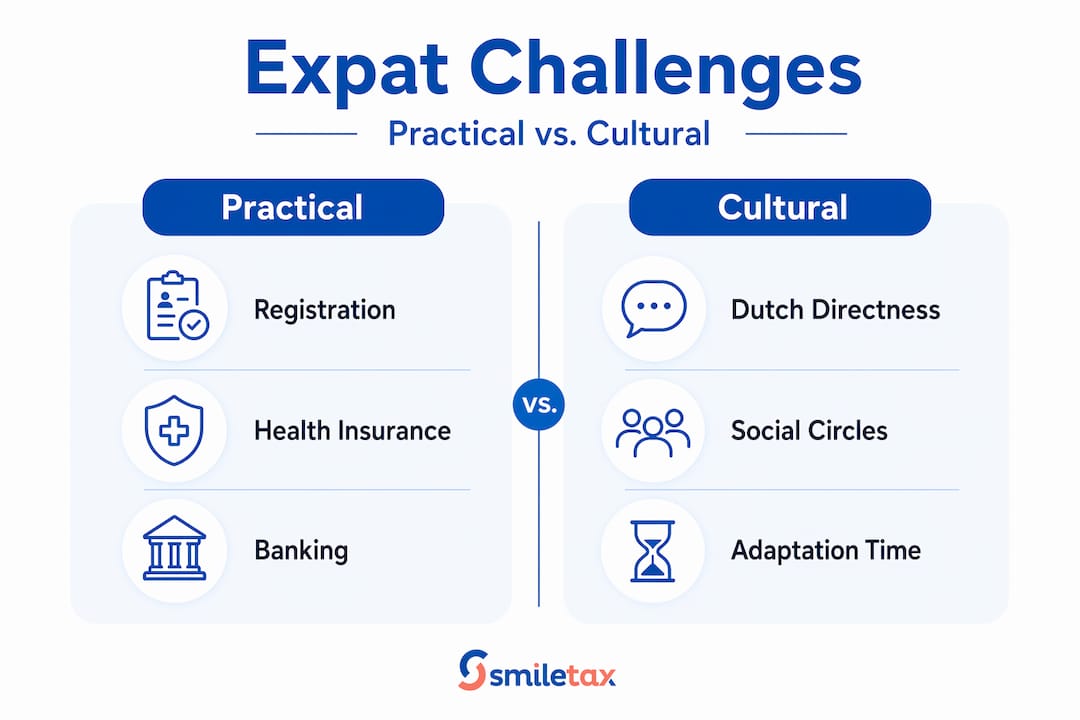
The deeper adaptation work is cultural and personal. It involves learning to read Dutch communication without filtering it through American social norms. It means accepting that building genuine friendships takes months, not weeks. It requires understanding that the Dutch value of doe maar gewoon (just act normal, do not show off) is not a put-down but a genuine social principle.
Americans who struggle most in the Netherlands tend to be those who underestimate the registration timeline, interpret directness as hostility, or wait for the culture to adjust to them. Those who adapt well are the ones who treat every friction point as information rather than a problem.
The cultural differences in the Netherlands are real, but they are not obstacles. They are the texture of a different way of living. With patience and a willingness to ask questions, most Americans find that Dutch life offers something genuinely valuable: clarity, efficiency, and a social contract built on honesty.
Your US tax obligations do not stop at the border
Living in the Netherlands full-time does not end your responsibility to file US taxes. Americans abroad are required to file US federal returns regardless of where they live or where their income is earned. This catches many expats off guard, particularly those who assumed that leaving the country simplified their tax situation.
SmileTax works specifically with Americans living and working overseas, including those employed locally in the Netherlands, teachers at international schools, and long-term expats with ongoing filing obligations. If you are working on the local economy abroad or serving in a professional capacity overseas, SmileTax provides clear, affordable support from experienced US tax professionals who understand expat realities. Explore US tax filing for Americans abroad to understand what your obligations look like and how to handle them without the stress of navigating it alone.
FAQ
How soon after arriving in the Netherlands must I register?
If you plan to stay longer than 4 months, you must register within 5 days of arrival at your local municipality to receive your BSN.
Is Dutch health insurance mandatory for American expats?
Yes. If you are legally registered or working in the Netherlands, you must arrange basic Dutch health insurance within 4 months or face fines and full personal liability for healthcare costs.
Why is it hard for Americans to open a Dutch bank account?
Due to FATCA compliance requirements, some Dutch banks apply additional scrutiny to US citizen applications. The process is possible but may take longer. Having your BSN ready and applying early reduces delays significantly.
How do Americans adapt to Dutch directness at work?
Recognizing that Dutch feedback is task-focused, not personal, is the key shift. Asking clarifying questions about the work itself rather than reacting emotionally helps expats build stronger professional relationships faster.
How competitive is the Dutch housing market for expats?
Very competitive, particularly in Amsterdam, Utrecht, and Rotterdam. Experts recommend starting your search 2 to 4 months before your planned arrival date to secure suitable housing before you land.