

Making the move from the US to Germany involves a lot more than packing boxes and booking a flight. Moving to Germany from the US is a practical relocation challenge that spans visa applications, mandatory registrations, housing searches, banking hurdles, and a genuine cultural shift. Many Americans arrive expecting the paperwork to be the hardest part. In reality, the systems you navigate after landing, from getting your address registered to understanding why your landlord expects a formal cover letter, are what truly test your patience and preparation. This guide covers everything you need to know to land on your feet.
Table of Contents
- Key takeaways
- Visa and residence permits for US citizens
- First 90 days: registrations you cannot skip
- Housing and cost of living in Germany
- Cultural adjustment and building your life in Germany
- What Americans often overlook when moving to Germany
- Your US taxes still matter when you live in Germany
- FAQ
Key takeaways
| Point | Details |
|---|---|
| Visa-free window is short | US citizens get 90 days to apply for a residence permit locally before needing consulate involvement. |
| Anmeldung unlocks everything | Registering your address within 14 days is the single step that makes all other services accessible. |
| Housing competition is fierce | Major German cities have vacancy rates under 2%, so prepare your rental documents before you arrive. |
| Banking requires local setup | Many US financial platforms restrict accounts for German residents, so open a local account early. |
| Cultural adjustment takes time | German communication norms and bureaucratic culture are genuinely different. Patience is a practical skill here. |
Visa and residence permits for US citizens
One of the first things to understand when relocating to Germany is that the process is more forgiving than many Americans expect. Under §41 AufenthV, US citizens can enter Germany visa-free and apply for most residence permits directly at local immigration authorities within their 90-day window. You do not need to apply at a German consulate before leaving the US, with one notable exception: the Opportunity Card (Chancenkarte), which requires a consulate application abroad.
The most common permit types for Americans include:
- Work visa for those with a job offer from a German employer
- EU Blue Card for highly skilled workers meeting salary thresholds
- Student visa for those enrolling in a German university
- Family reunification visa for joining a spouse or partner already residing in Germany
- Freelance visa for self-employed professionals in qualifying fields
The EU Blue Card is particularly popular among skilled American workers. For 2026, the salary thresholds are €43,800 for standard roles and €39,682 for shortage occupations including IT, engineering, and healthcare. Your US degree must also be formally recognized by German authorities, which can take several weeks, so start that process before you arrive.
Processing times at local immigration offices vary widely. Backlogs are common in major cities, and delays of several months are not unusual. If your permit is still being processed when your visa-free period expires, you can receive a Fiktionsbescheinigung. This is a temporary certificate that legally authorizes you to remain in Germany and, in most cases, to work while your application is reviewed.
One significant recent update worth knowing: since June 2024, Americans can hold dual US-German citizenship without renouncing their US passport. The naturalization timeline has also been reduced to five years of legal residence, down from the previous eight. This change makes Germany a much more attractive long-term destination for Americans considering permanent relocation.
Tip: Start gathering apostilled copies of your birth certificate, university diplomas, and any professional credentials before you leave the US. German immigration offices require original documents with official stamps or certified translations, and sourcing these from abroad takes time.
First 90 days: registrations you cannot skip
Once you have a place to stay in Germany, the clock starts ticking on one of the most consequential administrative steps of your entire move. Registering your address at the local Bürgeramt (citizens’ office), a process called Anmeldung, is legally required within 14 days of moving in. Missing this deadline can result in fines, and more practically, it blocks your access to almost everything else.
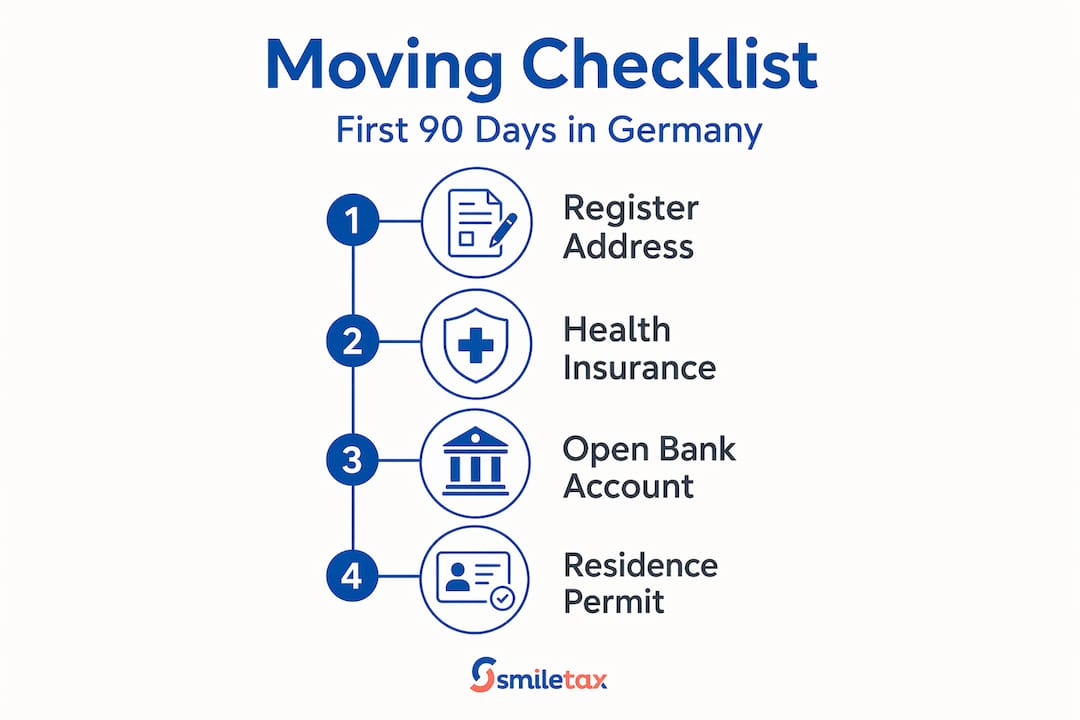
The Anmeldung is effectively the master key for settling into Germany. Without it, you cannot open a German bank account, enroll in health insurance, sign a phone contract, or receive your tax ID number. Here is the typical sequence of steps after arrival:
- Secure temporary or permanent accommodation (you need a physical address to register).
- Gather required documents: passport, completed Wohnungsgeberbestätigung (landlord confirmation form), and the registration form itself.
- Book an appointment at your local Bürgeramt. Slots fill up fast in large cities, so book online the moment you have an address.
- Attend your appointment and receive your Anmeldebestätigung (registration certificate).
- Use the certificate to open a bank account and enroll in health insurance.
- Your tax ID (Steuer-ID) will arrive by post within a few weeks of registration.
Health insurance is mandatory in Germany and must be in place before your residence permit can be approved. If your income falls below the statutory threshold, you will be enrolled in the public system (gesetzliche Krankenversicherung). Above that threshold, private insurance (private Krankenversicherung) becomes an option. Both systems provide solid coverage, but the rules around switching between them are strict, so choose carefully from the start.
| Step | Timeline | Why it matters |
|---|---|---|
| Anmeldung (address registration) | Within 14 days of arrival | Unlocks banking, insurance, and tax ID |
| Health insurance enrollment | Before permit approval | Legally required for residence permit |
| Bank account opening | After Anmeldung | Needed for salary, rent, and services |
| Tax ID receipt | 2 to 4 weeks post-Anmeldung | Required for employment and tax purposes |
| Residence permit application | Within 90-day visa-free window | Authorizes legal stay beyond 90 days |

Tip: Bürgeramt appointments in cities like Berlin, Munich, and Hamburg can be booked out for weeks. Check for cancellations early in the morning, as slots are frequently released overnight. Some expats also use services that monitor and grab available slots on their behalf.
Regarding banking, be aware that many US financial platforms restrict or close accounts for residents in Germany due to FATCA compliance requirements. Setting up a local German bank account as soon as you have your Anmeldung certificate is not just convenient. It is often necessary for receiving your salary and paying rent.
Housing and cost of living in Germany
Finding housing is one of the most stressful parts of relocating to Germany, particularly if you are targeting a major city. Vacancy rates in cities like Munich, Frankfurt, and Berlin sit below 2%, which means competition for available apartments is intense. Landlords regularly receive dozens of applications for a single listing.
To be competitive, prepare a rental application package before you start viewing apartments. Landlords typically expect:
- Proof of income (pay stubs or employment contract)
- A Schufa credit report (Germany’s version of a credit check)
- A letter from your previous landlord confirming you left in good standing
- Copies of your passport and visa or residence permit
- A brief cover letter introducing yourself
As a newly arrived American, you will not have a Schufa score yet. Some landlords will accept a letter from your employer or a larger deposit in lieu of this. Furnished short-term rentals through platforms like Wunderflats or HousingAnywhere are a practical bridge solution while you build your local profile and search for a permanent place.
| City | Average monthly rent (1-bed) | Cost of living index vs. US average |
|---|---|---|
| Munich | €1,800 to €2,400 | Higher than most US cities |
| Berlin | €1,300 to €1,800 | Comparable to mid-tier US cities |
| Hamburg | €1,400 to €1,900 | Slightly above US average |
| Leipzig | €700 to €1,000 | Significantly lower than US average |
| Stuttgart | €1,400 to €1,800 | Comparable to mid-tier US cities |
Beyond rent, budget for a few expenses that catch Americans off guard. The Rundfunkbeitrag is a mandatory public broadcasting fee of €18.36 per month that applies to virtually every household in Germany. Non-payment accumulates as debt and can eventually lead to enforcement action, so register for it within your first 45 days.
If you plan to drive, your US driver’s license is valid in Germany for six months. After that, you will need to convert it to a German license. The process varies by state and the country that issued your license. US licenses from most states require passing a theory exam and sometimes a practical driving test, so factor in both the time and cost.
Cultural adjustment and building your life in Germany
The practical steps of relocating to Germany are manageable with enough preparation. The cultural adjustment is a different kind of challenge, and it is one that many expat guides underplay. Understanding how to manage culture shock when moving from the US to Europe is genuinely useful preparation.
German communication tends to be direct and formal, especially in writing. Official letters arrive by post, often in dense bureaucratic language. Responses to emails from government offices can take weeks. This is not rudeness. It is simply how the system operates, and adjusting your expectations early saves a lot of frustration.
Common cultural differences Americans notice:
- Punctuality is taken seriously. Being late to a professional or social commitment is considered disrespectful, not casual.
- Sundays are quiet. Most shops are closed, and noise restrictions apply in residential areas. Plan your grocery shopping accordingly.
- Recycling is not optional. Germany’s waste separation system is detailed and enforced at the building level. Your neighbors will notice if you get it wrong.
- Small talk works differently. Germans tend to move past pleasantries quickly in professional settings, which can feel abrupt to Americans used to warmer openers.
Building a social network takes longer in Germany than many Americans expect. Expat meetup groups, language exchange events, and international community organizations are genuinely helpful. Apps like Meetup and Internations have active communities in most major German cities.
Start learning German before you arrive. Even basic conversational German signals respect and opens doors that English alone cannot. Many government offices, landlords, and service providers operate primarily in German, and having even a working knowledge of the language dramatically reduces your dependence on translators or expat intermediaries.
Tip: Free German language courses are available through the Volkshochschule (VHS), Germany’s network of adult education centers. Integration courses subsidized by the government are also available to newly arrived residents with a residence permit.
What Americans often overlook when moving to Germany
The biggest surprise for most Americans relocating to Germany is not the paperwork. It is the pace. Germany’s bureaucratic systems are thorough, sequential, and largely analog in practice. Physical documents with official stamps carry more weight than digital copies, and many processes cannot begin until a previous step is fully completed and certified.
Americans who arrive without apostilled documents, or who assume a scanned PDF will suffice, often lose weeks waiting for replacements. The same applies to banking. US financial platforms frequently restrict services for German residents, and setting up a local account is not a formality. It is a functional necessity.
Work permit timing is another area where planning matters. If you start a job before your permit is formally approved, you may be in violation of your visa conditions even if your Fiktionsbescheinigung is in hand. Confirm the exact scope of what your temporary certificate permits before your first day of work.
None of this is meant to discourage the move. Germany offers excellent public infrastructure, strong worker protections, world-class healthcare, and a genuinely high quality of life. The challenges are real, but they are manageable with preparation and the right support network in place.
Your US taxes still matter when you live in Germany
Living in Germany does not end your US tax filing obligations. US citizens are required to file US tax returns on worldwide income regardless of where they live, and Germany’s tax system adds another layer of complexity to manage. SmileTax specializes in helping Americans abroad handle their US expat tax filing accurately and without the stress of navigating it alone.
Whether you are just arriving or have been in Germany for years, having a professional handle your US filing means fewer surprises and more confidence that everything is done correctly. SmileTax works directly with each client, with no handoffs to unknown preparers and no generic software. You can also book an expat tax consultation to get clarity on your specific situation before filing season arrives. For a broader preparation checklist, the Americans moving to Europe guide is a practical starting point.
FAQ
Can US citizens move to Germany without a visa?
Yes. US citizens can enter Germany visa-free for up to 90 days and apply for most residence permits at local immigration offices during that window, without needing a visa from a US consulate beforehand.
How long does the Anmeldung process take?
The appointment itself takes about 15 to 30 minutes, but booking a slot in major cities can take several weeks due to high demand. You must complete it within 14 days of moving into your accommodation.
Is health insurance mandatory for Americans living in Germany?
Yes. Health insurance is legally required in Germany and must be in place before your residence permit is approved. Public insurance applies below income thresholds, and private insurance is available above them.
Can Americans keep their US citizenship when naturalizing in Germany?
Since June 2024, Germany permits dual citizenship, meaning Americans can naturalize in Germany after five years of legal residence without renouncing their US passport.
How competitive is the housing market in major German cities?
Very competitive. Vacancy rates in cities like Munich and Berlin sit below 2%, and landlords typically require a full application package including a Schufa credit report, proof of income, and a cover letter.