

Moving to Ireland from the US is genuinely doable, but it takes planning, realistic budgets, and a clear-eyed view of the housing market. Most Americans complete the move in 3–6 months from job offer to arrival. The visa process is straightforward if you have a qualifying job offer. The housing shortage is the real challenge, not the paperwork.
Here is what to expect at a glance:
- Visa: You need an employment permit to live and work in Ireland. Tourist stays up to 90 days are visa-free.
- Budget: Plan €10,000–€15,000 for the move itself plus first-month costs.
- Rent: Dublin one-bedroom apartments run high rents per month. Smaller cities cost notably less.
- Lifestyle: Slower pace, strong pub culture, and considerably more annual leave than most US jobs offer.
- Biggest hurdle: Housing. Properties in Dublin routinely attract 50+ applications.
Table of Contents
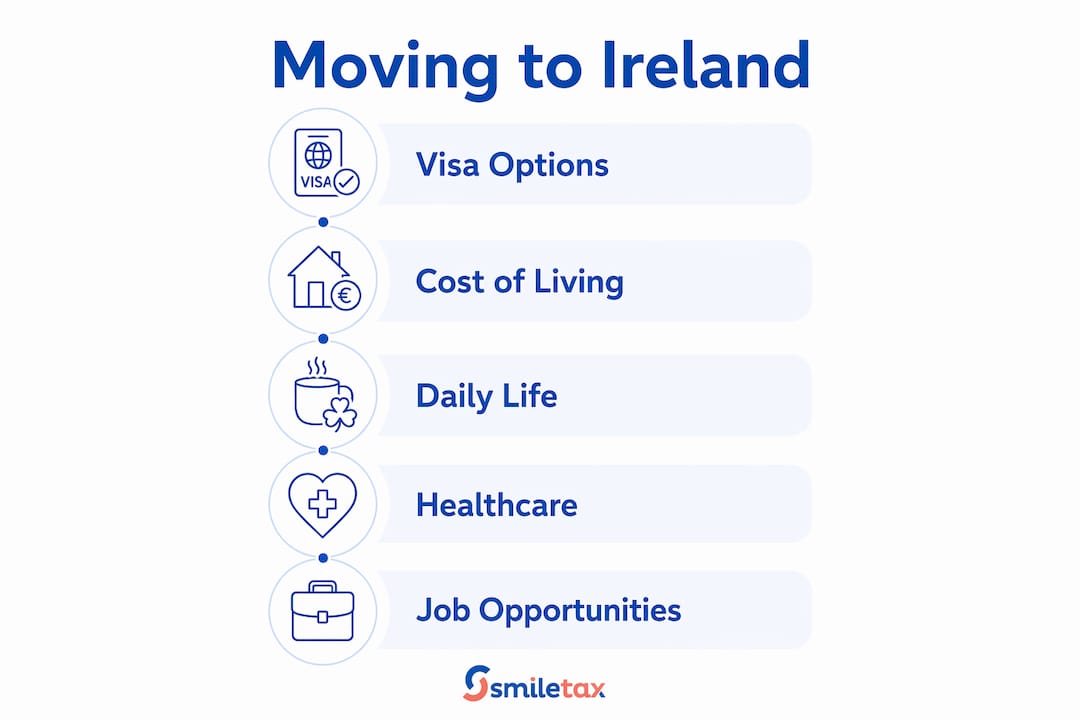
- What visa options do US citizens have for moving to Ireland?
- How much does it cost to live in Ireland, and is Dublin worth it?
- What is daily life actually like for Americans in Ireland?
- How does Ireland’s healthcare system work for American expats?
- Where are the best job opportunities for Americans in Ireland?
- What paperwork do you need before you move?
- How do you ship your belongings from the US to Ireland?
- How do you set up banking and finances in Ireland?
- Cultural adjustment tips and community resources for US expats
- Key Takeaways
- Your US taxes don’t stop when you move to Ireland
What visa options do US citizens have for moving to Ireland?
US citizens can enter Ireland visa-free for tourism or short business trips up to 90 days. Living and working long-term requires an employment permit, which your Irish employer applies for on your behalf.
Critical Skills Employment Permit is the primary route for most Americans. It covers roles on Ireland’s Critical Skills Occupations List, including tech, engineering, healthcare, and finance. From March 1, 2026, the minimum salary is €40,904 for listed occupations (with a relevant degree), or €68,911 for any role via the high-earner route. Processing takes 6–12 weeks, and your spouse can join immediately on Stamp 3. After roughly 21 months, you can apply for Stamp 4, which gives you open access to the Irish labor market.
General Employment Permit covers roles not on the Critical Skills list, with a minimum salary of €36,605 from March 2026. It requires a labor market needs test, meaning your employer must advertise the position locally for 28 days first. Family members can join after one year, and Stamp 4 eligibility comes after five years.
Visa application fees from the US are:
- Transit visa: $35
- Single-entry visa: $70
- Multiple-entry visa: $115
- All applications carry a $5 administration fee
Gather these documents before you apply: employment contract, proof of funds, passport copies, and supporting paperwork for any family members joining you.
How much does it cost to live in Ireland, and is Dublin worth it?
Ireland is expensive, and Dublin is the most expensive part of it. A single person living in Dublin needs roughly €2,500–€3,500 per month, with rent as the dominant cost.
Dublin rent by apartment type:
- One-bedroom, city center: €1,800–€2,800/month
- One-bedroom, suburbs: €1,500–€2,000/month
- Room in shared house: €900–€1,400/month
Smaller cities offer real savings:
- Cork one-bedroom: €1,300–€1,800/month
- Galway one-bedroom: €1,200–€1,600/month
- Limerick one-bedroom: €1,000–€1,400/month
Beyond rent, expect to spend notable amounts monthly on groceries, public transit, utilities, and mobile/internet. Dining out runs €15–€25 per main course at a mid-range restaurant, and a pint of beer costs €6–€7.
Tip: Build a relocation folder before you land, including your employment contract, pay stubs, proof of savings, and landlord references from the US. In Dublin’s rental market, being able to send a complete application within minutes of a viewing is often the difference between getting the apartment and losing it.
The housing shortage is real. Properties attract 50+ applications, viewings often have 20 or more candidates, and landlords strongly favor applicants already in Ireland with local income and references. Moving outside Dublin, to Cork, Galway, or Limerick, cuts costs significantly without sacrificing quality of life, especially for remote workers or families with financial planning already in place.
What is daily life actually like for Americans in Ireland?
The lifestyle shift is real, and most Americans find it a welcome one. Irish work culture values balance in a way that US corporate culture rarely does. Annual leave runs 20–25 days as standard, compared to 10–15 in most US jobs, plus nine public bank holidays per year.

The pub is the social center of Irish life, and it functions differently than an American bar. People go to talk, to hear live traditional music, and to become regulars. You do not need to drink alcohol to participate. Becoming a regular at your local pub is genuinely one of the fastest ways to build a social network.
The weather takes adjustment. Ireland is mild but persistently damp, with frequent drizzle and overcast skies year-round. Summer temperatures sit around 15–20°C (59–68°F), and winters rarely drop below freezing. Invest in a quality waterproof jacket. Umbrellas are largely useless against the wind.
Tip: Join a local GAA club, community group, or sports team early. Irish social life is built around these networks, and showing up consistently matters far more than any app or online group.
For families, school zones should drive your neighborhood search, not the other way around. Public primary and secondary education is free, though most schools expect voluntary contributions of €100–€300 per year. International school fees run considerably higher, at €15,900–€24,000 per child annually.
How does Ireland’s healthcare system work for American expats?
Ireland’s public healthcare system is managed by the Health Service Executive (HSE) and funded through general taxation. It is not free, but costs are predictable and far lower than in the US.
Key costs to know:
- GP consultation: €50–€70
- Accident and Emergency visit: ~€100 (waived with a GP referral or Medical Card)
- Prescription costs: capped at €80 per month per family under the Drugs Payment Scheme
Once you have your Personal Public Service (PPS) number and proof of address, you can register for public healthcare. Most Americans arriving on employment permits earn above the income threshold for a Medical Card, so you will pay GP visits out of pocket. Private health insurance costs vary, offering faster access to specialists and private hospital rooms. US Medicare and Medicaid do not cover care received in Ireland.
Tip: Register with a local GP as soon as you have an address. Lists fill up quickly in busy areas, and having a GP on record makes everything from prescriptions to specialist referrals much smoother.
Where are the best job opportunities for Americans in Ireland?
Dublin is where the largest concentration of jobs sits, particularly in tech. Google, Meta, and Apple all have major European operations there, and the Critical Skills Permit median salary in the tech sector runs around €65,000. Finance, engineering, and healthcare also have strong demand.
Cork is Ireland’s second city and home to Apple’s European headquarters in Hollyhill, plus a growing pharmaceutical sector with employers like Pfizer and Johnson & Johnson. Galway has Medtronic’s European headquarters and a biomedical corridor. Limerick, the most affordable of the four main cities, hosts Dell, Cook Medical, and Analog Devices, and sits 20 minutes from Shannon Airport.
Living outside Dublin offers a better cost-to-income ratio for sponsored professionals, especially when rent savings of 30–40% are factored in. For remote workers, Galway and Limerick deliver lifestyle quality that Dublin simply cannot match at the same price point.
What paperwork do you need before you move?
Start gathering documents at least three months before your planned departure. The permit application, rental applications, school enrollment, and bank account opening all require overlapping sets of documents, and certified copies take longer to obtain than most people expect.
Core documents to prepare:
- Valid passport (valid for the full duration of your stay)
- Employment contract and HR relocation letter
- Birth certificates for all family members (certified copies)
- Marriage certificate if applicable (certified copy)
- Proof of funds (bank statements, typically three to six months)
- US landlord references
- Previous school records for children (translated if not in English)
Children under 16 do not receive an Irish Residence Permit card but still need correct documentation on file. Adults register for an IRP after arrival, which requires your employment permit, proof of address, and per-person ID.
How do you ship your belongings from the US to Ireland?
Shipping costs depend on volume, origin port, and timing. Personal effects moved as part of a permanent relocation are generally duty-free, which makes a full household move more affordable than it might seem.
Typical shipping costs from the US East Coast:
- 20-foot container (1–2 bedroom home): $4,000–$8,000
- 40-foot container (3–4 bedroom home): $9,000–$14,000
- West Coast origin adds roughly 20–30% to these figures
- Transit time by sea: 6–10 weeks
Many Americans moving to Ireland choose to sell furniture and larger items rather than ship them, then buy secondhand in Ireland. This approach often costs less than a full container and avoids the wait. Summer moves (May through August) cost 10–15% more due to peak demand.
How do you set up banking and finances in Ireland?
Opening an Irish bank account requires a PPS number and proof of address, which creates a frustrating catch-22 for new arrivals: you need an address to get a bank account, and a bank account to secure a lease. The practical solution is to open a fintech account with Revolut immediately on arrival. It gives you an Irish IBAN for receiving salary and paying deposits while your full-service account application processes.
The major Irish banks are AIB, Bank of Ireland, and Permanent TSB. All three accept US citizens, though expect additional paperwork including a W-9 form and your US Social Security number. Budget two to four weeks from arrival to having a fully functional Irish bank account.
Ireland uses the euro. US dollars are not accepted anywhere, and some US credit cards are not accepted at Irish merchants. ATMs are widely available in cities, though rural ATMs may not accept US debit cards. Carry some euro cash when traveling outside urban areas.
For those considering property ownership down the line, understanding buying real estate abroad as a US citizen involves additional considerations worth researching before you commit to a location.
Cultural adjustment tips and community resources for US expats
The language is English, which removes one of the biggest barriers to settling in, but Irish culture has its own rhythms that take time to read. The pace is slower, conversations are longer, and directness is balanced with warmth in a way that feels different from American social norms.
The American expat community in Ireland is large and well-established, particularly in Dublin. Organizations like InterNations run regular meetups, and tech-industry social groups make it easy to connect with other Americans early on. That said, the deeper integration comes from engaging with Irish life itself: joining a local sports club, attending community events, or simply becoming a regular at a neighborhood pub.
For a fuller picture of what daily life actually looks like once you arrive, the expectations vs. reality guide for Americans in Ireland covers the adjustments that catch most people off guard.
Key Takeaways
Moving to Ireland from the US is achievable in 3–6 months with the right employer sponsorship, a realistic housing budget, and documents prepared well before departure.
| Point | Details |
|---|---|
| Visa route | The Critical Skills Employment Permit is the primary path; your employer applies, and processing takes 6–12 weeks. |
| Upfront budget | Plan €10,000–€15,000 for the move, deposit, first month’s rent, and a buffer for unexpected costs. |
| Housing reality | Dublin properties attract 50+ applications; a complete document pack sent immediately after viewings is essential. |
| City choice | Cork, Galway, and Limerick offer 20–40% lower housing costs than Dublin, with growing job markets. |
| SmileTax | SmileTax handles US tax filing for Americans living in Ireland, keeping compliance simple and professionally managed. |
Your US taxes don’t stop when you move to Ireland
One thing that does follow you across the Atlantic: your US filing obligation. Americans living in Ireland still need to file a US federal return each year, regardless of where income is earned.
SmileTax was built for exactly this situation. Working directly with an experienced US tax professional, not generic software, Americans in Ireland get accurate, personal filing support without the complexity of a large firm. Whether you are newly arrived or have been living abroad for years, SmileTax keeps your US filing straightforward and handled properly.
Visit smile.tax to learn more and get started.