

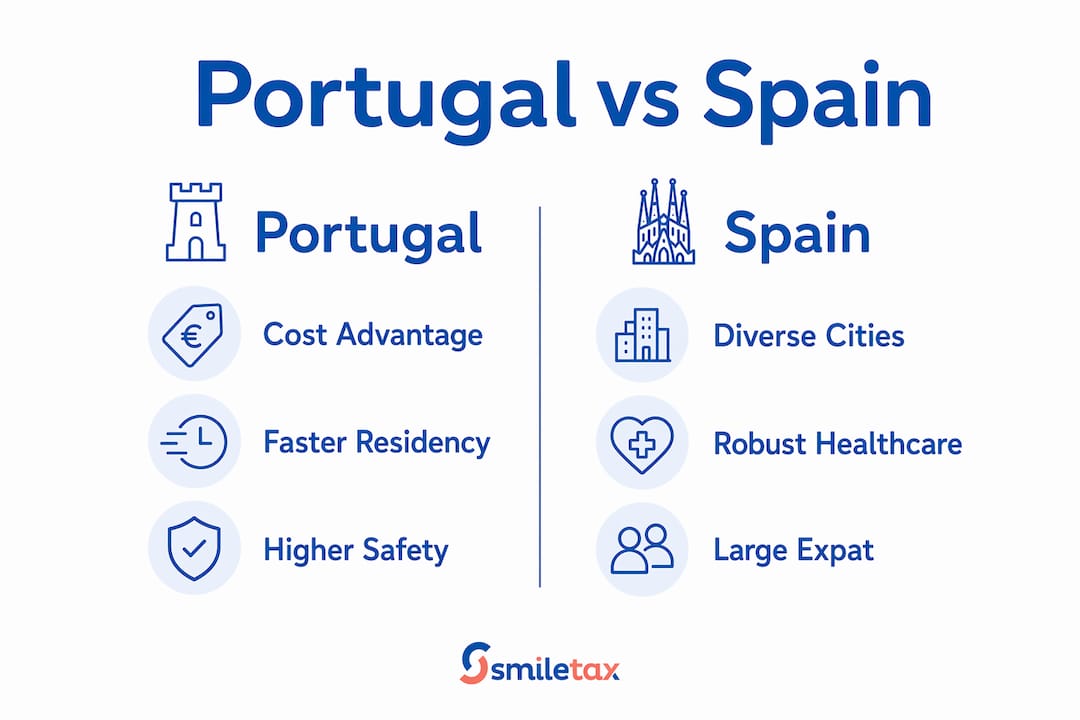
Portugal and Spain are the two most popular European destinations for Americans considering relocation abroad, and the choice between them comes down to a clear set of trade-offs: cost, visa accessibility, lifestyle pace, and cultural fit. Portugal generally offers a lower cost of living, a faster path to citizenship, and a quieter day-to-day rhythm. Spain delivers larger cities, richer cultural programming, stronger healthcare infrastructure, and a more diverse regional experience. Neither country is objectively better. The right answer depends entirely on what you want your life abroad to look like.
Portugal vs Spain: which is the better move for Americans?
The single most useful frame for this decision is matching your personal priorities to each country’s strengths rather than chasing a headline ranking. Portugal wins on affordability and simplicity. Spain wins on scale, variety, and social energy. Both countries offer legal pathways for Americans, warm climates, excellent food, and a high quality of life by any global standard.
Portugal is approximately 5% cheaper overall than Spain, with a cost of living index of 49 versus 52 on a scale where New York City equals 100. At a $3,000 monthly budget, that gap translates to roughly $163 less needed each month in Portugal for the same lifestyle. Over a year, that is nearly $2,000 in savings, which matters significantly for retirees or anyone living on passive income.

Spain’s appeal lies in its scale and diversity. Barcelona, Madrid, Seville, and Valencia each offer distinct cultural identities, climates, and economies. Portugal’s Lisbon and Porto are world-class cities, but the country’s smaller size means fewer options for those who want urban variety without crossing a border.
How do the cost of living and housing compare for expat budgets?
Cost comparisons between Portugal and Spain shift considerably depending on where you choose to live within each country.
| Expense Category | Portugal | Spain |
|---|---|---|
| Monthly rent (1-bed, city center) | €900–€1,400 | €800–€1,600 |
| Groceries (monthly, single person) | €200–€280 | €230–€320 |
| Dining out (mid-range meal) | €10–€15 | €12–€18 |
| Public transport (monthly pass) | €40–€50 | €45–€60 |
| Overall cost index (NYC = 100) | 49 | 52 |
Portugal holds a modest edge on daily expenses like groceries, dining out, and transportation, particularly outside capital cities. Lisbon and Porto have seen significant rent increases over the past five years, so Americans targeting affordability should look at secondary cities like Braga, Coimbra, or the Alentejo region. In Spain, coastal areas like the Costa del Sol and the Canary Islands offer lower costs than Madrid or Barcelona, with the added benefit of strong expat communities already in place.
Spain’s major metropolitan and coastal areas can be significantly costlier, but those higher costs are often offset by stronger local income opportunities for those working locally or running businesses. For retirees or remote workers with fixed dollar incomes, Portugal’s lower baseline is a genuine financial advantage.
Tip: Living 30 to 60 minutes outside a capital city in either country can reduce your monthly housing costs by 30 to 40 percent while keeping you within easy reach of urban amenities.
What are the visa requirements for Americans moving to Portugal vs Spain?
Visa requirements represent one of the sharpest practical differences between the two countries, and for many Americans, this factor alone determines the choice.
Portugal’s D7 visa, designed for retirees and passive income earners, requires proof of approximately €920 per month in stable income. Spain’s equivalent, the Non-Lucrative Visa, sets the bar considerably higher at around €2,400 per month. That difference is not trivial. A retired teacher drawing Social Security and a modest pension may qualify comfortably for Portugal’s D7 but fall short of Spain’s threshold without additional income sources.
The citizenship timeline also differs significantly. Portugal offers a path to citizenship after 5 years of legal residency. Spain requires 10 years. For Americans who want the option of an EU passport, Portugal’s timeline is a compelling advantage.
Processing times vary, but Portugal’s D7 has a reputation for being more straightforward to apply for and renew. Spain’s Non-Lucrative Visa requires more documentation and has stricter financial proof requirements at each renewal stage. Both visas prohibit working for a Spanish or Portuguese employer, though remote work for non-EU companies is generally permitted under current interpretations.
Spain does offer the Beckham Law, which provides a 24% flat tax rate for remote workers and employees for up to 6 years. This is a significant benefit for high earners relocating for work, though it applies to a specific profile of mover rather than the typical retiree or lifestyle expat.
Tip: Verify your income documentation and bank statement requirements with the relevant consulate before applying. Requirements can vary between Spanish consulates in the US, and Portugal’s consulates have specific formatting preferences for financial evidence.
For a deeper look at each pathway, the American’s guide to moving to Portugal and the guide to moving to Spain cover both processes in detail.
How do lifestyle and culture differ between Portugal and Spain?
Lifestyle is where the two countries diverge most noticeably in day-to-day experience, and where personal preference carries the most weight.
Portugal is quieter, slower, and more intimate. Portugal ranks 7th globally in safety, and the country has a well-earned reputation for being genuinely welcoming to foreigners. The expat community is growing but remains smaller and tighter-knit than Spain’s. For Americans who want to integrate into local life rather than live inside an expat bubble, Portugal offers that more naturally.
Spain’s cultural calendar is relentless in the best possible way. Festivals, markets, concerts, and sporting events fill the year in every major city. The social culture revolves around late dinners, long weekends, and a genuine investment in leisure time. For Americans who find the US pace exhausting and want a more socially rich environment, Spain delivers that consistently.
Key lifestyle contrasts worth considering:
- Language: Portuguese is considered harder for English speakers to learn than Spanish. In both countries, English is widely spoken in expat hubs, but investing at least 100 hours in the local language before arrival pays dividends in healthcare, banking, and daily bureaucracy.
- Climate: Spain offers more regional variety, from the dry heat of Andalusia to the green, rainy north. Portugal’s climate is more uniform, with mild Atlantic weather along most of the coast.
- Pace: Portugal moves at a noticeably slower pace than Spain’s larger cities. This suits some Americans perfectly and frustrates others.
- Regional identity: Spain’s regions, including Catalonia, the Basque Country, and Andalusia, have distinct cultures, languages, and social norms. Relocation satisfaction depends heavily on choosing the right specific region rather than treating Spain as a single destination.
Tip: Spend at least two weeks in your target city or region during the off-season before committing to a move. Tourist-season impressions rarely reflect what daily life actually looks like.
What about healthcare, schools, and expat community support?
For families and retirees, the quality of healthcare, schooling options, and community networks often matter as much as cost or visa rules.
Spain’s healthcare system ranks among Europe’s best, with universal public coverage available to legal residents and a well-developed private insurance market for faster access and English-speaking specialists. Major cities like Madrid and Barcelona have large international hospitals with English-speaking staff. Portugal’s healthcare system is effective and well-regarded, but operates at a smaller scale with fewer internationally staffed facilities outside Lisbon and Porto.
For families with school-age children, Spain has a clear advantage in the number and variety of international schools. Madrid alone has dozens of accredited international and bilingual schools, including American curriculum programs. Portugal has good options in Lisbon and the Algarve, but the selection is narrower. Families considering Madrid can explore US expat schools in Madrid to understand the full range of options available.
Expat community size also differs meaningfully. Spain hosts one of the largest American expat populations in Europe, with well-established networks in Madrid, Barcelona, Seville, and the Costa del Sol. Portugal’s expat community has grown rapidly, particularly in Lisbon and the Algarve, but it remains smaller. A larger community means more English-language services, social groups, and peer support during the adjustment period. A smaller community can mean deeper integration with local culture, which many expats ultimately find more rewarding.
Key takeaways
Portugal offers a faster, more affordable path to European residency, while Spain provides greater lifestyle variety, stronger healthcare infrastructure, and a larger expat network for Americans relocating abroad.
| Point | Details |
|---|---|
| Cost advantage | Portugal is roughly 5% cheaper overall, saving around $163/month at a $3,000 budget. |
| Visa accessibility | Portugal’s D7 visa requires €920/month income vs Spain’s Non-Lucrative Visa at €2,400/month. |
| Citizenship timeline | Portugal grants citizenship eligibility after 5 years; Spain requires 10 years. |
| Lifestyle fit | Spain offers more urban variety and cultural energy; Portugal delivers safety and a quieter pace. |
| Healthcare and schools | Spain has stronger healthcare rankings and more international school options for families. |
The real decision most Americans get wrong
The most common mistake Americans make when choosing between Portugal and Spain is treating the decision as a country-level choice rather than a city and region-level one. Comparing Lisbon to Madrid is a fair fight. Comparing rural Alentejo to the Costa del Sol is a completely different conversation, even though both pairs sit within the same national borders.
The data on cost and visa requirements is useful, but it only tells part of the story. Americans who thrive in Portugal tend to value simplicity, safety, and a slower rhythm. Those who thrive in Spain tend to want more stimulation, more social options, and more regional variety to explore over time. Neither preference is wrong.
One practical point that does not get enough attention: renting for at least 6 months before buying property in Spain is genuinely sound advice, not just a cautious cliché. The regional differences in Spain are sharp enough that a neighborhood or town that feels right in summer can feel isolating in January. Portugal is smaller and more consistent, but the same principle applies. Test before you commit.
Language investment also tends to be underestimated. English gets you far in both countries, but the Americans who report the highest satisfaction with expat life are almost always the ones who made a real effort with the local language. It changes how locals treat you, how you navigate daily life, and how quickly you stop feeling like a visitor.
Moving abroad? SmileTax supports Americans every step of the way
Relocating to Portugal or Spain is one of the most rewarding decisions an American can make, and it comes with a set of ongoing US financial obligations that do not disappear when you cross the Atlantic. SmileTax works specifically with Americans living abroad, including retirees, remote workers, and international school staff, to handle US tax filing accurately and without the complexity of large accounting firms. Whether you are still planning your move or already settled in Lisbon or Seville, an expat tax consultation with SmileTax gives you a clear picture of your obligations and options. You can also use the moving abroad checklist to make sure nothing falls through the cracks before departure.
FAQ
Which country is cheaper to live in, Portugal or Spain?
Portugal is approximately 5% cheaper overall than Spain, with a cost of living index of 49 versus 52 using New York City as the 100-point baseline. The savings are most noticeable in groceries, dining, and transportation, particularly outside major cities.
How does Portugal’s D7 visa compare to Spain’s Non-Lucrative Visa?
Portugal’s D7 visa requires roughly €920 per month in passive income, while Spain’s Non-Lucrative Visa requires approximately €2,400 per month. Portugal also offers citizenship eligibility after 5 years of residency compared to Spain’s 10-year requirement.
Is Portugal safe for American expats?
Portugal ranks 7th globally in safety, making it one of the most secure countries in the world for expats. Crime rates are low, and Americans consistently report feeling comfortable and welcome in both urban and rural areas.
Which country has better healthcare for American expats?
Spain’s healthcare system ranks among Europe’s best, with universal public coverage for legal residents and extensive private options in major cities. Portugal offers solid healthcare quality but at a smaller scale, with fewer English-speaking specialists outside Lisbon and Porto.
Should Americans rent or buy property when first moving to Spain?
Renting for at least 6 months before purchasing property in Spain is strongly recommended. Regional lifestyle and cost differences across Spain are significant enough that testing a location before buying protects against costly mismatches between expectation and reality.