

A Third Culture Kid (TCK) is defined as a child who develops a hybrid identity by growing up outside their passport country, blending influences from their home culture and host culture into something entirely their own. For American expat families, raising Third Culture Kids means more than managing school transfers and language barriers. It means making deliberate choices about identity, belonging, and family culture every single day. The research is clear: children thrive in multicultural environments when parents nurture an integrated identity rather than forcing a single cultural allegiance. This guide gives you the practical framework to do exactly that.
What does raising third culture kids as an american expat actually require?
Raising Third Culture Kids as an American expat starts with understanding what a TCK identity actually is. According to sociologist Ruth Hill Useem, who coined the term in the 1950s, TCKs develop a third culture that is distinct from both their passport nation and their host country. That third culture is not a compromise. It is a genuine, layered identity that gives children adaptability, cross-cultural empathy, and a global perspective most of their peers will never develop.
The challenge for American expat parents is resisting the urge to simplify this complexity. Many families unconsciously push children toward one cultural identity, either leaning heavily into American traditions or fully assimilating into the host culture. Both extremes create friction. Children who feel forced to choose often experience identity confusion well into adulthood.
The most effective approach treats cultural identity as additive, not exclusive. Your child can be deeply American and fluently German, or proudly Texan and comfortably at home in Singapore. The goal is not to pick a lane. The goal is to build a child who is confident navigating multiple lanes at once.
How do daily routines support TCK emotional development?
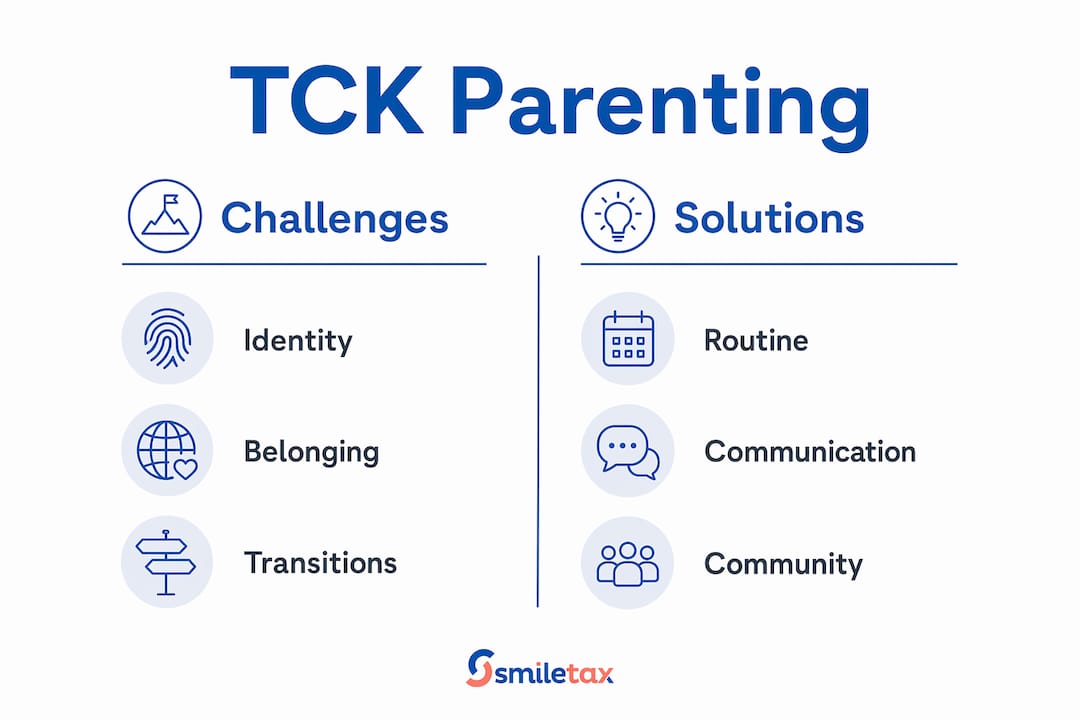
Consistent daily routines are one of the most powerful tools available to expat parents. Shared meals and fixed schedules improve sleep quality and academic outcomes for TCKs during the critical first year abroad. That is not a minor benefit. Emotional regulation, social confidence, and school performance all depend on a child feeling safe and predictable in their home environment.

The key is adapting routines to the host culture without abandoning the core habits that anchor your family. If your family has always eaten dinner together at 6:30 PM, protect that habit even when the host country’s social rhythms run later. If Sunday morning pancakes are a family institution, keep making them in Bangkok or Brussels.
Stable morning and evening routines build the predictability children need to manage change effectively. When the outside world is constantly shifting, home becomes the fixed point.
Here are the routine elements that matter most for TCK families:
- Fixed mealtimes shared as a family, regardless of local customs
- Consistent bedtime rituals that signal safety and predictability
- Weekly family traditions such as movie nights, game evenings, or faith practices
- Regular check-ins where children can name and process their feelings about the move
- Preserved home-country celebrations like Thanksgiving, Fourth of July, or family birthdays
Tip: Use what expat parents call “airport math.” Work backward from your move date to map out exactly when routines need to be re-established. Knowing that school starts in three weeks and bedtime routines restart on day two removes the chaos that overwhelms kids during transitions.
How can american expat parents nurture their children’s cultural identity?
Heritage transmission must be active and intentional. Casual immersion in American culture through Netflix shows or occasional hamburgers is not enough to sustain a child’s sense of cultural identity over years abroad. Parents need a deliberate strategy.
Language is the most powerful tool available. Maintaining English as a home language preserves your child’s emotional vocabulary, their ability to connect with extended family, and their sense of American identity. Children who lose fluency in their home language often report feeling disconnected from both cultures, belonging fully to neither.
Beyond language, cultural connection requires regular, structured engagement. Consider these approaches:
- Read American literature together, from picture books for younger children to novels for teens, to keep cultural references alive
- Connect with American expat communities through organizations like Democrats Abroad, Republicans Abroad, or local American Clubs in major cities
- Celebrate American holidays with intention, explaining the history and meaning behind each one rather than simply going through the motions
- Video call extended family regularly so children maintain genuine relationships with grandparents, cousins, and friends back home
- Explore the host culture actively, visiting museums, attending local festivals, and learning about local history so children develop genuine respect for both cultures
Helping children articulate their multicultural backgrounds reduces identity pressure and promotes emotional health. Give your child the language to describe who they are. Phrases like “I grew up in America but I’ve lived in three countries” or “I’m American and I also feel at home in Japan” are not confusing. They are accurate, and they are worth practicing.
Identity language validation empowers TCKs to tell their full cultural story without shame or pressure to simplify it.
What challenges do third culture kids face and how can parents help?
Third Culture Kids challenges are real and well-documented. The most common include identity confusion, difficulty forming lasting friendships due to frequent moves, grief over lost communities, and a persistent sense of not fully belonging anywhere. These are not signs of failure. They are predictable responses to an unusual childhood.
Parents can recognize early warning signs by watching for behavioral shifts after a move or during periods of cultural adjustment. Common signals include:
- Increased irritability or emotional outbursts that seem disproportionate to the trigger
- Sleep disturbances or changes in appetite
- Withdrawal from social activities or reluctance to make new friends
- Expressing shame about their home culture or overidentifying with the host culture
- Difficulty talking about the previous country or previous friendships
Building social support networks within 3–6 months of arrival significantly reduces transition stress for TCK families. This is a concrete, time-bound goal parents can work toward deliberately.
Effective social network building includes joining expat parent groups, enrolling children in local sports teams or arts programs, and connecting with school counselors who understand TCK dynamics. Organizations like Families in Global Transition (FIGT) offer resources specifically designed for internationally mobile families.
Effective parenting supports children to feel comfortable in the space between multiple cultures without pressure to choose sides. Belonging is not the same as fitting in. A child who belongs in multiple places is not confused. That child is genuinely global.
Tip: When your child says “I don’t know where I’m from,” treat it as an opening, not a problem. Ask follow-up questions: “What do you miss most about our last home?” and “What do you love about living here?” These conversations build emotional vocabulary and reinforce that complexity is a strength.
How do school choices and community shape TCK development?
Educational environment is one of the most consequential decisions American expat families make. The three main options each carry distinct advantages and trade-offs.
| School Type | Key Benefit | Key Trade-off |
|---|---|---|
| International school | Academic continuity, English instruction, expat peer community | Less integration with local culture and language |
| Local school | Deep host-culture immersion, strong language acquisition | Potential academic disruption, social adjustment challenges |
| Bilingual school | Balances both cultures, builds dual language fluency | Availability varies significantly by country and city |
Defining core family values helps parents select schools and communities that align with their cultural integration goals. A family that prioritizes language acquisition will make a different choice than a family prioritizing academic continuity. Neither choice is wrong. The wrong choice is the one made without a clear framework.
Beyond school, community involvement shapes TCK development in ways the classroom cannot. Sports teams, music groups, scouting programs, and neighborhood activities all provide children with a sense of belonging that transcends cultural background. A child who plays soccer with local kids three times a week develops friendships and language skills that no classroom can replicate.
When evaluating country options for your family, consider the availability of international schools, the strength of the local expat community, and the accessibility of activities your children already love. Continuity in hobbies and interests provides a powerful bridge during cultural transitions.
Strong family culture built on consistent routines, intentional language use, and open communication forms the foundation for TCK identity coherence across multiple moves and countries.
Key takeaways
Raising confident Third Culture Kids requires intentional identity integration, consistent family routines, and active cultural maintenance rather than passive assimilation.
| Point | Details |
|---|---|
| Identity is additive | Treat cultural influences as layers to build on, not competing loyalties to resolve. |
| Routines anchor stability | Fixed mealtimes, bedtime rituals, and weekly traditions reduce anxiety during transitions. |
| Language maintenance matters | Preserving English at home protects emotional vocabulary and family connection. |
| Social networks reduce stress | Building community within 3–6 months of arrival lowers TCK transition challenges significantly. |
| School choice needs a values framework | Align your school decision with your family’s cultural integration priorities, not just academic rankings. |
The complexity is the point
The most common mistake American expat parents make is treating their child’s multicultural identity as a problem to solve. It is not. A child who moves between cultures, holds multiple loyalties, and feels at home in more than one country is not confused. That child is developing a capacity for empathy, adaptability, and perspective that most adults spend decades trying to cultivate.
The real work is not simplifying your child’s identity for their comfort or yours. The real work is building a family culture strong enough to hold all of that complexity without collapsing under it. That means protecting routines when everything else is changing, speaking honestly about what you miss and what you love, and giving your child the words to describe who they are without apology.
Parents who do this well are not the ones who have it figured out. They are the ones who stay curious, stay present, and resist the pressure to make their child’s story simpler than it actually is.
Managing the practical side of expat family life
Raising a family abroad comes with its own US tax obligations. SmileTax works specifically with Americans living overseas, including international school families, NGO professionals, and long term expats, supporting them with their US tax filing. If you are building a life abroad and want your US filing handled by someone who understands expat family life, SmileTax was built for exactly that situation.
FAQ
What is a third culture kid?
A Third Culture Kid is a child who grows up outside their passport country and develops a hybrid identity blending their home culture and host culture into a distinct third culture. The term was coined by sociologist Ruth Hill Useem.
How do i support my tck’s sense of belonging?
Teach your child that belonging is different from fitting in. Effective parenting supports children to feel comfortable navigating multiple cultural identities without pressure to choose one over another.
Should my TCK attend an international or local school?
The right choice depends on your family’s values and goals. International schools offer academic continuity and English instruction, while local schools provide deeper cultural immersion. A values-led framework helps clarify which environment best fits your family’s priorities.
How do i maintain my child’s american identity abroad?
Preserve English as the home language, celebrate American holidays with context and meaning, and maintain regular contact with family in the US. Heritage transmission must be active and intentional to sustain cultural identity over years abroad.
When should i worry about my tck’s adjustment?
Watch for persistent irritability, sleep changes, social withdrawal, or expressions of shame about their home culture. Building social support within 3–6 months of arrival is the most effective way to reduce transition stress and support healthy adjustment.