

Thailand has quietly become one of the most talked-about retirement destinations for Americans, and the reasons are hard to argue with. Retiring in Thailand means trading US healthcare costs and high rents for fresh mango smoothies, world-class hospitals, and a monthly budget that can run under $1,500. But the visa rules are stricter than most people expect, the bureaucratic requirements are ongoing, and the 2024 tax changes rewrote some long-held assumptions. This guide walks you through everything you need to know before you book that one-way flight.
Table of Contents
- Understanding retirement visa options for Thailand
- Mandatory health insurance and healthcare costs in Thailand
- Cost of living and best places to retire in Thailand
- Visa renewal, 90-day reporting, and residency rules retirees must follow
- Managing US Social Security and tax considerations while retiring in Thailand
- The truth about retiring in Thailand: lifestyle benefits versus legal limitations
- Take the stress out of your US tax filing while enjoying your retirement abroad
- Frequently asked questions
Key Takeaways
| Point | Details |
|---|---|
| Age and visa options | You must be 50 or older to apply for Thailand’s O-A or O-X retirement visas, each with different financial requirements. |
| Mandatory health insurance | Health insurance from Thai-approved providers with specific coverage minimums is required for visa approval. |
| Affordable lifestyle | Thailand offers a significantly lower cost of living and quality healthcare compared to the US, varying by region. |
| Administrative compliance | Retirees must renew visas annually and report their address every 90 days to remain compliant. |
| Tax realities | US Social Security income is taxed only in the US, but all foreign income remitted to Thailand is taxable there since 2024. |
Understanding retirement visa options for Thailand
Thailand does not offer permanent residency or a simple long-stay permit. What it offers instead are two structured retirement visa categories, each with firm requirements around age, finances, and health insurance.
The two main options are:
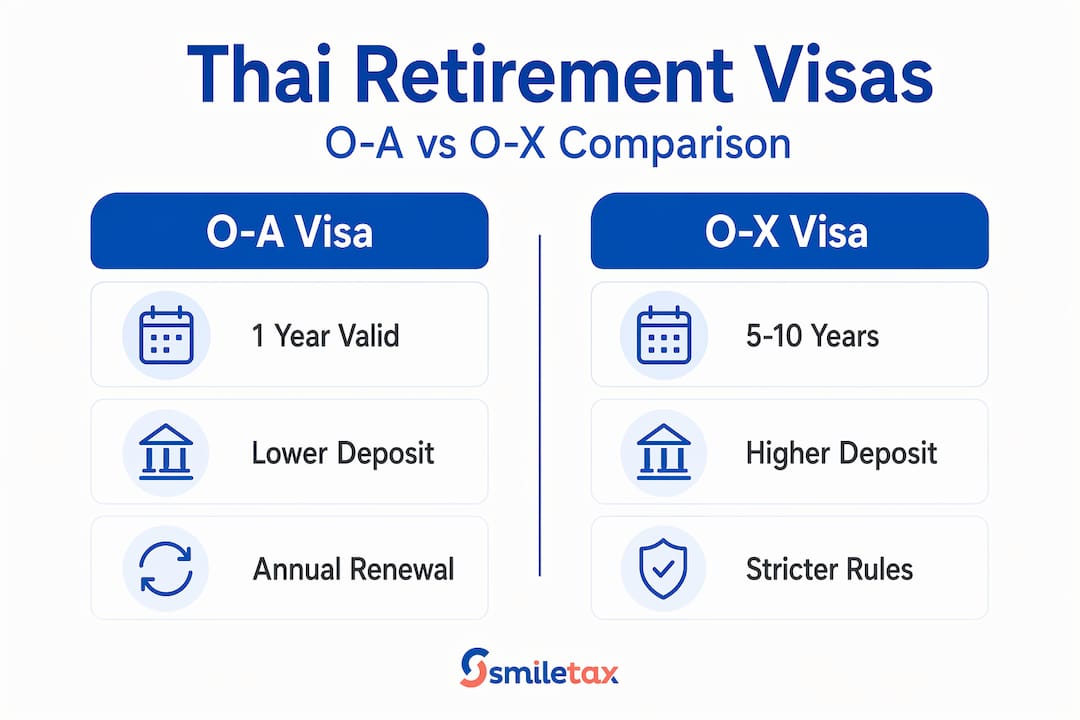
- Non-Immigrant O-A visa: Valid for one year, renewable annually inside Thailand. You apply from your home country at a Thai consulate or embassy.
- Non-Immigrant O-X visa: Valid for five years with a possible extension to ten years. It requires higher financial thresholds and is available only to nationals of select countries, including the US.
Both visas require age 50+, financial proof, and mandatory health insurance. There are no exceptions to the age rule.
IMPORTANT! The Non-Immigrant O-X visa was introduced as a long-stay option for nationals of select countries including the US, with validity of five years extendable to ten. However, as of 2021, Thai immigration offices have largely stopped processing O-X applications in practice, and most applicants have been redirected to the O-A pathway. Until official guidance confirms its reinstatement, the O-A visa should be treated as the primary retirement visa option.
Financial proof requirements
The O-A visa requires one of the following:
- A Thai bank deposit of THB 800,000 (roughly $22,000 USD)
- Monthly income or pension of at least THB 65,000 (roughly $1,800 USD)
- A combination where your deposit and annual income together meet the equivalent threshold
The O-X visa demands significantly higher deposits and carries stricter nationality and documentation requirements.
Neither visa allows you to work in Thailand. Thai law explicitly prohibits employment for local employers, but the legal status of remote work performed for foreign clients remains genuinely ambiguous. There is no clear statute addressing it, enforcement is inconsistent, and official guidance has not resolved the question. Retirees who do any paid work, even remotely, should get qualified legal advice before assuming it is permitted.
💡Tip: If your pension income falls slightly short of THB 65,000 per month, combine it with a partial bank deposit to meet the threshold. Many retirees find this combination method easier to maintain than keeping a large lump sum parked in a Thai bank account.
Annual renewal for the O-A requires you to re-submit financial documents and proof of insurance each year. Build that paperwork cycle into your calendar from day one. If you feel tax anxiety for retirees is already stressful, know that the visa renewal process has its own paperwork rhythm you will need to manage alongside your US filing obligations.
Mandatory health insurance and healthcare costs in Thailand
Since 2019, health insurance is not optional for retirement visa approval. It is a hard requirement, and the coverage minimums are specific.
Your policy must provide at minimum:
- THB 400,000 in inpatient coverage annually
- THB 40,000 in outpatient coverage annually
The insurance cost typically runs $550 to $1,650 per year, depending on your age, health history, and the insurer you choose. Supplemental coverage for dental or specialist care will push that number higher.
Stat to know: Healthcare in Thailand costs roughly 50 to 80% less than US private healthcare, with English-speaking doctors widely available in private hospitals.
That gap is significant. A procedure that costs $15,000 in the US might run $2,500 to $4,000 at a top private hospital in Bangkok or Chiang Mai. Private hospitals like Bumrungrad International in Bangkok and Bangkok Hospital Group locations across the country are internationally accredited and routinely treat foreign patients.
Regional cost differences matter too. Health insurance premiums tend to be similar nationwide, but out-of-pocket costs for consultations and procedures are lower in Chiang Mai than in Bangkok or on the islands. If you are managing a chronic condition that requires regular specialist visits, Chiang Mai’s lower costs and strong expat medical community make it worth serious consideration.
💡 Tip: Only insurers on the Thai government’s approved provider list will satisfy the visa requirement. Confirm your chosen insurer is on that list before you pay a premium, not after.
Cost of living and best places to retire in Thailand
The cost of living in Thailand runs about 45% lower than the US when excluding rent, and rent itself is roughly 65% cheaper. Those numbers translate into real monthly budgets that surprise most Americans.

Estimated monthly budgets by region (as of published date)
| City / Region | Estimated monthly budget | Average 1-bedroom rent |
|---|---|---|
| Chiang Mai | $1,000 to $1,500 | $300 to $600 |
| Bangkok | $1,200 to $1,800 | $500 to $1,000 |
| Phuket / Koh Samui | $2,500+ | $800 to $1,800 |
These figures cover rent, food, utilities, transportation, and basic entertainment. They do not include health insurance, flights home, or major medical events.
Here is how the three main retirement destinations break down in practice:
- Chiang Mai offers a cooler northern climate, a large and well-established expat community, excellent street food, and easy access to nature. It is the most affordable of the three and genuinely livable on $1,200 a month with comfort.
- Bangkok gives you world-class infrastructure, international restaurants, excellent private hospitals, and a transit system that actually works. The lifestyle is urban and stimulating, though noise and air quality can be drawbacks.
- Phuket and Koh Samui deliver beach living and tropical scenery, but the tourist economy drives prices up considerably. Budget $2,500 or more monthly to live comfortably, and expect higher costs during peak season.
💡 Tip: Living one or two neighborhoods away from the tourist center in any Thai city can cut your rent by 20 to 40%. Expats who settle in residential neighborhoods rather than tourist zones consistently report lower costs and a more authentic daily experience.
If you are exploring best expat locations beyond Thailand, understanding how your IRA contribution limits and retirement savings interact with overseas living is worth reviewing before you commit to any destination.
Visa renewal, 90-day reporting, and residency rules retirees must follow
Holding a retirement visa in Thailand is not a set-it-and-forget-it situation. There are ongoing administrative requirements that carry real penalties if you miss them.
Key compliance requirements
- 90-day address reporting: You must report your current address to Thai Immigration every 90 days. You can do this in person at your local immigration office, by mail, or online through the Thai Immigration Bureau’s portal.
- Annual visa renewal: The O-A visa must be renewed each year. You will need to show current financial proof and a valid insurance certificate.
- TM30 form: Your landlord is legally required to report your residence to immigration within 24 hours of your arrival at any address. In practice, however, immigration offices frequently treat the tenant as responsible for ensuring this is filed correctly. If your landlord is slow or unaware of the requirement, it can complicate your annual renewal — so confirm it has been submitted rather than assuming your landlord handled it.
- No employment: Working in any capacity on a retirement visa is prohibited. This includes remote consulting, freelance writing, or any paid activity.
Missing your 90-day report risks renewal denial and fines that accumulate daily. The fine is up to THB 500 per day, and repeated violations can result in being barred from re-entry.
“The 90-day reporting requirement catches many retirees off guard. It is not a one-time formality. It is a recurring obligation that requires active management throughout your stay.”
Annual visa renewals require submitting financial proof and insurance documentation, with processing times that vary significantly by immigration office. Apply 30 to 45 days before your visa expires to avoid gaps.
💡 Tip: Set recurring phone reminders 10 days before each 90-day deadline. Many long-term expats also use reputable visa agents, particularly for annual renewals, to navigate paperwork and reduce the risk of procedural errors.
Staying on top of your financial reporting requirements for US purposes runs parallel to these Thai obligations. Both require consistent attention throughout the year, not just at tax time.
Managing US Social Security and tax considerations while retiring in Thailand
Here is something many retirees do not realize until they are already living in Thailand: you remain a US taxpayer no matter where you retire. Your worldwide income must still be reported on a US federal return each year.
A few key points to understand:
- Social Security: Under the US-Thailand tax treaty, US Social Security benefits paid to Thailand residents are taxable only in the US, up to 85% depending on your total income. Thailand does not tax them.
- Pensions: Private pension income is taxed in Thailand under the treaty, which is a meaningful distinction from Social Security.
- Direct deposit: The SSA sends benefits to Thailand via direct deposit, and your monthly check stretches considerably further given Thailand’s lower cost of living.
- 2024 remittance rule change: Since January 2024, foreign income remitted to Thailand is taxable there regardless of when it was earned. This ended a popular strategy of delaying remittances to avoid Thai tax. However, implementation guidance from Thailand’s Revenue Department has continued to evolve, and enforcement specifics remain unsettled. Work with a tax professional familiar with both US expat and Thai tax obligations before making remittance decisions.
- Foreign Tax Credit: US citizens can claim a Foreign Tax Credit on their US return for taxes paid to Thailand, reducing the risk of being taxed twice on the same income.
💡 Tip: Work with a US tax professional who has real experience with expat retirees. The intersection of the US-Thailand treaty, the 2024 remittance rule, and Social Security taxation is genuinely nuanced. Getting it wrong in either direction costs money.
If you are concerned about managing US expat taxes from abroad, you are not alone. Many retirees find the ongoing US filing obligation the most stressful part of living overseas, even when the tax owed is minimal.
The truth about retiring in Thailand: lifestyle benefits versus legal limitations
Here is the honest take, and it is worth saying plainly: Thailand is one of the best places in the world to retire if you want an affordable, vibrant, and medically accessible life. It is a poor choice if your primary motivation is escaping taxes, gaining permanent residency, or building long-term legal roots in a country.
The lifestyle and healthcare affordability are genuinely world-class. But Thailand offers no pathway to citizenship or permanent residency through retirement, regardless of how long you stay or how much you spend. You will renew your visa annually, report your address every 90 days, and remain a guest in a legal sense, no matter how deeply you settle in.
The 2024 tax changes also ended the myth of tax-free foreign pension income. Many retirees moved to Thailand partly because remitted income was not taxed. That assumption no longer holds. If you are moving primarily for tax efficiency, Thailand now requires the same careful planning as any other destination.
The bureaucratic rhythm of annual renewals and 90-day reports is manageable. But it is a real ongoing commitment, not a background process you can ignore. Retirees who struggle most are those who underestimated the administrative load or assumed the rules were loosely enforced.
“Retire in Thailand for the lifestyle and medical affordability, not as a residency or citizenship strategy.”
The stress of expat taxes compounds when you are also managing Thai immigration paperwork. Building systems for both from the start saves a lot of frustration later.
Thailand rewards retirees who go in with clear eyes. The food, the community, the healthcare, and the cost of living are as good as advertised. The legal framework is simply not built for people who want to put down permanent roots.
Take the stress out of your US tax filing while enjoying your retirement abroad
Retiring in Thailand is genuinely rewarding, but your US tax obligations do not pause because you moved abroad. Social Security reporting, the Foreign Tax Credit, the 2024 remittance changes, and annual filing deadlines all require attention from someone who understands expat realities, not generic software.
At SmileTax, we work specifically with Americans living overseas, including retirees in Thailand and across Asia. Every client works directly with an experienced US tax professional. No handoffs, no generic tools, no confusion about which forms apply to your situation.
Frequently asked questions
What is the minimum age requirement to retire in Thailand?
You must be at least 50 years old to apply for the Non-Immigrant O-A or O-X retirement visas in Thailand, with no exceptions.
Can I work in Thailand on a retirement visa?
No. Working in any capacity, including freelance or consulting work, is prohibited on a Thai retirement visa and can lead to immediate visa revocation.
How often do I need to report my address to Thai Immigration?
Retirement visa holders must report their current address to Thai Immigration every 90 days, either in person, by mail, or online, with fines for missed reports.
Is there a path to citizenship for retirees in Thailand?
No. Thailand does not offer citizenship or permanent residency through retirement visas, regardless of how long you have lived in the country.
Are US Social Security benefits taxable in Thailand?
Under the US-Thailand tax treaty, Social Security benefits are taxed only in the US, not in Thailand, though the amount subject to US tax depends on your total income.