

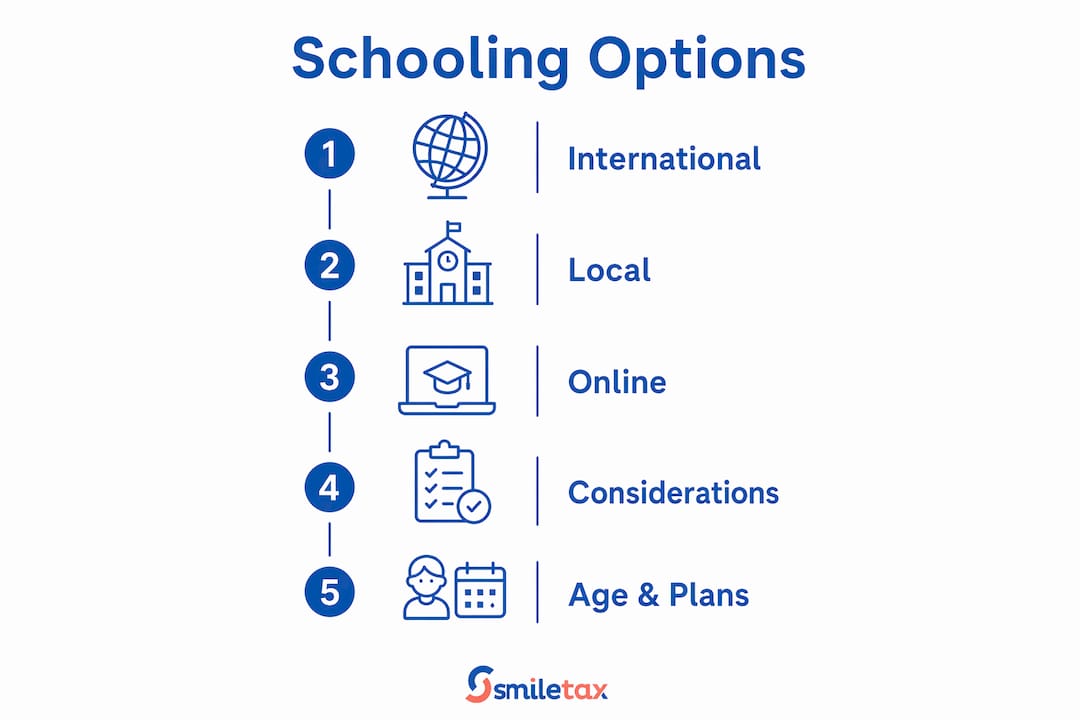
Schooling options for American kids abroad fall into three main categories: international schools with globally recognized curricula, local public schools offering full cultural immersion, and accredited online programs built for flexibility. Each path serves a different family situation. The right choice depends on your child’s age, how long you plan to stay, your budget, and whether you need a clear path back into the US school system or toward American college admissions.
What are international schools and how do they serve American kids abroad?
International schools are private institutions that teach in English and follow structured curricula recognized worldwide. The most common options are the International Baccalaureate (IB), American, and British programs. Schools like the Singapore American School and the International School of Brussels represent the kind of full-service international experience many American families seek.
Tuition typically runs $10,000 to $45,000 per child per year. That range reflects everything from smaller regional schools to flagship campuses in cities like Singapore, Brussels, and Amman. For families on a tight budget, this cost is the single biggest barrier.

Curriculum continuity is the main reason families choose international schools, especially for assignments of two to three years. A child moving from Houston to Berlin can pick up roughly where they left off academically, without losing ground in math, science, or English literacy. That consistency matters most for children aged 10 and older, when academic gaps become harder to close.
The American curriculum offered at international schools varies more than parents expect. The term “American curriculum” is not standardized globally the way IB or British A-Levels are. Parents should ask specifically about accreditation bodies like WASC or NEASC, and whether the school aligns with Common Core or specific state standards. Without that verification, a school’s “American curriculum” label may mean very little when your child applies to a US university.
Admissions at top international schools are competitive. Demand for private placements among American families in the UK rose 8% by january 2026, and some schools require applications four to five years in advance. Starting the process early is not optional at the most sought-after campuses.
Key advantages of international schools at a glance:
- English-medium instruction from day one
- Structured curricula with clear college pathways (AP, IB Diploma, IGCSEs)
- Strong extracurricular programs and counseling services
- Familiar social environment for newly arrived expat children
- Easier academic reentry to US schools or colleges
Tip: If you are a teacher employed by an international school, ask your HR department whether tuition benefits extend to your own children. Many schools cover partial or full tuition for staff, which changes the financial calculation entirely.
How do local public schools benefit and challenge American expat children?
Local public schools are free or nearly free in most countries. That cost difference compared to international school tuition is significant for families planning a longer stay or working outside of employer-sponsored packages. The financial flexibility this creates allows families to invest in language tutoring, travel, or other enrichment instead.
The deeper benefit is cultural immersion. A child attending a local school in Mexico City, Tokyo, or Amsterdam builds language skills and friendships that an international school bubble simply cannot replicate. Parents often overlook these social and cultural gains when focused on curriculum continuity. For families committed to a country long term, local schooling produces children who are genuinely bilingual and bicultural.
Age is the critical variable. Children under 10 adapt to local schools with remarkable speed. Language acquisition at that age is fast, and the curriculum gap with US standards is manageable. Children aged 10 to 14 face a harder transition. Academic content becomes more specialized, and falling behind in a second language while also navigating algebra or history creates real stress.
Challenges parents should weigh honestly:
- Instruction in a foreign language with limited English support
- Curriculum mismatch that complicates reentry to US schools
- Variable quality depending on country, city, and district
- Limited Advanced Placement or IB pathways for college-bound teens
- Social adjustment pressure, especially for older children
Tip: Before enrolling in a local school, contact the school directly and ask whether they have an ESL or language support program. Countries like the Netherlands, Germany, and Sweden often have structured integration classes for non-native speakers. Many families are surprised by how much support is available.
What are the advantages and limitations of accredited online schooling for expat families?
Accredited online schools offer a complete US curriculum delivered remotely, making them the most portable option available. For families who move frequently, live in remote locations, or follow irregular schedules, online learning solves problems that neither international nor local schools can address.
Accreditation is the non-negotiable starting point. Triple accreditation from bodies like Cognia, WASC, and NEASC is the gold standard. It confirms that credits will transfer to US schools and that transcripts will be recognized by American universities. A school without recognized accreditation may deliver solid instruction but leave your child in a difficult position at reentry.
The choice between synchronous and asynchronous models matters more than most parents realize. Synchronous learning means live classes at scheduled times, which builds social connection but creates real challenges across time zones. A family in Southeast Asia following a US Eastern Time schedule faces early morning or late-night classes. Asynchronous programs offer flexibility but require strong self-motivation from the student.
Key considerations when evaluating online schools:
- Verify accreditation first. Confirm Cognia, WASC, or NEASC status before anything else.
- Check the time zone model. Ask whether live classes are required and at what hours.
- Assess your child’s learning style. Self-directed learners thrive online; children who need peer interaction may struggle.
- Review technology requirements. Reliable high-speed internet is non-negotiable for synchronous programs.
- Understand the full cost. Base tuition often excludes exam fees, materials, and proctoring costs.
Tip: Online schooling works best as a primary option for highly mobile families or as a supplement for children in local schools who need to maintain US academic standards. Combining both approaches is more common than most parents realize.
How to choose the best schooling option based on your child’s age and plans
The single most useful framework for this decision is the age threshold combined with your family’s timeline. These two factors narrow the field faster than any other variable.
| Child’s age and situation | Recommended option | Key reason |
|---|---|---|
| Under 10, staying 2+ years | Local public school | Fast language acquisition; cultural integration outweighs curriculum risk |
| Under 10, staying under 2 years | International school | Curriculum continuity; easier reentry |
| Ages 10–14, any stay length | International school | Academic disruption risk is highest in this window |
| Ages 14+, college-bound | International school with IB or AP | Consistent transcripts and recognized college pathways |
| Highly mobile, any age | Accredited online school | Portability and curriculum consistency regardless of location |
| Long-term resident, older teen | Local school plus online supplement | Immersion plus maintained US academic standards |
Reentry planning shapes the decision as much as current circumstances. The American curriculum’s flexibility with GPA and AP courses is an advantage for US college applications, but it requires proactive college counseling because no standardized national exam exists the way IB Diploma or British A-Levels do. Families planning a return to the US within three years should prioritize schools with clear AP or IB pathways and verified accreditation.
For teachers employed at international schools, the calculus often shifts. Tuition benefits for staff children can make an international school placement effectively free, removing cost as a deciding factor entirely.
What additional factors should American parents consider when selecting schooling abroad?
Practical logistics shape the final decision as much as curriculum philosophy. Several factors consistently catch families off guard.
Application timing is critical. The most sought-after international schools in cities like Berlin, Singapore, and Brussels fill seats years in advance. Families relocating for work should begin school research before accepting a job offer, not after arrival. The John F. Kennedy School Berlin and similar flagship campuses are prime examples of schools where late applications rarely succeed.
Homeschooling is legal in some countries and restricted or banned in others. Germany prohibits homeschooling entirely. France requires registration and regular assessments. Before choosing this path, verify the legal status in your host country. Families who homeschool abroad often combine a structured US curriculum with local enrichment activities to address the socialization gap.
Additional factors worth evaluating before committing:
- Language support services: Does the school offer ESL, bilingual programs, or transition classes?
- Community fit: Are there other American or English-speaking families in the school community?
- Extracurricular access: Sports, arts, and clubs matter for social integration, especially for teens.
- Transport and location: Daily commute time affects family quality of life more than parents anticipate.
- Support for learning differences: International schools vary widely in their special education resources.
Families at schools like King’s Academy in Jordan or the Escola Americana de Campinas in Brazil often find that the school community itself becomes their primary social network abroad. That community value is real and worth factoring into the decision alongside academics and cost.
Key takeaways
The best schooling choice for American kids abroad depends on age, length of stay, and reentry plans, with no single option working for every family.
| Point | Details |
|---|---|
| Age determines fit | Children under 10 adapt well to local schools; ages 10–14 benefit most from international school continuity. |
| Accreditation is non-negotiable | Verify WASC, NEASC, or Cognia status for any online school to protect credit transferability. |
| International school costs vary widely | Tuition ranges from $10,000 to $45,000 per year; teacher employment benefits can offset this entirely. |
| Apply to international schools early | Competitive schools in cities like Singapore and Berlin fill seats years in advance. |
| Reentry planning shapes curriculum choice | Families returning to the US should prioritize schools with AP or IB pathways and verified American accreditation. |
What experience actually teaches you about schooling abroad
The families who navigate schooling abroad best are the ones who make a deliberate choice rather than defaulting to the most familiar option. The instinct to find the nearest international school and enroll immediately is understandable. It feels safe. But for a seven-year-old moving to a country where the family plans to stay for five years, a local school with a good language support program will often produce a more confident, capable child than the English-medium bubble of an international campus.
The overlooked risk runs in the other direction too. Families who enroll a thirteen-year-old in a local school to save money, without a plan for maintaining US academic standards, can create real problems at college application time. Transcripts from unaccredited local schools are difficult to evaluate, and the absence of AP or IB coursework leaves college counselors with little to work with.
The accreditation issue with online schools deserves more attention than it gets. Parents sometimes choose an online program based on marketing language about “American curriculum” without checking whether the school holds recognized accreditation. That gap only becomes visible when a university admissions office rejects the transcript.
The practical advice that holds across every situation: decide on your schooling path before you arrive, not after. School research done under pressure, in a new country, with children already anxious about the move, produces worse decisions than research done calmly from home six months before departure.
American families abroad and the bigger picture
Living abroad involves more moving parts than most families anticipate, and schooling is just one of them. SmileTax works specifically with Americans living overseas, including international teachers, NGO professionals, and long-term expats who need reliable support navigating life outside the US. If you are settling into a new country and want to make sure the practical side of your American life stays in order, SmileTax offers clear, personal service from experienced professionals who understand how expat life actually works. No generic software, no handoffs to strangers. Just straightforward help from people who know the territory.
FAQ
What is the most affordable schooling option for American kids abroad?
Local public schools are free or nearly free in most countries, making them the most budget-friendly choice. International school tuition typically ranges from $10,000 to $45,000 per year.
At what age should American kids switch to an international school abroad?
Children aged 10 to 14 face the highest risk of academic disruption in local schools, making international school the stronger choice for that age group. Children under 10 generally adapt well to local schooling.
How do I know if an online school is accredited for US college admissions?
Look for accreditation from Cognia, WASC, or NEASC. Triple accreditation from these bodies confirms that credits and transcripts will be recognized by US universities and future schools.
Do international schools offer the American curriculum abroad?
Many do, but the term “American curriculum” is not standardized globally. Parents should verify specific accreditation and whether the school aligns with Common Core or recognized state standards before enrolling.
Can American teachers enroll their own children in the international school where they work?
Many international schools include partial or full tuition benefits for staff children as part of the employment package. Parents should confirm this directly with HR during the hiring or contract negotiation process.