

A visa is permission granted by a foreign government for you to enter and stay in its country for a specific purpose and duration. A passport, by contrast, is a U.S.-issued identity document that proves your citizenship and allows you to cross international borders. Understanding the difference between these two documents, and adding residency permits to the picture, is the foundation of every legal long-term move abroad. This guide covers the visas and residency basics Americans need to stay abroad lawfully, from tourist entry limits and the Schengen 90/180 rule to work visas, digital nomad permits, retirement pathways, and the road to permanent residency.
What are the entry limits for Americans abroad?
Most Americans can enter dozens of countries without a visa at all. That visa-free access is convenient for short trips, but it comes with firm limits. The most important rule to understand before planning any extended stay in Europe is the Schengen 90/180 rule: Americans may spend a maximum of 90 days in any 180-day period across the Schengen Area, which covers 27 European countries including France, Germany, Spain, Italy, and Portugal.
The 180-day window is not a calendar reset. It is a rolling calculation that starts from the date you enter and looks back continuously. That means if you spent 60 days in Spain in january and february, you cannot simply return in july and assume a fresh 90 days. The days already used count against you until the full 180-day window has passed. This rolling calculation is the most common source of unintended overstays among Americans in Europe.
Visa-free entry also does not grant any right to work or establish residency. Tourist status is tied to a specific purpose and duration. Treating it as a workaround for a long-term stay is both legally risky and practically unsustainable.
The consequences of overstaying are serious:
- Fines payable before departure
- Deportation and detention at the border
- Multi-year bans on re-entry to the country or the entire Schengen Area
- A damaged immigration record that affects future visa applications worldwide
Tip: Use the European Commission’s official Schengen calculator at ec.europa.eu to check your exact day count before any trip to Europe. It removes the guesswork from the rolling window.
What are the main legal pathways for Americans to live long-term abroad?
A long-stay visa or residence permit is the legal mechanism that allows Americans to live abroad beyond tourist limits. The right category depends on why you are there and what you plan to do. Matching your immigration category to your actual situation is not optional. Governments verify it.
| Visa Type | Who It’s For | Key Requirements |
|---|---|---|
| Work visa | Employer-sponsored or skilled workers | Job offer, employer sponsorship, or points-based qualification |
| Digital nomad visa | Remote workers employed outside the host country | Proof of income (often $2,000–$3,000/month), health insurance, clean criminal record |
| Retirement / passive income visa | Retirees or those with investment income | Minimum monthly income threshold, health insurance, age requirements vary |
| Student visa | Enrolled in accredited foreign institution | Enrollment letter, proof of funds, health insurance |
| Family reunification visa | Spouses, dependents of residents or citizens | Proof of relationship, sponsor’s residency status, financial means |
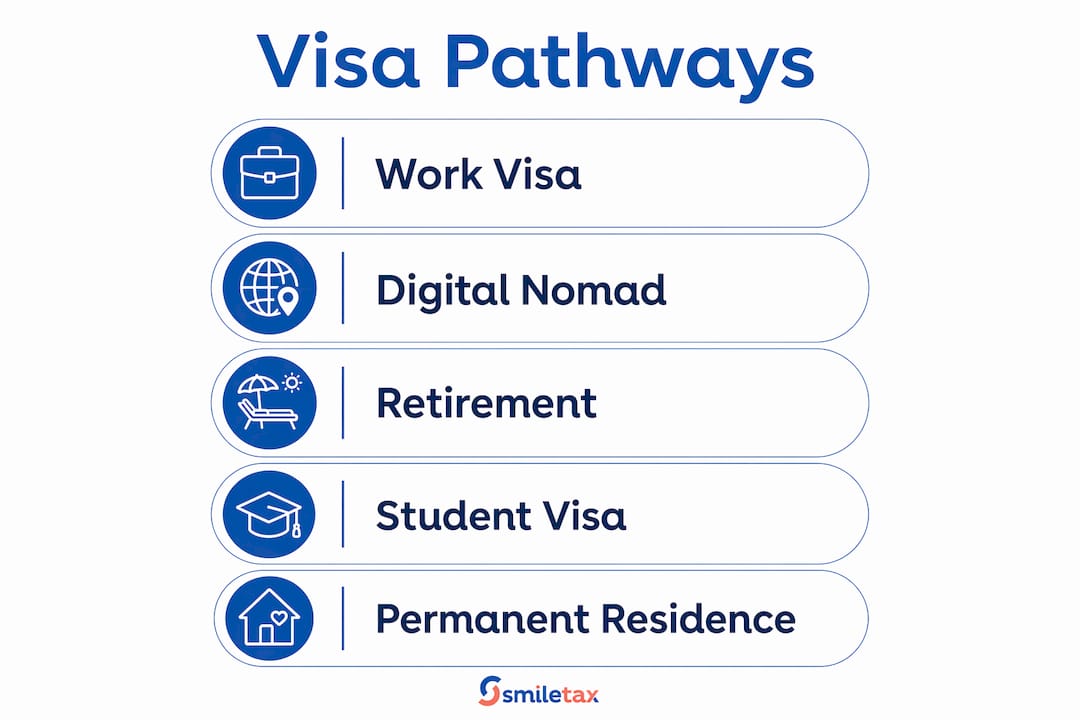
Work visas are the most common route for Americans moving abroad for employment. Some countries use employer sponsorship models, where a local company petitions on your behalf. Others, like Canada and Australia, use points-based systems that score applicants on age, education, and language skills.
Digital nomad visas have expanded rapidly since 2021. Portugal, Spain, Croatia, Greece, Costa Rica, and Colombia all offer formal programs. Most require proof of consistent remote income, private health insurance, and a background check. These visas typically do not allow you to work for local employers.

Retirement and passive income visas are a strong option for Americans drawing Social Security, pension income, or investment returns. Countries like Panama, Mexico, and Thailand offer dedicated retiree programs with income thresholds that are accessible for many Americans. Check the best countries for retirement abroad for a detailed breakdown of qualifying income levels by country.
Student visas are straightforward but restrictive. They are tied to your enrollment at a specific institution, and most countries limit or prohibit paid work on a student visa. Family reunification visas can be faster than other routes if your spouse or partner already holds legal residency in the destination country.
How do Americans move from temporary to permanent residency abroad?
Temporary residence permits are the starting point for most long-term expats. They are typically valid for one to two years and must be renewed. Each renewal requires proof that you still meet the original qualifying conditions, whether that is employment, income, enrollment, or family ties.
Permanent residency typically becomes available after about five years of continuous legal residence. That five-year clock matters more than most people realize when they first arrive. It runs only on qualifying visa categories. Time spent on tourist entries or short-stay visas does not count toward the residency clock.
The path from temporary to permanent residency generally follows these steps:
- Secure the correct long-stay visa before arrival. Entering on a tourist visa and trying to convert it from inside the country is riskier than confirming your permit before you land.
- Renew your temporary permit on time. Lapses in legal status can reset or pause your residency clock.
- Limit extended absences. Most countries allow short trips abroad without penalty, but lengthy absences, often defined as more than six months in a single year, can reset your residency clock entirely.
- Maintain compliance throughout. Pay any required local fees, register with local authorities, and keep your documentation current.
- Apply for permanent residency when eligible. Requirements typically include a clean criminal record, proof of financial stability, and sometimes a basic language test.
Permanent residency is not the same as citizenship. It gives you the right to live and work in the country indefinitely, but it does not grant a passport or voting rights. Citizenship through naturalization usually requires additional years of residence beyond permanent residency, plus language proficiency and a formal application process.
Tip: Keep a personal log of every entry and exit date from your host country. Border crossing records are not always consistent across databases, and your own records are your best defense if a discrepancy arises.
Why does overstaying a visa create serious long-term problems?
Overstaying is not a minor administrative slip. The consequences include fines, deportation, and bans that can follow you for years across multiple countries. An overstay on your record also weakens future visa applications, because immigration officers in other countries can see it.
The most damaging misconception is that you can enter a country as a tourist and then convert to a residency permit from inside. In most countries, that is not how the system works. Residency applications must be submitted from your home country or through a specific national visa process before you arrive. Attempting to “enter first and apply later” puts you in an irregular status that is difficult and expensive to resolve.
Common mistakes that lead to overstays include:
- Misunderstanding the Schengen rolling window as a calendar-year reset
- Assuming a visa extension is automatic or easy to obtain
- Relying on border agents to flag you before you exceed your limit
- Treating a long-stay visa application as something that can wait until after arrival
The practical fix is straightforward: plan your visa category before you book your flights. If you are unsure which route fits your situation, use official embassy and consulate websites for the destination country. The easiest countries for Americans to relocate to is a useful starting point for comparing how accessible different countries are for long-term stays.
Practical steps for Americans preparing to secure legal status abroad
Getting your visa and residency paperwork right takes more time than most people expect. Starting the process three to six months before your planned move date gives you enough runway to gather documents, handle delays, and schedule consulate appointments.
The documents required for most long-stay visa and residency applications include:
- Valid U.S. passport with at least six months of validity beyond your planned stay
- Apostilled background check from the FBI or your state, confirming a clean criminal record
- Proof of income or financial means, such as bank statements, pension letters, or employment contracts
- Private health insurance that meets the host country’s minimum coverage requirements
- Medical certificate, required by some countries for retirement and passive income visas
- Proof of accommodation, such as a lease agreement or property deed
Apostilling documents is a step many Americans overlook. An apostille is a form of international certification that makes your U.S.-issued documents legally recognized abroad. The U.S. Department of State handles federal apostilles, while state-level documents go through the relevant secretary of state’s office. Budget two to four weeks for this step alone.
Always verify current requirements directly with the embassy or consulate of your destination country. Visa rules change frequently, and information from travel blogs or forums can be outdated. For country-specific details on visa categories and residency steps, the SmileTax guide on moving to Spain is a good example of the depth of country-level guidance available.
Tip: Always verify current rules directly with the official embassy or consulate before making any plans. Visa requirements, income thresholds, and documentation lists change regularly, and an outdated source can send your application in the wrong direction.
Key Takeaways
Legal long-term stays abroad require the right visa category secured before arrival, with residency built through continuous compliance over time.
| Point | Details |
|---|---|
| Visa vs. residency distinction | A visa grants entry permission; a residence permit grants the right to live long-term. |
| Schengen 90/180 rule | Americans get 90 days in any rolling 180-day window across all 27 Schengen countries combined. |
| Match visa to purpose | Work, digital nomad, retirement, student, and family visas each require specific documentation and eligibility. |
| Five-year residency path | Permanent residency typically requires about five years of continuous legal residence on a qualifying visa. |
| Start paperwork early | Begin visa and residency applications three to six months before your move to avoid delays. |
The part most people skip until it costs them
The single most common mistake Americans make when planning a move abroad is treating the visa question as something to figure out after they arrive. It is understandable. The excitement of choosing a country, finding housing, and imagining daily life is far more appealing than reading through consulate websites. But the legal framework is not a detail you can retrofit.
What experience with expats consistently shows is that the people who struggle most are not the ones who chose the wrong country. They are the ones who chose the right country but entered on the wrong visa. A digital nomad who enters Portugal on a tourist visa and then tries to apply for a digital nomad visa from inside the country faces a much harder process than someone who applied from the U.S. before departure. The bureaucratic path is longer, the risk of irregular status is real, and the stress is avoidable.
The other thing worth saying plainly: no single visa type fits every American moving abroad. A retired teacher drawing a pension has different options than a 35-year-old remote software developer or a spouse joining a partner who already has residency. The pathways are genuinely different, and the documentation requirements reflect that. Spending time early to understand which category applies to your situation is not bureaucratic busywork. It is the foundation that makes everything else, including housing, banking, and healthcare, legally possible.
Your US taxes, handled while you focus on the move
Relocating abroad is demanding enough without worrying about your U.S. tax obligations at the same time. SmileTax works specifically with Americans living and working overseas, including teachers at international schools, retirees, NGO professionals, and remote workers. Every client works directly with an experienced U.S. tax professional. There is no generic software and no handoff to an unknown preparer. If you are in the middle of a move or already settled abroad and want your U.S. filing handled with accuracy and personal attention, SmileTax was built for exactly that situation.
FAQ
What is the difference between a visa and a residency permit?
A visa grants entry permission to a foreign country for a specific purpose and duration. A residency permit is a separate authorization that allows you to live in that country long-term, often tied to work, family, study, or income.
How long can Americans stay in Europe without a visa?
Americans can stay in the Schengen Area for up to 90 days in any rolling 180-day period. This limit applies cumulatively across all 27 Schengen countries, not per country individually.
Can I convert a tourist visa to a residency permit from inside the country?
In most countries, you cannot convert tourist status to residency from inside the country. Residency applications must typically be submitted through a national visa process before arrival.
How long does it take to qualify for permanent residency abroad?
Permanent residency typically requires about five years of continuous legal residence on a qualifying visa. Time spent on tourist entries or short-stay visas does not count toward that total.
What documents do Americans need for a long-stay visa application?
Most long-stay visa applications require a valid U.S. passport, an apostilled background check, proof of income or financial means, private health insurance, and sometimes a medical certificate. Requirements vary by country and visa type.