

Over 180,000 Americans moved abroad in 2025, and teachers are among the most motivated group making that move. The reasons go well beyond salary. American educators are leaving classrooms not because they stopped loving teaching, but because they found a version of it that works better for them. Better conditions, richer cultural experiences, and real career growth are pulling teachers toward international schools on every continent. If you have ever wondered whether teaching overseas could be right for you, this article breaks down exactly what is driving the trend and what you need to know before making the leap.
Table of Contents
- Key takeaways
- Why more American teachers are moving abroad
- US classrooms vs. international schools
- Where American teachers are going
- Challenges you should expect
- My perspective on what teaching abroad really changes
- Living abroad as an American teacher: how SmileTax can help
- FAQ
Key takeaways
| Point | Details |
|---|---|
| Burnout is a major push factor | Nearly 61% of US teachers experience moderate-to-severe burnout, making international roles increasingly attractive. |
| Total compensation matters most | International packages often include housing, flights, and tuition that can effectively double your take-home pay. |
| Location strategy shapes your career | The Middle East and Far East offer the strongest entry points; Europe is competitive and harder to access early on. |
| Contracts require careful reading | Hidden clauses around repatriation and housing allowance limits can create unexpected financial pressure. |
| The move is a lifestyle shift | Successful international teachers treat relocation as a full life change, not just a job swap. |
Why more American teachers are moving abroad
The honest answer is that the US classroom has become harder to sustain as a long-term career. 61% of teachers report moderate-to-severe burnout driven by heavy workloads, administrative pressure, and the emotional weight of under-resourced environments. That number is not a surprise to anyone who has spent time in a public school recently. What is surprising is how quickly the conversation has shifted from “surviving the school year” to “what if I taught somewhere else entirely?”
Teacher turnover in the US sits at around 7.7% annually. That figure sounds modest until you consider what it represents: thousands of experienced educators walking away from a profession they trained for, often because the conditions made it unsustainable. International teaching offers a genuine alternative, not a retreat.
Here is what is actually driving American teachers overseas right now:
- Burnout and workload relief. International schools, particularly those in the Middle East and Asia, tend to offer smaller class sizes and more focused teaching responsibilities. Less administrative noise means more time for actual instruction.
- Work-life balance. Many international contracts include generous vacation time, structured school calendars, and a culture that respects boundaries between work and personal life.
- Cost of living advantages. In countries like Thailand, Vietnam, and Portugal, a teacher’s salary goes considerably further than it would in a US city. Lower housing costs and everyday expenses translate directly into financial breathing room.
- Cultural immersion and travel. Living abroad puts you at the center of a new culture, not just passing through it as a tourist. Teachers consistently cite this as one of the most personally rewarding aspects of the move.
- Professional development. International schools often invest heavily in staff training, curriculum development, and leadership pathways. Teachers report faster career advancement than they experienced in the US system.
- Global citizenship. Exposure to diverse student populations, multilingual environments, and different pedagogical traditions reshapes how teachers think about education itself.
💡 Tip: Before applying abroad, research the specific curriculum used by your target schools. IB, Cambridge, and American curriculum schools each value different experience and certifications, so tailoring your application to match makes a real difference.
US classrooms vs. international schools
Understanding why teachers stay abroad long-term requires an honest look at what changes when you cross the classroom threshold in another country. The differences are significant.
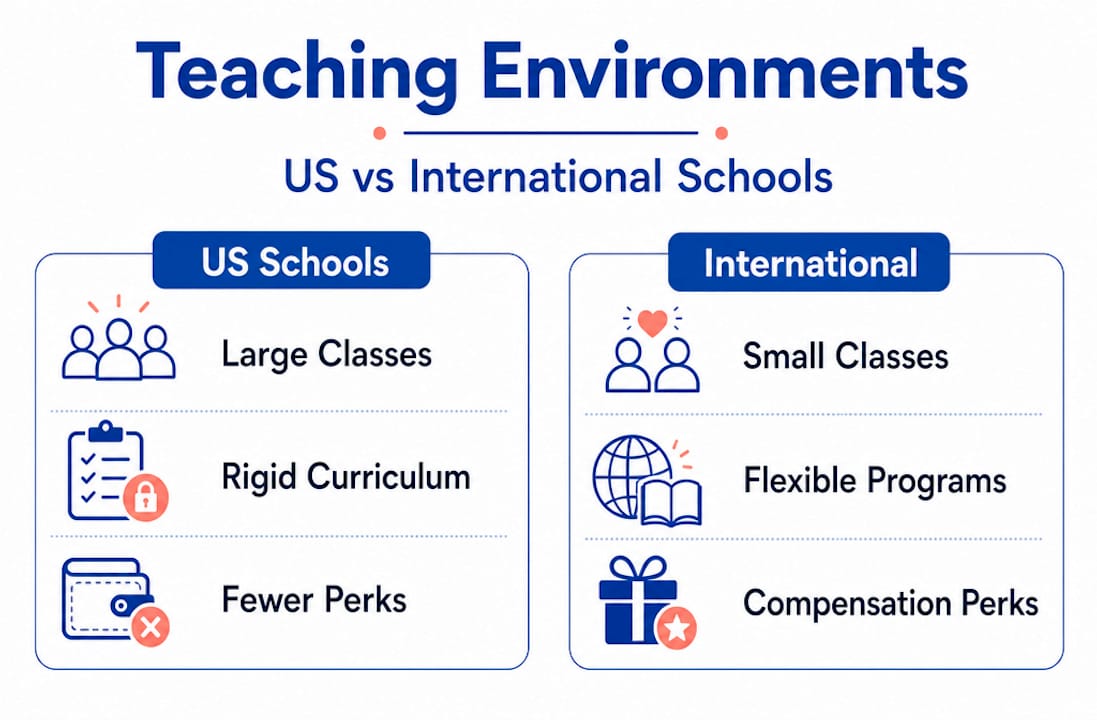
| Factor | US public schools | International schools abroad |
|---|---|---|
| Class size | 25 to 35+ students | Typically 15 to 22 students |
| Resources | Often limited; budget-dependent | Generally well-funded with modern facilities |
| Parental involvement | Variable; often low in under-resourced areas | Typically high; engaged parent communities |
| Teaching autonomy | Constrained by state standards and testing | Greater flexibility in curriculum delivery |
| Compensation structure | Salary only | Salary plus housing, flights, and often tuition |
| Staff support | Inconsistent; varies by district | Structured onboarding and mentoring common |
The total compensation picture abroad is where many teachers have their first real surprise. When you factor in free or subsidized housing, annual flights home, and sometimes tuition benefits for your own children, the effective value of an international package can be double what the base salary suggests. A teacher earning $45,000 in a US district might take home less disposable income than a colleague earning $38,000 in Abu Dhabi with a housing allowance and no rent to pay.

Smaller class sizes and supportive school environments abroad also reduce the burnout cycle that plagues so many US educators. When you are not managing 32 students through a standardized test prep curriculum, you have space to actually teach. That shift alone changes the professional experience dramatically.
The curriculum flexibility is worth noting too. Many international schools use the International Baccalaureate or Cambridge frameworks, which reward inquiry-based learning and critical thinking over rote memorization. For teachers who felt creatively constrained in the US system, this can feel like rediscovering why they chose the profession.
Where American teachers are going
Geography matters more than most teachers realize when planning an international career. Not every market is equally accessible, and the region you choose will shape your salary, lifestyle, and long-term career trajectory.
- Middle East (UAE, Qatar, Saudi Arabia, Jordan). This region offers the strongest demand for American teachers right now. Packages are generous, often including tax-free salaries, furnished housing, flights, and health insurance. The trade-off is cultural adjustment and shorter initial contract terms, typically two years. Schools like King’s Academy in Jordan attract experienced American educators looking for prestigious placements.
- Far East (China, South Korea, Japan, Singapore). China in particular stands out. Teaching in China offers monthly salaries between $2,500 and $5,000 with benefits, and experienced teachers who move into leadership roles can reach six-figure compensation. Singapore is more competitive but offers a world-class living environment. Teachers at institutions like Stamford American International School Hong Kong find a strong professional community and excellent career progression.
- Southeast Asia (Thailand, Vietnam, Indonesia, Bali). These markets offer lower salaries in absolute terms but an exceptionally high quality of life relative to cost. Bali in particular has become a magnet for teachers who want lifestyle alongside career. Schools like CCS Bali represent the growing international school network in this region.
- Latin America (Brazil, Colombia, Mexico, Ecuador). A growing number of American teachers are choosing Latin America for its cultural richness, Spanish-language immersion, and lower cost of living. The Escola Americana de Campinas in Brazil is one example of a well-established American-curriculum school in the region.
- Europe (Germany, Belgium, Czech Republic, Portugal). Europe is the most competitive market for American teachers. Passport restrictions and lower turnover mean fewer openings. Most experienced international educators recommend building your resume in the Middle East or Asia first before targeting European placements.
Challenges you should expect
Teaching abroad is genuinely rewarding. It is also genuinely hard in ways that career guides tend to underplay. Going in with clear expectations protects you from the kind of disillusionment that sends teachers home early.
- Contract complexity. International contracts can contain non-obvious financial traps, including repatriation clauses that require you to pay your own way home if you leave before the contract ends, and housing allowances that do not cover actual market rents. Read every clause before signing, and consider having a legal professional review the document.
- Visa and work permit timelines. Visa processing can be slow and unpredictable. Some teachers arrive at their destination before their paperwork is fully processed, which creates stress around banking, housing, and even getting paid. Start the process early and stay in close contact with your school’s HR team.
- Isolation and homesickness. The first three to six months abroad are often the hardest. Being far from family, navigating an unfamiliar city, and building a social network from scratch takes real energy. Teachers who invest in community, whether through school colleagues, expat groups, or local activities, tend to adapt far faster than those who wait for connection to happen naturally.
- Cultural and language adjustment. Even in English-medium schools, daily life outside the classroom involves a different language and set of social norms. Small things, like grocery shopping, using public transit, or navigating a local clinic, can feel exhausting at first.
- Differences in education standards. What counts as best practice in the US does not always translate directly. Some international school systems have very different expectations around discipline, grading, and parent communication. Flexibility and curiosity serve you better than assuming your US training covers everything.
💡 Tip: Join international teacher forums and Facebook groups specific to your target country before you arrive. The practical knowledge shared by teachers already on the ground, from which neighborhoods to avoid to which banks accept foreign documents, is worth more than any relocation guide.
Our perspective on what teaching abroad really changes
What strikes us most, after seeing so many American teachers make this move, is how rarely the transformation is purely professional. Yes, the classroom conditions improve. Yes, the compensation package often makes more financial sense. But the deeper shift is personal.
Teachers who thrive abroad are not the ones who went looking for a better job. They are the ones who went looking for a fuller life. The educators who struggle are often those who treated the move as a temporary fix, expecting to return home once things “got better.” Things rarely get better if you have not changed the environment.
What international teaching actually teaches you is adaptability. You learn to read a room differently when your students come from twelve different countries. You learn patience when bureaucracy moves at a pace you cannot control. You learn that your way of doing things is one way, not the only way. That shift in perspective is genuinely hard to replicate inside a single-country career.
If you are considering the move, stop waiting for the perfect school in the perfect country. Take a strong offer in a region that interests you, commit fully to the experience, and give yourself at least two years before evaluating whether it worked. One year is barely enough to stop feeling like a tourist.
Living abroad as an American teacher: how SmileTax can help
One reality that catches many international teachers off guard is that the US expects its citizens to file taxes no matter where they live. It is not complicated in most cases, but it does require someone who understands the specific situation of Americans working abroad.
SmileTax was built exactly for this. The team works directly with American teachers at international schools around the world, from APAC to schools across Europe and the Middle East. Every client works with an experienced US tax professional, not software or a generalist. If you want your US filing handled properly while you focus on building your life abroad, working with SmileTax is the clearest next step.
FAQ
Why are American teachers leaving the US to teach abroad?
The primary reasons include burnout, heavy workloads, and limited resources in US schools, combined with the appeal of better working conditions, higher disposable income, and cultural experiences available through international teaching positions.
How much do American teachers earn at international schools?
Base salaries vary widely by region, but the total compensation package often includes housing, flights, and health insurance that can effectively double a teacher’s disposable income compared to a US salary.
Which countries have the highest demand for American teachers?
The Middle East and Far East currently offer the strongest demand, with countries like the UAE, Saudi Arabia, China, and South Korea actively recruiting qualified American educators.
What are the biggest challenges for American teachers abroad?
Contract complexity, visa timelines, cultural adjustment, and homesickness are the most commonly cited challenges. Carefully reviewing contract clauses, particularly around repatriation and housing, is one of the most practical steps you can take before signing.
Do American teachers still need to file US taxes while living abroad?
Yes. US citizens are required to file US tax returns regardless of where they live. SmileTax specializes in helping American teachers abroad handle this obligation accurately and without unnecessary stress.