

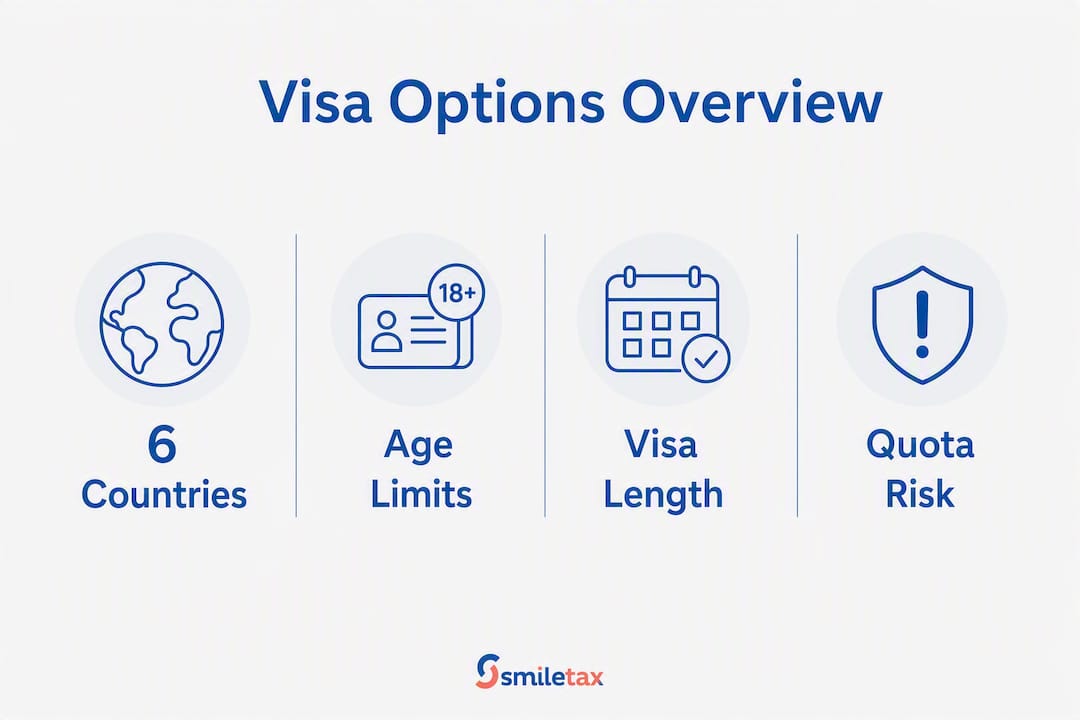
As of 2026, U.S. citizens can access working-holiday programs with six countries: Australia, New Zealand, Ireland, South Korea, Singapore, and Canada. That list is short compared to what Commonwealth or EU passport holders can access, but every program on it is real, achievable, and worth pursuing if you plan ahead.
TL;DR — start here:
- Check your age against each country’s cutoff (most cap at 30; Canada goes to 35).
- Gather your documents before application windows open.
- Apply the moment quotas open for Ireland and South Korea — slots go fast.
- If no program fits, TEFL teaching, seasonal work, and J-1 internships are proven alternatives.
This article reflects program rules as of 2026. Always verify current requirements on official government portals before applying.
Table of Contents
- How do the six countries compare at a glance?
- What you need to know about each country
- How to apply and when to start
- What are your options when a working-holiday visa isn’t available?
- Your pre-application checklist
- Key Takeaways
- Why Americans have fewer options than they expect
- Planning to live and work abroad? SmileTax is built for that
- Useful sources
How do the six countries compare at a glance?
| Country | Age Limit | Visa Length | Extensions | Key Eligibility Note | Quota Risk |
|---|---|---|---|---|---|
| Australia | 18–30 (subclass 417/462) | 12 months | Up to 3 years via regional work | No degree required for 417; 462 requires degree or enrollment | Low — no quota for Americans |
| New Zealand | 18–30 | 12 months | Limited | Citizen of eligible country | Moderate |
| Ireland | 18–35 | 12 months | No | Full-time student or graduated within 12 months | High — limited slots |
| South Korea | 18–30 | Up to 18 months | No | Tertiary degree or current enrollment | High — fills quickly |
| Singapore | 18–25 | 6 months | No | Must be enrolled university student | Low volume program |
| Canada (IEC) | 18–35 | 12–24 months | No | Must apply via a Recognized Organization (RO) | Moderate |
Programs with quota risk require the most preparation. Ireland and South Korea both limit available slots, and demand often exceeds supply.
Tip: Check the official application opening date for your target country at least three months in advance. Set a calendar reminder — some windows open and fill within days.
What you need to know about each country
Australia
Australia is the most flexible option for Americans. The Work and Holiday visa (subclass 417) covers ages 18–30 and allows you to stay 12 months initially. Complete specified regional work (farm work, construction, mining, or bushfire recovery) and you can extend up to three years total. Proof of funds runs approximately several thousand Australian dollars. There is no quota for Americans, which makes this the most accessible program on the list.

Permitted work spans hospitality, tourism, retail, and seasonal agriculture. You cannot work for the same employer for more than six months without special permission.
New Zealand
New Zealand’s working-holiday visa is open to Americans aged 18–30 for up to 12 months. Proof of funds is approximately several thousand New Zealand dollars. No degree is required, and there is no restriction on the type of work you can take. Extensions are limited, so plan your timeline carefully before applying.
Ireland
Ireland’s program has a meaningful catch: you must be a full-time post-secondary student or have graduated within the past 12 months. The age window includes applicants up to their mid-thirties, and the visa covers about a year with no extension. Applications go through the relevant Irish consulate, and because Ireland uses a vignette sticker, you will likely need to mail your physical passport to the consulate for endorsement. Plan for several weeks without your passport.
Slots are limited and fill quickly. Prepare everything before the window opens.
South Korea
South Korea offers up to one and a half years, one of the longer durations on this list. The application fee is around $70, and most applicants need a tertiary degree or current enrollment. Quota pressure is real — prepare your documents early and submit as soon as the window opens. Check the Korean embassy in your consular district for exact opening dates and slot availability.
Singapore
Singapore’s program is the most restricted: applicants must be currently enrolled university students, and the visa covers only six months. It suits a semester-abroad or summer-gap approach rather than a year-long stay. Check the Singapore Ministry of Manpower for current enrollment and application requirements.
Canada
Canada’s International Experience Canada (IEC) program accepts Americans up to age 35, the highest ceiling of any program here. The catch: Americans typically cannot apply directly and must go through a Recognized Organization (RO) — a third-party body that sponsors your application. The RO pathway adds a step and sometimes a fee, but the process is well-established. Visa length runs 12–24 months depending on the IEC category.
How to apply and when to start
The core steps are the same across most programs: create an online profile on the official immigration portal, prepare your documents, pay the application fee, and submit when the window opens. Ireland and South Korea require consular applications rather than fully online portals.
Common documents you will need:
- Valid passport (minimum six months’ validity beyond your intended stay)
- Bank statements showing proof of funds (approximately $2,500–$4,200 equivalent depending on destination)
- Proof of enrollment or graduation certificate (Ireland, South Korea, Singapore)
- Health insurance coverage for the full visa period
- Passport-style photos
- Police clearance certificate (some countries require this)
- Return ticket or proof of funds to purchase one
Application timeline:
- Three months out: Confirm your age eligibility at the time of submission, not arrival. Age is calculated at the date you apply — if you meet the cutoff when you submit, you remain eligible even if your birthday passes while the application is pending.
- Six weeks out: Gather all documents, request bank statements, and order a police certificate if needed.
- Application window opens: Submit immediately, especially for Ireland and South Korea.
- After approval: Book travel only after your visa is confirmed.
Tip: If applying to Ireland, do not book nonrefundable flights until your passport has been returned with the vignette sticker. Consular processing can take several weeks, and travel plans made too early can become expensive mistakes.
What are your options when a working-holiday visa isn’t available?
Americans have fewer working-holiday options than Commonwealth citizens, but clear alternative pathways exist that many younger Americans use successfully to fund extended time abroad.
TEFL/English teaching is the most accessible route. A TEFL or CELTA certification (roughly 120 hours, available online or in-person) opens doors in South Korea, Japan, China, Spain, Thailand, and dozens of other countries. Many schools sponsor a work visa directly, removing the need for a working-holiday agreement entirely. Job boards like Dave’s ESL Cafe and EPIK (South Korea’s public school program) post openings year-round.
Seasonal agricultural and hospitality work is available in countries like Australia and New Zealand under the working-holiday programs above, but also through specific seasonal worker schemes in parts of Europe. Research the specific country’s seasonal worker permit requirements.
J-1 Exchange Visitor programs cover internships, traineeships, camp counseling, and au pair placements. The U.S. Department of State designates sponsors for each J-1 category. Au pair placements through agencies like Cultural Care or AuPairCare place Americans with host families in Europe and beyond, covering room and board in exchange for childcare.
Remote work is a practical option for Americans already earning in USD. Many countries allow short tourist stays of 30–90 days, and a growing number offer dedicated digital nomad visas (Portugal, Costa Rica, and others). Combining a remote income with a low-cost-of-living destination can stretch a budget further than any working-holiday wage.
Tip: Start with a TEFL contract for structure and income, then use your settled status to explore short-term local gigs or freelance work once you know the local market. Many long-term expats began exactly this way.
Your pre-application checklist
Before you submit anything, work through this list. Missing one item can delay or derail your application.
- [ ] Passport valid for at least six months beyond your planned return date
- [ ] Bank statements covering the last three months, showing required proof of maintenance funds
- [ ] Enrollment letter or graduation certificate (Ireland, South Korea, Singapore)
- [ ] Health insurance policy covering the full visa period
- [ ] Passport-style photos meeting destination country specs
- [ ] Police clearance certificate (check if required for your target country)
- [ ] Return ticket or proof of sufficient funds to purchase one
- [ ] Accommodation plan for your first week (some applications ask for this)
- [ ] For Ireland: passport mailing timeline confirmed with the consulate
Most programs expect proof of funds in the range of approximately $2,500–$4,200, though official portals set the exact figures. Always check the official page for the current amount before preparing your bank statements.
Tip: Photograph every original document before mailing anything. Store encrypted copies in cloud storage (Google Drive or iCloud with two-factor authentication). If your passport or certificates are lost in transit, having digital copies speeds up replacement significantly.
Key Takeaways
As of 2026, six countries offer working-holiday programs to U.S. citizens, but limited quotas and strict eligibility rules mean preparation and timing are the deciding factors.
| Point | Details |
|---|---|
| Six countries available | Australia, New Zealand, Ireland, South Korea, Singapore, and Canada accept U.S. applicants as of 2026. |
| Age matters at submission | Eligibility is determined by your age when you apply, not when you arrive or when the visa starts. |
| Quotas fill fast | Ireland and South Korea have limited slots; submit the moment the application window opens. |
| Alternatives are real | TEFL teaching, J-1 programs, and seasonal work are proven routes when no WHV is available. |
| SmileTax supports Americans abroad | Once you’re living overseas, SmileTax helps Americans handle their U.S. administrative obligations with confidence. |
Why Americans have fewer options than they expect
The working-holiday visa gap between U.S. passport holders and Commonwealth citizens is structural, not accidental. Australia, New Zealand, and Canada built their WHV networks primarily through bilateral agreements with countries that send large volumes of young travelers, and historically those agreements centered on the UK, Ireland, and other Commonwealth nations. The U.S. has signed agreements with a smaller number of countries, partly because reciprocity matters: each agreement requires the partner country to offer equivalent access to its own young citizens, and the U.S. has not always extended that access broadly.
The practical result is that younger Americans need to plan more carefully, apply earlier, and keep alternatives ready. The six programs that do exist are genuinely worthwhile, and the alternatives, particularly TEFL and J-1 programs, have sent hundreds of thousands of Americans abroad successfully. The options are narrower, but they are not thin.
Planning to live and work abroad? SmileTax is built for that
Once you land and start working, the administrative side of being an American overseas becomes real. SmileTax works specifically with Americans living and working abroad, including teachers, seasonal workers, and anyone building a life outside the U.S. Every client works directly with an experienced U.S. tax professional, with clear pricing and no handoffs to unknown preparers. Visit smile.tax to learn more about how SmileTax supports Americans wherever they end up.
Useful sources
Always verify program rules, fees, and quota opening dates directly on official portals before applying. Rules change, and the figures in this article reflect available information as of 2026.
- Work and Holiday visa (subclass 417) — Australian Department of Home Affairs
- Work and Holiday visa (subclass 462) — Australian Department of Home Affairs
- Who can apply for a working holiday visa — Immigration New Zealand
- US-Ireland Holiday Working Agreement (J1) — Ireland.ie
- Working holiday authorisation — Ireland.ie
- Recognized organizations — International Experience Canada
- Working Holiday Visas for Americans — GoOverseas
- Working Holiday Visas for Americans — WhereNext (2026)
- How to Get a Working Holiday Visa as a U.S. Citizen — LegalClarity
This article is general information only. Program rules, fees, and quota availability change regularly. Verify all details on official government portals or with a qualified immigration adviser before applying.